Is Snowflake a Data Warehouse? A Straight Answer
Is Snowflake a data warehouse? A short answer, how vendors and analysts categorise it, what makes something a warehouse and how it compares with its peers.
The quick answer
Snowflake is a cloud data platform that is commonly used as a data warehouse and also supports other workloads. Whether something counts as a data warehouse depends on what it does and how it is designed, not on the product name. A warehouse still needs modelling, loading and governance on top of any platform.
Key takeaways
- Snowflake is best described as a cloud data platform; data warehousing is its most common use.
- A data warehouse is defined by its function: integrated, modelled, historical data for analysis.
- Vendors and analysts use broader labels than they once did, so categories overlap.
- Any platform needs modelling, loading and governance added before it behaves like a warehouse.
- BigQuery, Redshift and Microsoft's options sit in the same broad category, with different strengths.
Is Snowflake a data warehouse?
In everyday use, yes. Many organisations run their data warehouse on Snowflake. In strict terms, Snowflake is a cloud data platform, and a data warehouse is something you build on it.
That is the same relationship as a database engine and a customer database. The engine is the product you buy. The database is the structured content and design you create with it. Both statements can be true at once: Snowflake provides warehouse capability, and a particular Snowflake account may or may not contain a proper warehouse.
If you want the longer tour of how it is built and where it fits, read our overview of the Snowflake data warehouse. This article stays on the category question. If you need help planning a build, our data warehouse services team can advise on platform and design.
↑ Back to contentsHow do vendors and analysts categorise Snowflake?
Categories have shifted over the years. Snowflake was introduced as a cloud-native data warehouse, and many analysts still list it under cloud data warehouse or database management products. More recently, the vendor has described itself as a data cloud or data platform, reflecting a wider set of features.
This matters because the same product can be placed in more than one category. Analyst categories change, so check the current wording from the vendor and from any research you rely on, rather than treating a single label as fixed.
A practical reading is this. The label tells you what a product started as and what it is sold for. It does not tell you what your project will be. Your own design decides that.
↑ Back to contentsWhat actually makes something a data warehouse?
A data warehouse is defined by what it does. The classic description covers four qualities. These are worth holding up against any platform, Snowflake included.
- Subject-oriented. Data is organised around business subjects such as sales, customers or finance, not around the source systems that produced it.
- Integrated. Data from different systems is brought together with consistent names, formats and definitions.
- Time-variant. History is kept, so you can compare this year with last year and see how things changed.
- Stable for analysis. Data is loaded in controlled ways and not edited casually, so a report run twice gives the same answer.
Notice that none of these mentions a brand or a technology. You could meet them on a cloud platform, on SQL Server in your own data centre, or on a lakehouse. If you want the fundamentals in more depth, our guide to what a data warehouse is covers them.
↑ Back to contentsWhy does this question come up so often?
Because the word "warehouse" is used in two ways. To a buyer, a data warehouse is a business asset: a trusted store of reporting data. To a vendor, a warehouse is also a product category, and Snowflake began there. When a product outgrows its original category, people ask whether the old label still applies.
Snowflake adds its own wrinkle. Inside the product, a "virtual warehouse" is simply a block of compute. So a person can create a virtual warehouse in Snowflake without having built a data warehouse at all. Searchers sometimes land on the question for exactly this reason.
It is also a question about expectations. People hope that buying a well-known platform will settle the hard parts of reporting. It does not. That is not a weakness in the product. It is the same for every platform in this space.
↑ Back to contentsWhat are the common misconceptions?
- "It is a warehouse because it says so." A platform becomes a warehouse only when modelled, governed data sits in it.
- "A cloud warehouse needs no maintenance." Hardware is managed for you. Loading, security, cost monitoring and model changes still need an owner.
- "Moving to the cloud fixes bad data." Poor source data arrives intact. Quality work has to happen somewhere.
- "All the platforms are the same." They share a category but differ in packaging, integrations, skills required and cost behaviour.
- "We have to pick a lake or a warehouse." Many organisations use elements of both, and the boundary between them is increasingly blurred.
Spotting these early saves arguments later, especially when business stakeholders and technical teams are using the same words differently.
↑ Back to contentsWhat does a warehouse still need on top of any platform?
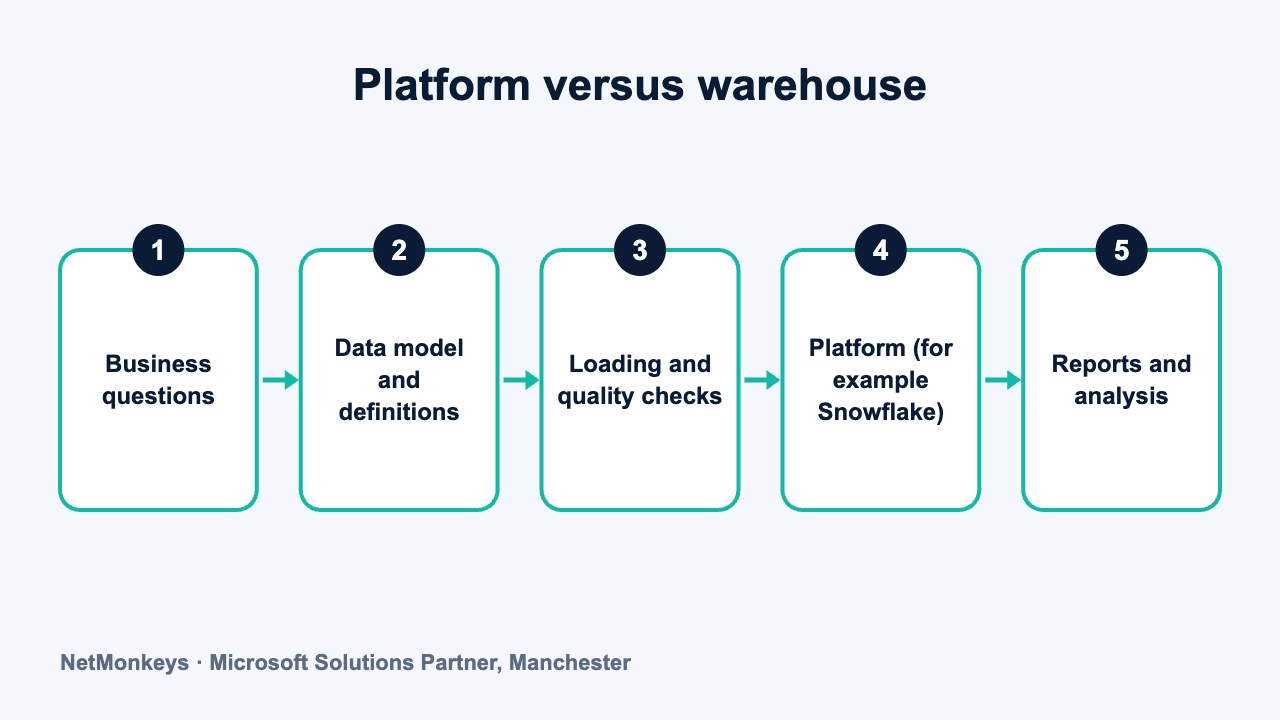
This is the point that gets missed. A platform gives you somewhere to store and query data quickly. It does not decide what the data means. A warehouse needs several layers of work that sit above the product.
- Modelling. Someone has to decide the tables, the keys and how facts and dimensions relate. Without this, you have a pile of copied source tables.
- Loading. Pipelines extract data from source systems, clean it and load it on a schedule. They also need monitoring and a plan for failures.
- Business definitions. Terms such as revenue, active customer and margin need one agreed meaning, written down and owned.
- Data quality. Duplicates, missing values and mismatched codes must be found and fixed or flagged.
- Security and governance. Who can see what, how access is reviewed and how sensitive data is protected.
- Reporting layer. A semantic model or set of curated views so users query meaningful objects, often through Power BI.
Common mistake
Loading every source table straight into the platform and calling it a warehouse. It will run quickly and still give three different answers to the same question, because nobody has modelled or defined anything.
Our own work focuses on exactly these layers, because the platform choice is rarely where projects succeed or fail.
↑ Back to contentsCan Snowflake do more than data warehousing?
Yes, and this is why the label is argued over. Snowflake is generally described as supporting workloads beyond classic warehousing. Examples vendors and users often mention include holding semi-structured data, sharing data with other organisations, and supporting data science and application development.
Capabilities in these areas develop quickly, and some are newer than the core warehouse features. If a project depends on one, confirm it against the vendor's current documentation and ask for evidence from a workload like yours before committing.
For most business reporting needs, none of this changes the answer. You can use Snowflake simply as a warehouse and ignore the rest. Many do.
The sensible approach is to start with the warehouse need that justifies the project, then add other uses only when a clear business case appears. Adding capabilities to a platform is easy. Governing them, training people and paying attention to their cost is where the effort goes.
↑ Back to contentsHow does Snowflake compare with BigQuery, Redshift and Synapse or Fabric?
In category terms, all of these are cloud-based analytical platforms that can serve as a data warehouse. The table gives a general orientation only. Product details, names and packaging change often, so verify specifics before you rely on them.
| Platform | Commonly described as | Often considered when |
|---|---|---|
| Snowflake | Cloud data platform used as a warehouse; available on several public clouds | You want a cloud-neutral platform or plan to share data across organisations |
| Google BigQuery | Serverless cloud data warehouse on Google Cloud | Your estate or analytics work is centred on Google Cloud |
| Amazon Redshift | Cloud data warehouse on AWS | Your systems already live in AWS and you want close integration |
| Azure Synapse Analytics | Microsoft analytics service combining warehousing and big data tools | You have an existing Synapse deployment or Azure-centred skills |
| Microsoft Fabric | Microsoft's unified analytics platform with warehouse capability | You use Power BI heavily and want one Microsoft-managed environment |
Microsoft's product lineup has changed in recent years, so check its current guidance on which service is recommended for new projects. Our notes on Fabric as a data warehouse and the wider data warehouse platforms category go further.
One more point on comparisons. Published benchmarks and feature charts rarely match a real workload. A test that uses your own tables, your own refresh windows and your own report users tells you far more than a league table does.
Reporting also matters. If most of your users work in Power BI, the quality of the model and the refresh design will shape their experience more than the warehouse engine underneath. Our Power BI services team looks at both sides together.
↑ Back to contentsWhich platform is the right one for you?
There is no universal winner, and any article that names one without knowing your estate is guessing. The deciding factors are usually ordinary ones.
- Where your systems already run. Moving data between clouds takes effort and may add cost.
- What your team knows. A platform your analysts can already use can save months of learning.
- How you report. If Power BI is central, check how well each option connects and refreshes.
- What data you hold. Regulated or personal data affects region, residency and access design.
- How much change you can absorb. A smaller step, such as improving your current SQL Server setup, can beat a full move.
Because we are a Microsoft Solutions Partner, we are often asked about the Microsoft route. Our Azure cloud services cover it, and we will say so when another platform is a better match for the problem.
↑ Back to contentsWhat should you check before choosing a platform?
What we would check first
Write down the ten questions the business needs answered, and the systems that hold the data for them. If you cannot list these, platform selection is premature. The questions decide the model, and the model decides how much platform you actually need.
Also agree who will own the warehouse after launch. A platform with no named owner drifts. Definitions go out of date, access lists grow, and loads fail without anyone noticing. Ownership can sit with an internal data lead or with a managed partner, but it should be a decision rather than an accident.
Then test with real data. Load one or two source systems, build a small model and run the reports people use today. Measure effort as well as speed, including the time spent on loading, definitions and access rules.
Ask each vendor or partner to explain how they would handle failed loads, changes to source systems and cost monitoring. Answers to those questions reveal more than a feature list does. A business intelligence consultancy can run this comparison independently if you do not want to rely on vendor material alone.
↑ Back to contentsWhat if you are already on SQL Server or Excel?
Many organisations asking this question are not choosing between cloud warehouses at all. They are deciding whether to move on from SQL Server reporting databases, scheduled exports and spreadsheets.
A cloud platform is not automatically the next step. If your data volumes are modest and your reports are stable, a well-modelled SQL Server database may do the job. If refreshes are failing, numbers disagree and Excel is holding the process together, a proper warehouse is worth considering.
When you do move, plan the transition carefully. Our data migration services team treats reconciliation, parallel running and report retesting as part of the project. For the wider picture of how this change fits your plans, see our digital transformation work. If you want a second opinion before committing, NetMonkeys' data warehouse consultancy team can review your current setup.
↑ Back to contentsFrequently asked questions
Is Snowflake a database?
It stores and queries data using SQL, so it behaves like a database from a user's point of view. It is more accurately described as a cloud data platform. The distinction is mostly about scope, as it includes sharing, governance and other features.
Is Snowflake an ETL tool?
No, Snowflake is not primarily an extract, transform and load tool. It can run transformations inside the platform, but moving data in from source systems usually needs separate loading or integration tools.
Can I run Power BI on Snowflake?
Yes, Power BI can connect to Snowflake as a data source. Check the current connection methods and any refresh limits in the documentation from both vendors.
Is Snowflake a data lake?
Not in the traditional sense, although it can store semi-structured data and some organisations use it in lake-like ways. If you are weighing the two ideas, our comparison of a data lake and a data warehouse explains the difference.
Do I need a data warehouse if I use Snowflake?
You need a warehouse design if your goal is trusted reporting. Snowflake provides the platform. Modelling, loading and governance still have to be built, whichever product you choose.
Is Snowflake the best data warehouse?
There is no single best platform. The right choice depends on your existing systems, skills, data and reporting needs. Compare options against a realistic test, not a marketing summary.
About this guide and NetMonkeys
Written by Caleb Adoh, Growth Marketing Manager at NetMonkeys. NetMonkeys is a Manchester-based Microsoft Solutions Partner offering data warehouse services, Power BI services and business intelligence consultancy. This guide explains general data warehousing practice. Vendor products and features change, so check the current vendor documentation before making platform decisions.
Planning a data warehouse?
Talk to NetMonkeys about what you need to report on, where your data lives and which approach fits your business.
Explore data warehouse services Contact the team