
Data Lake vs Data Warehouse: Which Do You Need?
Data lake vs data warehouse explained: data types, schema on read vs write, users, cost, governance and performance, plus when to use each or both.
The quick answer
A data warehouse holds structured, modelled data that is ready for reporting, while a data lake holds raw data of any type until someone needs it. The warehouse applies structure when data is loaded (schema on write). The lake applies structure when data is read (schema on read). Many businesses run both, with the lake feeding the warehouse.
Key takeaways
- A warehouse is built for trusted reporting; a lake is built for cheap, flexible storage of raw data.
- Schema on write gives consistent answers. Schema on read gives flexibility but pushes work to the reader.
- Finance, sales and operations reporting usually belongs in a warehouse.
- Logs, documents, images and data science work usually suit a lake.
- Most mid-sized organisations end up using both, and a lakehouse blurs the line between them.
What is the difference between a data lake and a data warehouse?
A data warehouse is a database designed for reporting. Data is cleaned, matched and shaped into agreed tables before people use it, so a figure such as revenue means the same thing in every report. A data lake is a large store of raw data, held in its original form, which could be spreadsheets, system exports, log files, emails, images or sensor feeds.
The short version is this. The warehouse is organised before it is stored. The lake is stored first and organised later. Neither is better in general. They answer different questions, and the right choice depends on what you need to do with the data. Choosing on fashion, or because a competitor has a lake, is how organisations end up paying for something nobody uses.
If you are new to the topic, our guide to what a data warehouse is covers the basics. This article focuses on how the two approaches compare and how to choose. If you are weighing up a build, NetMonkeys' data warehouse team can give a view on which fits.
A useful mental model
Think of a warehouse as a well-organised stockroom with labelled shelves, and a lake as a large yard where deliveries are put down as they arrive. You can find things quickly in the stockroom. The yard holds more kinds of goods, but someone has to sort them before they are useful.
How do they compare side by side?
The table below sets out the main differences. Real platforms vary, and the lines are blurring, but these are the patterns we see most often.
| Area | Data lake | Data warehouse |
|---|---|---|
| Data types | Structured, semi-structured and unstructured | Mostly structured, tabular data |
| Structure applied | On read, when someone queries the data | On write, when data is loaded |
| Typical users | Data engineers, data scientists, analysts comfortable with code | Finance, sales and operations teams, report writers, executives |
| Main purpose | Low-cost storage, exploration, machine learning | Trusted reporting, dashboards and analysis |
| Data quality | Varies, as raw data is kept as received | Cleansed and reconciled before use |
| Governance effort | Needs deliberate cataloguing and access control to avoid a mess | Governance is largely built into the model and load process |
| Query performance | Depends on file formats, partitioning and the query engine | Tuned for repeatable analytical queries |
| Cost behaviour | Storage is typically cheap; effort shifts to preparation | Storage and compute can cost more; effort is spent upfront |
| Change handling | New sources are easy to land | New sources need modelling work before use |
What does schema on read versus schema on write mean?
Schema on write means the structure is decided before data goes in. You define tables, columns and data types, and every incoming record must fit. If a source sends a date in the wrong format, the load process fixes it or rejects it. By the time a report runs, the data has already been checked.
Schema on read means the data goes in as it arrives, and structure is applied when someone reads it. This makes it quick to collect new material, because you do not need a design first. The cost is that every reader has to interpret the data, and two analysts can interpret it differently.
Why this matters in practice
A board pack needs one version of the truth. If sales and finance each read raw order files and apply their own rules, the numbers will drift apart. That is the problem schema on write solves.
A data science team exploring customer behaviour may not know which fields matter yet. Forcing structure too early would slow them down. That is where schema on read helps. Many teams use both ideas at different stages: loose structure on arrival, firm structure before anything reaches a manager's dashboard.
Common mistake
Treating a lake as a warehouse. If business users query raw files directly, rules are repeated in every report, and results stop agreeing. Put agreed definitions into a modelled layer before reports depend on them.
Who uses a data lake and who uses a data warehouse?
The audience is one of the clearest dividing lines. The people who will use the data should shape the decision more than the technology does.
- Warehouse users: finance managers, sales leaders, operations teams and executives who want consistent figures in Power BI or another reporting tool, without writing code.
- Lake users: data engineers who build pipelines, and data scientists who need raw history, text or images to train and test models.
- Analysts: they often sit in the middle. They may start in the lake to explore a new source, then ask for the useful parts to be promoted into the warehouse.
- Auditors and compliance teams: they usually prefer the warehouse for reported figures, and may value the lake as a record of what was originally received.
If most of your users are business managers who want dashboards, a warehouse is the more natural home. If most are technical specialists working with varied data, a lake earns its place sooner.
↑ Back to contentsHow do cost, performance and governance differ?
We avoid quoting prices here, because they depend on the platform, volumes and how heavily the data is used. The general behaviour is easier to describe.
Cost
Lake storage is usually cheap per unit of data, which is why organisations keep large volumes of raw material there. The effort moves elsewhere. Someone has to prepare, document and secure the data before it is useful. Warehouse platforms generally cost more to store and query, but the preparation is done once and reused by every report.
Performance
A warehouse is tuned for the same kinds of question being asked repeatedly, such as monthly revenue by region. Lakes can be fast too, but performance depends on how files are stored and which query engine sits on top. Without care, a lake can be slow and unpredictable for everyday reporting.
Governance
Governance means knowing what data you hold, who can see it, how long you keep it and where it came from. A warehouse tends to carry this in its design. A lake needs it added on purpose, through cataloguing, naming standards and access controls. A lake without these is often called a data swamp, and nobody trusts it.
Personal data needs particular care in either system. Retention, access and deletion rules should be agreed before the data is loaded, and managed security should be part of the design rather than an afterthought.
↑ Back to contentsWhen is a data warehouse the right choice?
A warehouse is usually the better starting point when the main need is reliable reporting from business systems. These are the signs we look for.
- Departments disagree on the numbers. A modelled warehouse gives everyone the same definitions. See improving data accuracy across departments.
- Your data is mostly structured. Accounting, CRM, ERP and stock systems produce tables, which suit a warehouse well.
- You report on a schedule. Monthly packs and weekly dashboards benefit from stable, repeatable queries. See automating monthly management reports.
- Business users need self-service. People who are not engineers need clean tables with clear names.
- You need history. A warehouse can keep a consistent record of how figures looked over time.
Confirm whether this describes your situation before any platform is chosen. A short review of your sources and your reporting pain points is usually enough to tell, and it costs far less than building the wrong thing.
↑ Back to contentsWhen is a data lake the right choice?
A lake is the better fit when variety and volume matter more than polish. Typical cases include the following.
- You collect unstructured data. Documents, call recordings, images, emails and web logs do not fit neatly into tables.
- You are building machine learning models. Data scientists often need raw, detailed history rather than summarised tables. Our AI consultancy work often starts with this question.
- You need a cheap archive. Keeping original source files supports audit and lets you reprocess data later if rules change.
- You do not yet know the questions. If the use cases are still being discovered, landing data first keeps options open.
The honest caveat is that many small and mid-sized businesses do not have these needs. If your reporting comes from five or six business systems, a lake may add cost and complexity without adding value.
↑ Back to contentsWhat is a lakehouse?
A lakehouse is an approach that tries to combine the two. Data sits in low-cost lake storage, but a management layer adds tables, transactions and quality controls so it can be queried much like a warehouse. The idea is to avoid keeping two copies of the same data in two separate systems.
It is a useful idea, and several major platforms now support it, including parts of the Microsoft stack. See how this plays out in Fabric data warehouse and Azure data warehouse options.
It does not remove the need for design. You still need agreed definitions, a modelled layer for reporting and clear ownership. A lakehouse changes where the data lives. It does not decide what the data means. Features and product names change often, so check each vendor's current documentation before you commit.
↑ Back to contentsDo businesses use both, and how do they fit together?
Many organisations that grow beyond basic reporting end up with both. We cannot give you a reliable percentage, and any figure you see should be checked against its source, but the pattern is common enough to be a standard design.
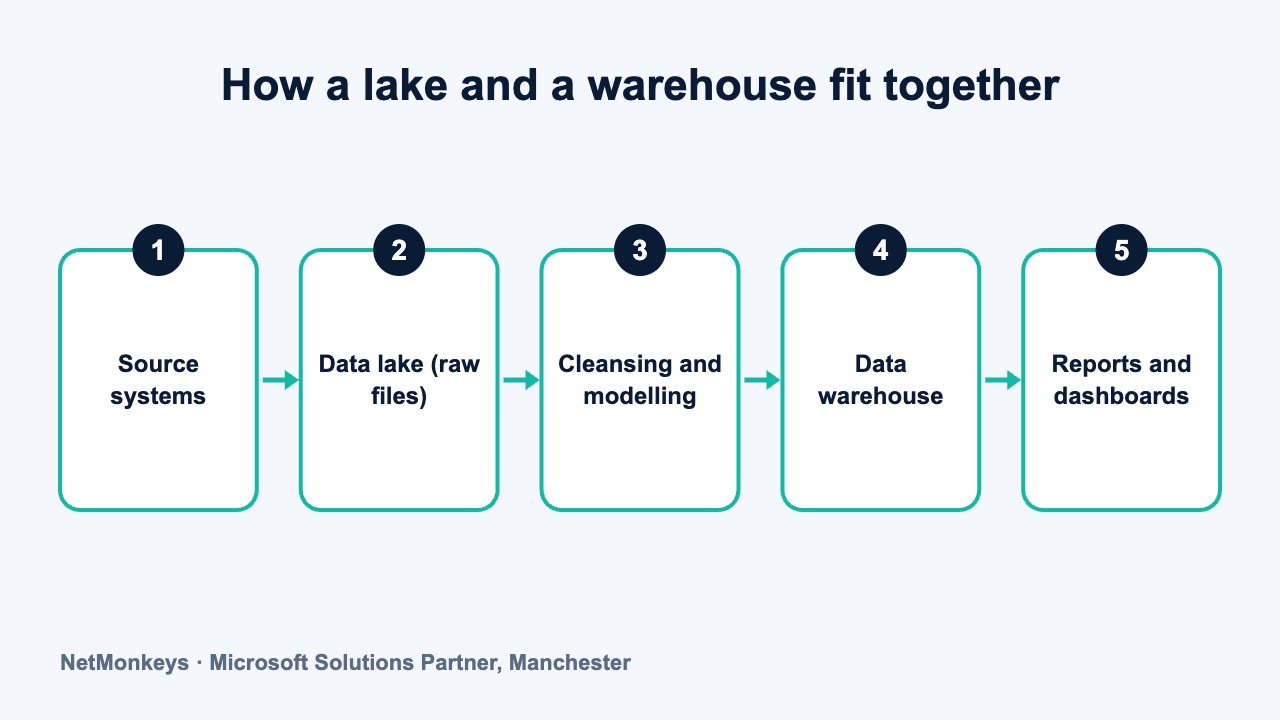
A typical flow works like this. Source systems and files land in the lake as they are. Pipelines clean and reconcile the data that the business needs for reporting. That modelled data is loaded into the warehouse. Reports and dashboards read from the warehouse, while data scientists read from the lake.
This gives you an audit trail of raw data, a trusted reporting layer and room for advanced work. It also means more to build and maintain, so it should be earned by a real need. Our guide to data warehouse architecture requirements explains what to plan for.
What we would check first
Before recommending a lake alongside a warehouse, we ask what questions the business needs answered, which systems hold the data, and whether anyone will actually use the raw material. If the answer to the last question is no, start with the warehouse.
How do you decide? A short checklist
Work through these questions in order. The pattern of your answers usually points to the right starting point.
- What will the data be used for? Reporting points to a warehouse. Exploration and models point to a lake.
- What types of data do you hold? Mostly tables from business systems suit a warehouse. Documents, images and logs suit a lake.
- Who will use it? Business managers need a warehouse. Data scientists and engineers can work in a lake.
- Do you need one agreed set of figures? If yes, build a modelled layer, whatever the storage.
- Do you have the skills to run a lake? Cataloguing, security and pipeline engineering are ongoing work.
- Can you start with one and add the other? For most organisations, the answer is yes, and starting with reporting is lower risk.
If you want an independent view, NetMonkeys' data warehouse services team can review your sources and recommend a starting design. You may also want to look at business intelligence consultants for the reporting side.
↑ Back to contentsFrequently asked questions
Is a data lake cheaper than a data warehouse?
Storage in a lake is usually cheaper per unit of data. The total cost depends on the effort needed to prepare, secure and query the data, which can be considerable. Compare whole-lifecycle costs rather than storage alone.
Can a data lake replace a data warehouse?
For trusted business reporting, rarely on its own. A lake can serve reports if a modelled layer is added on top, which is what a lakehouse does. Without that layer, definitions tend to drift between reports.
What is a data swamp?
A data swamp is a lake that has grown without cataloguing, ownership or quality checks. People cannot find what they need or trust what they find. Naming standards, documentation and access rules prevent it.
Do small businesses need a data lake?
Usually not at first. If your data comes from a handful of business systems, a warehouse or a well-built Power BI model is often enough. Add a lake when you have unstructured data or machine learning plans.
Is a lakehouse better than using both?
It can reduce duplication and simplify the architecture, but it is not automatically better. It suits teams that want one platform and have the skills to manage it. Review current vendor documentation, as capabilities change.
About this guide and NetMonkeys
Written by Caleb Adoh, Growth Marketing Manager at NetMonkeys. NetMonkeys is a Manchester-based Microsoft Solutions Partner offering data warehouse services, Power BI services and business intelligence consultancy. This guide explains general data warehousing practice. Vendor products and features change, so check the current vendor documentation before making platform decisions.
Planning a data warehouse?
Talk to NetMonkeys about what you need to report on, where your data lives and which approach fits your business.
Explore data warehouse services Contact the team
