
Supply Chain Security Audits: How IT Standards Win Bigger Clients
What a supply chain security audit asks of suppliers, which certifications help, and how to build an evidence pack and 90-day plan before the next bid.
The quick answer
A supply chain security audit is a buyer's check on whether your IT controls are safe enough to trust with their data. Mid-market firms can lose larger bids when they cannot evidence basics such as MFA, patching, backups and incident response. Building an evidence pack and working towards Cyber Essentials, Cyber Essentials Plus or ISO 27001 improves your eligibility, though it never guarantees a win.
Who this is for: Managing Directors, Commercial Directors
Key takeaways
- Larger buyers review supplier security before they sign, and weak answers can end a bid quietly.
- Questionnaires keep asking about the same areas, so you can prepare evidence in advance.
- Cyber Essentials, Cyber Essentials Plus and ISO 27001 answer different questions, so choose by buyer.
- A dated evidence pack and a 90-day plan turn security into a commercial advantage.
- Certification improves your odds but does not guarantee a win, and requirements vary by buyer.
Why do IT standards decide whether you win bigger clients?
Larger buyers do not only compare price, capability and references. Before they sign, most also ask whether your business is a safe pair of hands for their data, their systems and their reputation. If your answers on IT security are thin, a bid that looked strong on paper can stall in procurement or fail the supplier due-diligence review.
This is where a supply chain security audit enters the picture. The customer, or a third party acting for them, looks at how you manage access, patching, backups, incident response and staff awareness. The outcome can be a pass, a pass with conditions, or a quiet decision to go with someone else.
For Managing Directors and Commercial Directors, the useful reframe is simple. Good IT support and security are not just a cost line. They are part of what you sell when you move from local customers to enterprise, public sector or regulated buyers. A supplier that answers a security questionnaire in a day, with evidence, looks like a business that can be trusted with a larger contract.
This guide goes deeper on the tender and bid angle than our general pieces on assessing third-party IT supplier risk and demonstrating cyber security compliance to customers. Those cover the buyer's view and the general proof points. Here we focus on what happens inside a bid, what the questions look like, and how to be ready before the invitation arrives.
Who this applies to
If your customers are mostly consumers or very small businesses, you may never see a formal supplier questionnaire. This article is aimed at firms of roughly 50 to 250 staff that are starting to bid into larger organisations, or are already being asked for security evidence they struggle to produce.
What does a supply chain security audit actually involve?
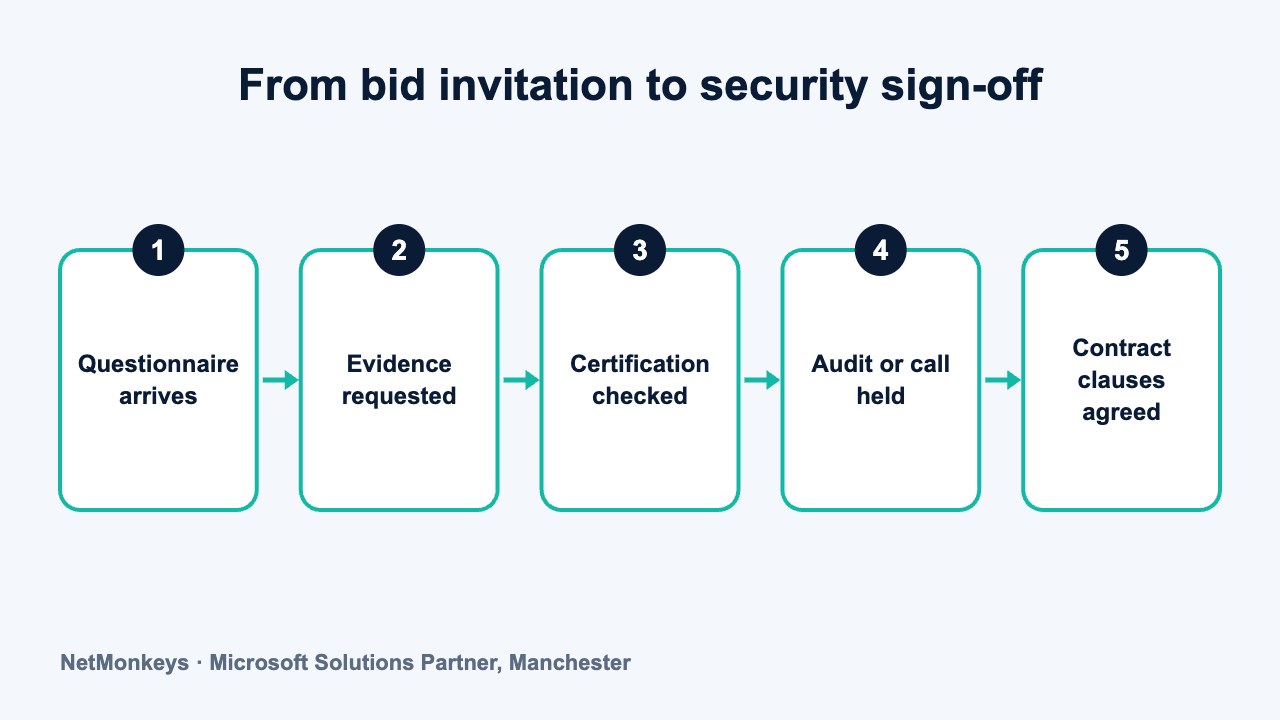
There is no single standard format. The scope depends on the buyer, the sensitivity of the work and how much of their data you will touch. In practice, a supplier review tends to take one of four forms.
- Self-assessment questionnaire. A spreadsheet or portal form with a few dozen to several hundred questions, answered by you. This is the most common form for mid-market suppliers.
- Evidence request. The buyer asks for certificates, policies, test reports or screenshots to back up your answers.
- Remote or onsite audit. A call or visit where someone from the buyer's security or procurement team walks through your controls and asks to see them working.
- Contractual flow-down. Security clauses in the contract that require specific controls, breach notification and the right to audit you later.
Many buyers combine these. You complete the questionnaire during the bid, supply evidence if shortlisted, and agree to audit rights in the contract. Treat the questionnaire as the first gate, not the last.
Some tender documents ask for a recognised certification as a minimum. Others accept equivalent evidence. Always read the exact wording in the invitation, because requirements vary by buyer and sector, and sometimes by contract. For a wider view of the legal and contractual requirements, see our guide to cyber security requirements for UK businesses.
The key point for a commercial leader is timing. Questionnaires usually arrive with a deadline of days, not weeks. If the evidence does not already exist, you will be assembling it under pressure, and that is when weak answers and over-claims creep in.
↑ Back to contentsWhat do supplier security questionnaires typically ask?
Questionnaires differ, but the same areas appear again and again. The table below shows the typical areas, the sort of question you will see, and the evidence worth keeping ready. Wording is illustrative. Check each buyer's actual form.
| Area | Typical question | Evidence to keep |
|---|---|---|
| Governance and policy | Do you have a documented information security policy, approved by senior management and reviewed regularly? | Signed policy with review date, named owner, board or director sign-off record |
| Certification | Do you hold Cyber Essentials, Cyber Essentials Plus or ISO 27001? | Current certificates with scope and expiry dates |
| Access control | How do you control who can access systems and data? Is multi-factor authentication enforced? | MFA enforcement report, joiner and leaver procedure, admin account list |
| Device security | Are laptops and servers encrypted, patched and protected against malware? | Device compliance report, patching report, endpoint protection status |
| Network and boundary | How are firewalls, remote access and Wi-Fi managed? | Firewall rule review record, remote access configuration summary |
| Data protection | Where is customer data stored, who can access it and how is it backed up? | Data flow summary, backup schedule, restore test record |
| Incident response | Do you have a tested incident response plan and a breach notification process? | Incident plan, contact tree, last exercise notes |
| People | Do staff receive security awareness training and are they screened? | Training completion records, onboarding checklist |
| Suppliers | How do you assess your own suppliers and subcontractors? | Supplier register, due-diligence records for key suppliers |
| Resilience | Do you have business continuity and disaster recovery arrangements? | Continuity plan, recovery objectives, last test result |
| Insurance | Do you hold cyber liability cover, and at what level? | Current insurance certificate, [add figure from your policy] |
Notice how many of those rows ask for proof, not just a yes. A tick in a box is easy. A dated report is harder to produce if nobody has been collecting it.
What we would check first
Before any bid, we would check whether you can produce three things within one working day: a current MFA enforcement report, a device patching report and a recent backup restore test. These cover the questions that most often slow a response. If any of them takes a week to produce, that is the first gap to close.
How do weak IT standards cost you bids?
A failed security review rarely arrives with a clear rejection. More often the bid team hears that the buyer has gone with another supplier, or that onboarding has been paused while questions are resolved. The loss is real, but the reason is hard to see. Common patterns include the following.
- Unanswerable questions. The questionnaire asks for something you do not do, such as annual penetration testing or a documented recovery test, and the honest answer is no.
- Slow responses. Nobody owns the questionnaire, so it passes between sales, operations and an IT provider, and misses the deadline.
- Inconsistent answers. Different people give different answers to similar questions. A reviewer notices, and trust drops.
- Over-claiming. Someone ticks yes to speed things up, and the evidence request later shows the control is partial. This is worse than an honest gap.
- No certificate where one is expected. Some buyers set a certification as a pass or fail gate, and you are out before price is considered.
- Unmanaged devices and shadow IT. An audit asks for an asset list, and the real number of laptops, phones and cloud accounts does not match the one you gave.
Illustrative scenario. A 90-person engineering services firm is shortlisted for a framework place with a large manufacturer. The security questionnaire asks for evidence that multi-factor authentication is enforced for all staff. The firm believes it is, but a few legacy accounts and a shared mailbox are exempt. The first evidence report shows the gaps, the buyer asks for remediation within the bid window, and the firm scrambles. It might win the place, or it might not. Either way, the problem was visible months earlier to anyone who looked.
The lesson is not that every gap is fatal. Buyers often accept a documented gap with a dated plan. What they dislike is surprise, and what they trust is a supplier that already knows its own position. Our guide to cyber security asset management explains why knowing what you own is the starting point for most of these answers.
↑ Back to contentsWhere do Cyber Essentials, Cyber Essentials Plus and ISO 27001 fit?
These three are the certifications buyers mention most. They answer different questions, and the right one depends on who you sell to.
- Cyber Essentials is a UK government-backed scheme covering a defined set of basic technical controls, assessed through a self-assessment that is verified by a certification body. It is often accepted as a baseline, and some public sector contracts expect it.
- Cyber Essentials Plus covers the same control areas, but includes hands-on technical verification by a certification body, such as testing devices and the network. It gives a buyer stronger assurance that controls work in practice.
- ISO 27001 is an international standard for an information security management system. It is broader than Cyber Essentials, covers governance, risk assessment and continual improvement, and is certified by an accredited body after an audit of your management system.
For a detailed comparison, see Cyber Essentials versus Cyber Essentials Plus. For the choice between the technical scheme and the management standard, read ISO 27001 or Cyber Essentials Plus. Both go further than we can here.
A practical decision rule for bid-focused firms. If the invitation names a certification, get that one. If it does not, look at who is buying. Government and defence supply chains tend to look for Cyber Essentials or Plus. Large corporates, financial services and international buyers more often ask about ISO 27001 or equivalent. When several of your target buyers differ, start with the scheme that has the shortest path and builds towards the next.
Scheme rules, scope definitions and assessment methods change from time to time. Check the current requirements before you commit to a timetable. Our page on whether Cyber Essentials is mandatory sets out where it is and is not required.
Common mistake
Certifying a narrow scope to win a tender, then handling the buyer's data on systems outside it. Buyers can ask about scope, and a certificate that covers only part of your estate may not satisfy the question they are really asking.
Is a certificate enough, or do buyers want more?
A certificate is a strong first answer, but it is rarely the only one. Reviewers read it as evidence that a baseline exists. They then look for signs that the baseline is maintained between assessments.
Three follow-up areas come up often. First, how you stay current: certificates last a limited period, and a buyer will ask what happens between renewals. Second, how you handle incidents: they want a plan and a named person. Third, how you manage your own suppliers, because your IT provider, software vendors and subcontractors are part of their supply chain too.
If you hold no certification yet, that does not automatically rule you out. Some buyers accept a completed questionnaire with strong evidence, an independent assessment, or a remediation plan with dates. Others will not. Ask early what they accept, and do not assume.
It also helps to be realistic about what certification does not prove. It shows controls were in place at assessment. It does not guarantee a breach will never happen, and a thoughtful buyer knows that. What they want to see is that you take the discipline seriously and can respond well if something goes wrong. Our guide to cyber security standards for business helps place each scheme in context.
↑ Back to contentsWhat does a supplier readiness checklist look like?
Use the checklist below as a starting point. Score each line as yes, partly or no, and note who owns the fix. Anything marked partly is a candidate for a dated action rather than a rushed answer.
| Check | What good looks like | Status |
|---|---|---|
| Named security owner | One director or senior manager accountable, with an IT provider contact | Yes / Partly / No |
| Written security policy | Approved, dated, reviewed within the last year | Yes / Partly / No |
| Asset register | All laptops, servers, phones and cloud services listed and owned | Yes / Partly / No |
| MFA enforced | On email, remote access and all admin accounts, with exceptions documented | Yes / Partly / No |
| Patching | Operating systems and applications updated on a schedule, with reporting | Yes / Partly / No |
| Endpoint protection | Malware protection on every device, with alerts watched by someone | Yes / Partly / No |
| Backups | Offsite or immutable copies, with a restore test in the last year | Yes / Partly / No |
| Joiner and leaver process | Access granted and removed on a documented trigger | Yes / Partly / No |
| Incident plan | Written, with contacts, and exercised at least once | Yes / Partly / No |
| Staff training | Awareness training completed and recorded | Yes / Partly / No |
| Supplier register | Key suppliers listed with a basic security check recorded | Yes / Partly / No |
| Certification path | Target scheme chosen, with a date for assessment | Yes / Partly / No |
If you score no on more than three lines, a bid with a short deadline is risky. That is not a reason to avoid bidding. It is a reason to be honest in the answers, and to start closing gaps before the next invitation arrives. Our guide to cyber security assessments describes how an independent review can establish an accurate baseline.
A quick test for your own team. Pick a recent questionnaire, or a sample one from a buyer, and ask who would answer each section and where the proof would come from. Gaps in ownership are as telling as gaps in controls.
↑ Back to contentsHow do you build an evidence pack before the bid arrives?
An evidence pack is a folder, owned by one person, containing current proof for the questions you are asked most often. It turns a three-week scramble into a two-day review. Building it is mostly a matter of discipline, not technology.
- Choose an owner and a location. One named person and one access-controlled folder. Document who can see it, because the pack itself contains sensitive material.
- Collect the core documents. Security policy, incident response plan, backup and recovery summary, joiner and leaver procedure, acceptable use policy and any certificates.
- Schedule the reports. Ask your IT provider for monthly or quarterly exports: MFA coverage, patch status, endpoint protection status, backup success and restore tests. Date them and file them.
- Write short model answers. Draft plain-English responses to the twenty or so questions you see most. Link each to its evidence.
- Record exceptions accurately. If a control is partial, write what is in place, what is not, and the plan with dates. Buyers respond better to a managed gap than to silence.
- Review before each bid. A pack that is six months stale is a risk. Check dates, update changed facts and remove anything you can no longer stand behind.
An experienced managed IT provider should help with this. Reports on devices, patching, access and backups are often already produced by their tools. The work is asking for them in a usable form and keeping them. A provider offering managed IT support is well placed to supply most of the technical evidence, and our Cyber Essentials certification support shows how that evidence feeds into an assessment.
Practical tip
Keep a single page that lists every claim you make in questionnaires, with the evidence file next to it. When a new questionnaire arrives, answers come from that page, so they stay consistent across bids.
What does a 90-day supplier readiness plan look like?
Ninety days is an example timeframe, not a promise. Your starting point, the size of your estate and your chosen certification will change the pace. The structure below works as a template.
Days 1 to 30: find the gaps
- Appoint an owner and agree who decides on risk acceptance.
- Run a baseline review of devices, accounts, backups and policies. An independent cyber security audit gives a neutral view if you do not trust self-assessment.
- Build the asset and supplier lists so you know what is in scope.
- Pick the target certification based on the buyers you want to win.
Days 31 to 60: close the gaps that matter most
- Enforce MFA everywhere it can be enforced, and document exceptions.
- Fix patching and device configuration and start generating regular reports.
- Test a backup restore and record the result.
- Write or refresh policies, in plain English, and have a director sign them.
Days 61 to 90: prove it
- Run an incident exercise. Use a realistic scenario and note what you learned. Our incident response plan template is a useful starting point.
- Assemble the evidence pack and test it against a sample questionnaire.
- Book the certification assessment and agree the scope with the assessor.
- Brief the bid team on what you can and cannot claim, and who answers questions.
If your internal IT capacity is thin, this is the type of project where a virtual CIO service can own the plan while your team keeps running the business. If you are also approaching a cyber insurance renewal, the same evidence supports both. See our cyber insurance renewal checklist for the overlap.
↑ Back to contentsWhat are the honest limits of all this?
It is worth being direct about what readiness does and does not do. Certification and a tidy evidence pack improve your odds. They do not guarantee a win.
- Buyers decide on many factors. Price, capability, references, relationship and timing all count. Security is a gate in some processes and a scoring criterion in others.
- Requirements vary by buyer. One customer wants a certificate, another wants a questionnaire, a third wants an onsite audit. Read each invitation carefully.
- Some buyers will ask for more than you need for the rest of your business. Weigh the cost of meeting a single customer's demands against the value of the contract and the others like it.
- A certificate dates quickly. It reflects a point in time. If controls slip afterwards, the paper no longer reflects the reality.
- You may not need it at all. If none of your target buyers ask, the investment can wait. Be guided by your sales pipeline, not by fear.
There is also a point about proportion. A 60-person firm will not match a multinational's security function, and buyers know it. What they look for is that controls are appropriate to the data you will hold, consistently applied, and understood by senior people. Your IT standards should match the work, not an imagined ideal.
Finally, security evidence has a legal and contractual side. If a contract includes warranties about your controls, take advice from a solicitor before you sign. Your insurer or broker should also be told if you give commitments that affect your cover. See our cyber insurance guide for how those questions tend to interact.
↑ Back to contentsHow should leadership treat IT security in commercial planning?
The firms that handle this well treat it as part of their go-to-market, not an afterthought. A few habits stand out.
- Include security in bid reviews. When you decide whether to bid, ask what security evidence the buyer will expect and whether you can supply it.
- Budget it as enablement. Treat certification, testing and reporting as part of the cost of selling to larger buyers, alongside bid writers and references.
- Ask your IT provider for commercial support. A good provider will explain technical controls in the buyer's language, and help you answer questions accurately.
- Track lost and delayed bids for security reasons. If it happens twice, you have a business case.
None of this needs a large team. It needs one accountable owner, a provider that produces usable reports, and a calendar. If you want to talk through where you stand against a specific tender, you can speak to our team and we will tell you plainly whether your current setup is likely to cause problems.
If you are also weighing up an acquisition, merger or being acquired, the same discipline pays off. Our IT due diligence checklist for M&A looks at the reverse situation, where you are the one being reviewed.
↑ Back to contentsFrequently asked questions
What is a supply chain security audit?
It is a review by a customer, or a party acting for them, of how a supplier protects the data and systems they touch. It can be a questionnaire, an evidence request, a call or visit, or contract clauses that allow later audits. Scope and depth depend on the buyer and the sensitivity of the work.
Do I need Cyber Essentials to win larger contracts?
Not always. Some tenders, particularly in the public sector, set it as a requirement, and many corporate buyers treat it as a helpful baseline. Others ask for other evidence or none at all. Check each invitation and the current requirements.
How long do supplier questionnaires usually give us to respond?
Deadlines are often days or a couple of weeks, though this varies. Because of that, evidence needs to exist before the invitation arrives. An organised evidence pack is the most practical way to respond quickly and consistently.
Does ISO 27001 replace Cyber Essentials?
They are different. ISO 27001 certifies a management system with a wider scope, while Cyber Essentials focuses on a defined set of technical controls. Some buyers accept one in place of the other and some ask for both. Check the buyer's wording.
What if we cannot answer yes to every question?
Answer accurately and explain what you do have in place, with a dated plan for the gap. Many buyers accept documented gaps with a plan. Over-claiming and being found out later is usually worse than an honest answer.
Can our IT provider produce the evidence for us?
A good managed provider should be able to produce reports on patching, devices, access, endpoint protection and backups, and help with technical answers. Policies, risk decisions and sign-off still belong to you. Agree the report schedule in your contract.
Will certification guarantee we win the bid?
No. It may remove a barrier or earn points, but price, capability, references and relationships also count. Treat it as improving your eligibility and credibility, not as a guarantee of the contract.
About this guide and NetMonkeys
Written by Caleb Adoh, Growth Marketing Manager at NetMonkeys. NetMonkeys is a Manchester-based Microsoft Solutions Partner with offices in Manchester, Nottingham and London and field engineers across around 12 UK cities, providing managed IT support, cyber security and virtual CIO services. This guide gives general information for UK businesses. Contracts, insurance policies and certification schemes differ, so check your own documents and current requirements, and take legal, insurance or financial advice where it matters.
Want a second opinion on your IT?
Talk to NetMonkeys about your current set-up, your contract and what a sensible next step looks like for your business.
Explore managed IT support Contact the team
