
IT Support Contract Renewal Checklist: 5 Traps to Avoid
Planning an IT support contract renewal? Check notice periods, price indexation and out-of-scope clauses about 90 days out, before you auto-renew again.
The quick answer
An IT support contract renewal should start about 120 days before the term ends, not on the day the renewal invoice arrives. Check the notice period, any automatic renewal clause, the price indexation wording and the definition of out-of-scope work. Terms vary between providers, so check your own contract and take advice from a solicitor before you rely on any reading of it.
Who this is for: Finance Directors, Operations Managers, Procurement
Key takeaways
- Find the notice date in your contract first, then diarise it at least 120 days before the term ends.
- Auto-renewal clauses can lock you in for a full further term if notice is missed, so check the wording and the method of notice.
- Indexation clauses can change your price every year, so work out what the formula would add to your budget.
- Vague out-of-scope wording turns a fixed fee into a variable one, so ask for a written list of what is and is not covered.
- Renewal is the best point to renegotiate service levels, exit terms and data return, not just the price.
What should you check before an IT support contract renews?
Start with the notice clause. It tells you the last date on which you can end or change the agreement, and in many managed IT contracts that date falls well before the renewal date itself. Miss it and you may be committed to a further full term on the existing terms.
This guide covers the five traps we see most often in standard managed service agreements, then gives you a dated timeline and a question list to take to your provider. It is written for the people who sign and pay for the contract: finance, operations and procurement.
It is a planning aid, not legal advice. Contract wording differs from one provider to the next, so read your own agreement, and take advice from a solicitor if anything is unclear or the sums are large.
What we would check first
Find three things in the contract: the current term end date, the notice period and the method by which notice must be served (email, post, named person). Everything else in your renewal plan is built on those three facts.
- The term: how long the current commitment runs and when it started.
- The notice period: how many days before the end date you must tell the provider.
- The renewal mechanism: whether the contract rolls on automatically, and for how long.
- The change clauses: how and when the price, scope or service levels can be altered.
Trap 1: Is a long auto-renewal window locking you in?
An automatic renewal clause says that unless one side gives notice, the agreement continues for a further period. That is common and not unreasonable in itself. The trap is the combination of a long notice period and a long renewal term.
Consider an illustrative case. A contract has a 36-month term, requires 90 days notice, and renews automatically for another 36 months. If the notice date passes unnoticed, the business is committed for three more years on terms it has not reviewed. The renewal invoice, when it arrives, may already be inside the notice window.
What to look for in the clause
- Notice length: 60, 90 and 120 days are all seen in practice. Check yours rather than assuming.
- Renewal term: does it renew for the original term, a shorter period or month to month?
- Method of notice: some contracts require written notice to a named address, and an email to your account manager may not count.
- Who can give notice: the signatory, or any authorised contact?
- Start of the clock: does the notice period run from the date you send it or the date it is received?
Put the notice date in at least two calendars, held by two different people. Key-person risk applies to contract dates as much as to technical knowledge, and the finance team and the operations lead should both hold the date.
Common mistake
Treating the renewal date as the deadline. The real deadline is the renewal date minus the notice period, and it is usually the one nobody has diarised.
Trap 2: How do indexation clauses change what you pay?
Indexation clauses let the provider increase prices during the term or at renewal, usually by reference to an inflation measure, a fixed percentage or a figure the provider sets with notice. They are a legitimate way of covering rising costs, but they are easy to skim past.
What matters is the exact wording. A clause linked to a published index, with a stated cap, is predictable. A clause that allows increases by notice with no cap or formula is not, and your budget has no ceiling.
| Wording you might see | What to check | Budget effect |
|---|---|---|
| Increase linked to a named published index | Which index, which month, and whether it applies to the whole fee | Predictable, but still moves each year |
| Fixed annual percentage uplift | Whether it compounds and when it starts | Easy to model across the term |
| Index plus a set percentage | The size of the extra margin | Can run above general inflation |
| Cap and collar (a maximum and a minimum) | Whether the floor applies even when the index falls | Limits upside and downside |
| Increase at provider's discretion on notice | Notice length and your right to exit if you disagree | Hard to budget; ask for a cap |
Also check what the percentage applies to. Some clauses uplift the per-user fee only, others uplift licences, hardware rental and project rates as well. Ask for a worked example using your current invoice so finance can see the number before signing. For a wider view of how fees are built, see our guide to IT support pricing and cost and the comparison of fixed-fee and per-user pricing.
Practical tip
Ask the provider to put a cap on any indexation in the renewed contract, and to confirm in writing whether licence pass-through costs sit inside or outside it. Providers often accept a cap in exchange for a longer term, so decide in advance whether you want that trade.
Trap 3: What does a vague out-of-scope clause cost you?
A fixed monthly fee only stays fixed if the scope is clear. Many agreements describe the service in broad terms, then carve out work that is "out of scope" and chargeable at a day rate. If the carve-out list is long or loosely worded, the real annual cost can drift well beyond the headline fee.
This is not a sign that anyone is acting in bad faith. Scope boundaries are hard to write, and both sides often read them differently. The risk lies in finding that out when an invoice arrives. Settle it at renewal, in writing, with examples.
| Area | Question to ask | Why it matters |
|---|---|---|
| New starters and leavers | Are joiner and leaver tasks covered, and is there a monthly limit? | Staff growth is the most common source of extra charges |
| Projects | What counts as a project, and at what size does it leave the fixed fee? | Office moves and migrations are usually priced separately |
| Onsite visits | Are visits included, and how are travel and callout charged? | Hybrid teams still need hands-on support |
| Third-party software | Is vendor liaison included, or only the provider's own tools? | Line-of-business applications cause many tickets |
| Out of hours | Is evening and weekend support included or an add-on? | See the SLA guide for how hours are defined |
| Security tooling | Is monitoring included, and who responds to an alert? | Detection without response leaves a gap |
Ask for three recent examples of work that was charged outside the fixed fee, and check each against the contract wording. If the contract and the practice differ, update the contract so it says what actually happens.
If you are comparing models, a managed IT support agreement and a broader managed IT services arrangement can draw the scope line in different places. The line matters more than the label.
↑ Back to contentsTrap 4: Are the exit and data return terms usable?
Renewal is the one point at which you have bargaining power over the exit terms. After you have signed, you have much less. A contract that is silent on handover can leave you chasing documentation and credentials at the worst moment.
Check what the agreement says about returning administrator credentials, system documentation, configuration backups and licence ownership if the relationship ends. Check whether any assistance with the transition is charged, and at what rate.
- Credentials and admin access: who holds the global admin accounts, and are they in your name?
- Documentation: network diagrams, asset lists and configuration records, in a usable format.
- Licence ownership: whether Microsoft 365 and other subscriptions sit in your tenant or the provider's.
- Data return: what is returned, in what format, and how long it takes.
- Transition help: whether the provider will work with an incoming supplier, and on what terms.
These points become important if you ever change supplier. Our guide to switching IT support providers covers the process, and the 90-day transition plan sets it out week by week. Where data has to move, a defined data migration approach reduces surprises.
Common mistake
Assuming that because you own the data, getting it back will be quick. Ownership and practical access are different things, so write the process and the timescale into the contract.
Trap 5: Do the service levels have any consequence?
A service level agreement that lists response targets but attaches no consequence to missing them is a statement of intent, not a commitment. Read the remedies clause. Look for service credits, a right to escalate, and a right to terminate if targets are missed repeatedly.
Check also how performance is measured and who measures it. A target of responding within a set time is not the same as resolving within a set time, and averages can hide a poor month. The SLA explained guide sets out the common terms, and the article on how to audit MSP SLA reports shows how to test the figures you are given.
Do not skip the question of whether the service you receive matches the service you pay for. If your tickets are routinely escalated or reopened, the levels in the contract may not describe your experience. Our guide to the levels of IT support explains the tiers so you can ask better questions.
- Service credits: a stated percentage or amount, and how you claim it.
- Repeated failure: a right to terminate without penalty if targets are missed over a defined period.
- Reporting: a monthly report you receive without asking, with ticket-level data available.
- Review meetings: a scheduled service review with an agenda that includes your concerns.
What is a sensible renewal timeline?
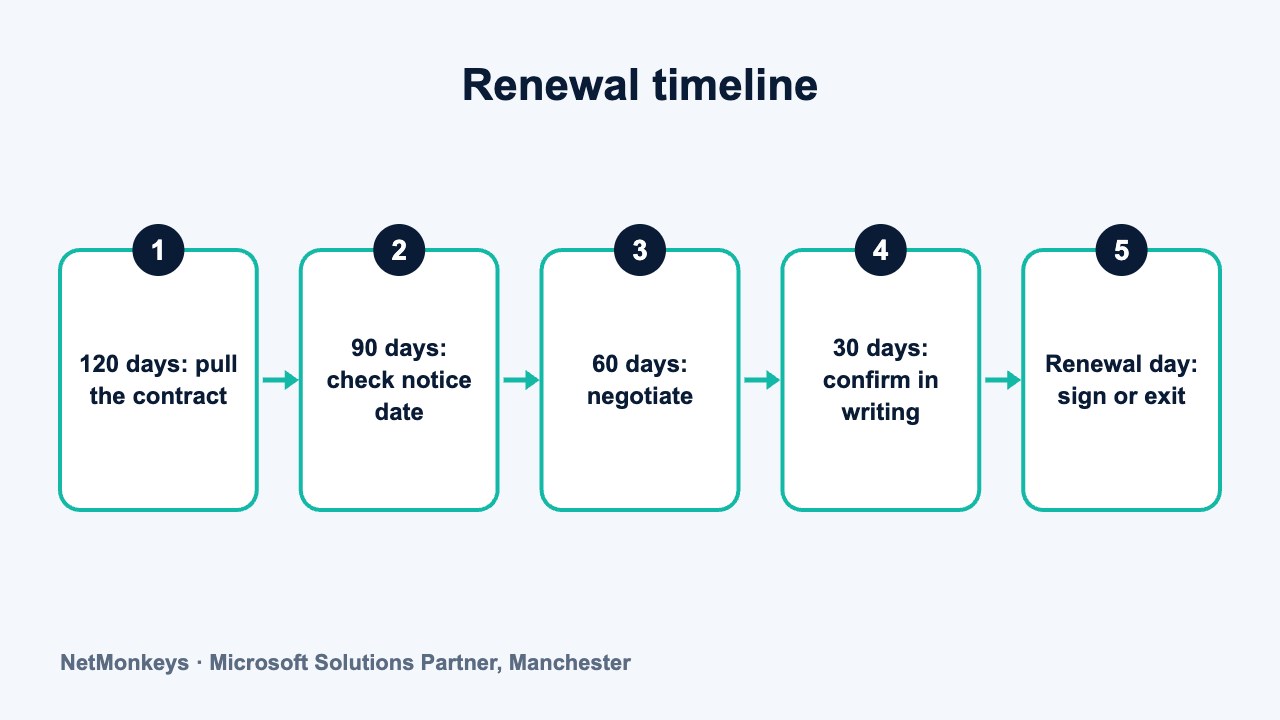
Work backwards from the notice date. The table below uses 120, 90, 60 and 30 days as example checkpoints and assumes a 90-day notice period. Adjust the dates to your own contract, because your notice period may be shorter or longer.
| Days before term end | Action | Owner |
|---|---|---|
| 120 days | Pull the signed contract and all variations. Note the term end, notice period, notice method and indexation wording. Diarise the notice date. | Finance or Procurement |
| 105 days | Request a service review and the last 12 months of ticket and billing data from your provider. | Operations Manager |
| 90 days | Notice date. Decide whether to renew as is, renegotiate or exit, and serve any notice in the form the contract requires. | Finance Director |
| 60 days | Compare alternatives, take proposals and agree negotiating points. Get legal advice on any variations. | Procurement and Operations |
| 30 days | Obtain the renewal terms in writing, check them against the old contract and confirm start dates. | Finance Director |
| Term end | Sign, or begin the exit and transition plan. | Signatory |
If your notice period is shorter than 90 days, move the dates forward to match, but keep the early checkpoint. The first review is the one that gives you room to act. A review that begins 45 days out may leave no time to obtain proposals from other suppliers.
If you find you are already inside the notice window, do not guess. Read the clause, speak to your provider, and take advice from a solicitor about your position before you decide how to respond.
↑ Back to contentsWhat questions should you ask your provider?
Put these questions to your provider in writing and ask for written answers. A good provider will not mind. The answers also form a record if a disagreement arises later.
- What is the exact notice date? Ask them to confirm the end of the term and the last day for notice, in an email you can file.
- What changes in the renewal terms? Ask for a marked-up comparison against the current contract, not just a new document.
- How is indexation calculated? Request a worked example based on your current invoice.
- What is excluded from the fixed fee? Ask for a list, with the day rate for each excluded activity.
- How many tickets were outside scope last year? Compare the answer with your invoices.
- Who owns the licences and admin accounts? Confirm that the main tenant and admin credentials are held by you.
- What does exit assistance cover? Ask what is included, what is chargeable and the typical timescale.
- What happens if service levels are missed? Ask about credits and termination rights.
- Can we have a shorter renewal term? A 12-month term gives you a cheaper option to review again.
- What does the roadmap for our account look like? A provider with a plan for your next 12 months is easier to evaluate than one without.
Should you renew, renegotiate or switch?
Many renewals should simply go ahead. If the service is working, the pricing is fair, the contract is clear and your provider has a plan for the year ahead, signing again is a sensible decision and switching adds cost and risk for little benefit.
Renegotiate when the service is broadly sound but the terms have drifted. Common targets are an indexation cap, a shorter term, clearer scope, better exit terms and a named account manager. Renewal is the point at which your provider most wants to keep the relationship, so it is the time to ask.
Consider switching when the problems are structural: repeated missed targets, a service that has not kept up with business growth, or a lack of strategic input. Our list of signs a business has outgrown its IT provider is a good test, and how to choose an IT support company gives you a framework for the comparison.
| Situation | Likely best option | First step |
|---|---|---|
| Service is good, terms are clear, price is fair | Renew | Confirm terms in writing |
| Service is good, terms are loose or one-sided | Renegotiate | Send a list of changes with the notice date in mind |
| Service is adequate but strategic input is missing | Renegotiate or add a virtual CIO element | Ask for a 12-month roadmap |
| Service has missed targets repeatedly | Switch, or renew for a short term only | Gather evidence and take advice on your contract |
| Growth has outpaced the provider's capacity | Switch | Request proposals at least 90 days out |
What if you only notice the deadline has passed?
It happens. The first step is to read the clause again, because contracts sometimes provide a longer window, a right to terminate on a defined event, or a different rule for the first renewal. The second is to speak to your provider. Some will agree a shorter renewal term or a mid-term review in return for the relationship continuing.
Do not assume that you are locked in, and do not assume that you are free. Ask a solicitor to read the clause. That is a modest cost compared with the value of the contract, and it is better to have the advice before you send a notice than after.
Once the immediate position is clear, put in place a diary routine so that it does not happen again. A single owner in finance, a named deputy in operations and a shared calendar entry 120 days ahead are enough.
If the relationship is strained and you do want to move on, plan the exit with care. An independent IT consultancy review can help you describe what you need before you approach other suppliers, and you can speak to our team if you want a second opinion on your current setup.
↑ Back to contentsFrequently asked questions
When should I give notice on an IT support contract?
Give notice by the date stated in your contract, which is the term end date less the notice period. Many businesses diarise this about 90 days out, with a review starting at 120 days. Check your own agreement, as notice periods and methods vary.
What is an auto-renewal clause in an IT contract?
It is a term saying the agreement continues for a further period unless one side gives notice. The renewal period may be the same as the original term. Read the clause for the notice length, the renewal term and the method by which notice must be served.
Can my IT provider increase prices during the contract?
Only if the contract allows it. Many agreements contain an indexation clause that permits annual increases linked to an index, a fixed percentage or a notice-based change. Ask for a worked example and consider asking for a cap.
What does out of scope mean in an IT support agreement?
It describes work that is not covered by the fixed monthly fee and is charged separately. Typical examples are projects, office moves, onsite callouts and third-party software issues. The list should be written down, with rates, so you can budget for it.
Should I sign a shorter IT contract at renewal?
A shorter term, such as 12 months, gives you more flexibility and a nearer review point. Providers may price a longer term more keenly, so compare the saving against the loss of flexibility. The right answer depends on how settled your needs are.
What should I ask for if I am thinking of switching provider?
Ask for administrator credentials, documentation, licence ownership details and a clear statement of any exit assistance and its cost. Then plan the move in stages, with parallel running where possible. See the guides on switching without downtime for the full process.
Do I need a solicitor to review my IT support contract?
You are not required to, but it is sensible where the contract is long, the sums are large or the wording is unclear. A solicitor can advise on notice, renewal and termination rights in your specific agreement. This guide does not replace that advice.
About this guide and NetMonkeys
Written by Caleb Adoh, Growth Marketing Manager at NetMonkeys. NetMonkeys is a Manchester-based Microsoft Solutions Partner with offices in Manchester, Nottingham and London and field engineers across around 12 UK cities, providing managed IT support, cyber security and virtual CIO services. This guide gives general information for UK businesses. Contracts, insurance policies and certification schemes differ, so check your own documents and current requirements, and take legal, insurance or financial advice where it matters.
Want a second opinion on your IT?
Talk to NetMonkeys about your current set-up, your contract and what a sensible next step looks like for your business.
Explore managed IT support Contact the team