
Why the UK Is Telling Londoners to Stockpile Food: Cyber Lessons
The government wants households ready for three days of disruption. Here is what was asked, what is unconfirmed, and what businesses should do about payments, suppliers and patching.

Key Takeaways
- The advice is national: households are asked to be ready for three days, not Londoners alone.
- No specific cyberattack or scenario has been named as at 23 October 2026.
- The NCSC's critical PHP alert of 21 October 2026 is a separate but urgent patching task.
- Businesses should plan a 72-hour fallback for payments, suppliers and communications.
Short answer: the UK government has not singled out Londoners. It is running a national preparedness push, and the government's Be Ready campaign page asks households to be ready for three days of disruption. The cyber link is real but indirect: a serious attack on payments, logistics or utilities is one of several emergencies the advice covers. As at 23 October 2026, no specific attack or scenario has been named.
That is why the headline "uk government urges londoners to stockpile food cyberattack" needs care. London features heavily in coverage, but the sources checked describe a message aimed at Britons generally. Defence Secretary Wes Streeting, reported by London Loves Business, framed it as a simple ask within a whole-society approach, covering power cuts, loss of online banking, flooding and other emergencies.
For a business owner, the useful question is not whether to buy tinned food. It is what happens to your organisation if card payments, cloud services or your website go down for three days. This article sets out what was actually said, what a cyberattack can realistically disrupt, how the recent PHP flaw fits in, and what to do this week.
What did the government actually ask households to do?
The government asked households to be ready to cope for three days. The government's Be Ready campaign page says being ready for three days helps people manage while support reaches those in need. It points to a checklist, volunteering, the Priority Services Register for people who need extra help during outages, and Met Office weather warnings.
Press coverage fills in the detail. Mr Streeting told The Sun, as reported by London Loves Business on 27 September 2026, that households should keep bottled water, tinned food and some cash at home. Other coverage describes torches, a battery or wind-up radio, medicines and copies of documents as part of the same checklist.
Two points are worth stating plainly:
- Not Londoners only. The government page directs readers in Scotland and Northern Ireland to their own services, which implies a UK-wide campaign. No source checked says only Londoners were told to stockpile.
- Not a stockpile in the panic-buying sense. Three days of essentials is a modest buffer, not weeks of supplies.
Some critics have called the campaign scaremongering. The government line, as reported, is "alert but not alarmed", with no specific scenario in mind. That is a political debate. The operational point for organisations is simpler: public bodies are asking everyone to plan for outages, so you should too.
↑ Back to ContentsIs this advice a warning about a specific cyberattack?
No. As at 23 October 2026, no source checked links the advice to a named cyberattack, attacker or date. The campaign covers war, natural disasters and other emergencies, and Mr Streeting listed power cuts and loss of online banking alongside flooding and wildfires.
The cyber angle comes from what those emergencies have in common. Modern services depend on a small number of connected systems: payment processors, logistics software, energy control systems and cloud platforms. A failure in any of them, whether from attack, fault or weather, looks much the same to a customer: the card machine does not work and the shelf is empty.
What has not been confirmed is any claim that an attack is imminent. Treat anyone who says otherwise as speculating. Do not make decisions on rumour; make them on what you would do if a dependency failed tomorrow.
↑ Back to ContentsWhat can a cyberattack realistically disrupt?
A cyberattack most realistically disrupts the digital layer that businesses rely on: payments, websites, ordering and stock systems, communications and identity services. Mass loss of food or water is far less likely than days of inconvenience and lost trading. That distinction matters for how you plan.
| Area | What failure looks like | Typical business impact |
|---|---|---|
| Payments | Card terminals or online checkout unavailable | Lost sales; need for cash or manual fallback |
| Logistics and stock | Order, warehouse or delivery systems offline | Late deliveries; empty shelves or missed orders |
| Utilities | Power or connectivity interrupted | Sites close; remote staff cannot work |
| Websites and portals | Site offline or defaced | Lost enquiries; reputational damage |
| Cloud and identity | Staff locked out of email and files | Work stops even if premises are fine |
The incident-response lesson is the same across all five: the disruption is usually in a supplier or a shared service, not in your own building. Our piece on supply chain lessons from recent retail breaches shows how one dependency can stall many organisations at once.
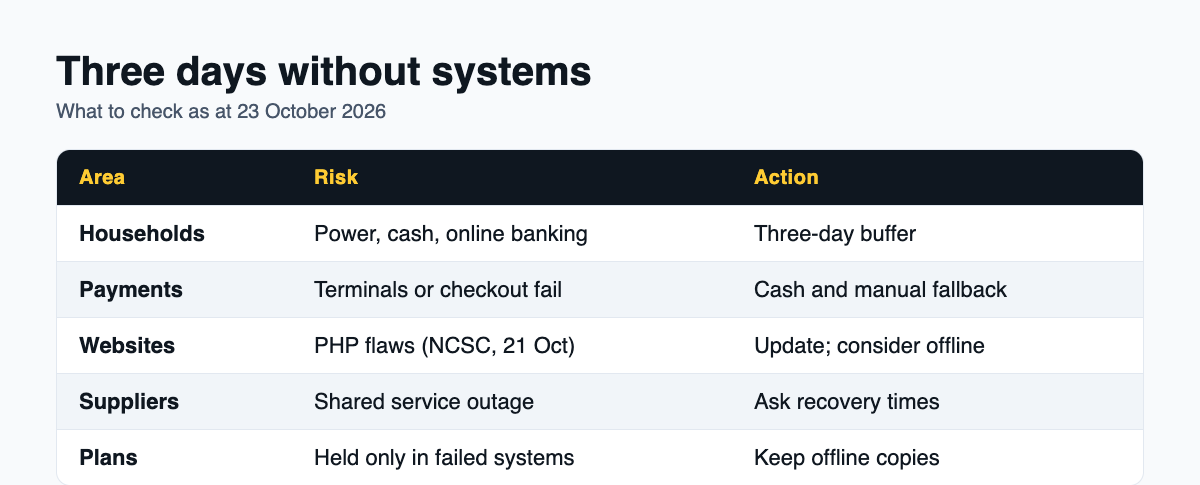 Summary of the continuity checks in this article.
How does the critical PHP flaw fit into this?
The PHP flaw is a separate event that happens to land in the same week. The NCSC alert on PHP, published on 21 October 2026, describes two critical vulnerabilities (CVE-2026-109618 and CVE-2026-109619) that could let attackers run commands on web servers, under certain conditions without logging in. It says all PHP versions may be affected, and that PHP has released a fix.
The NCSC's advice, paraphrased:
- Find every PHP installation, starting with internet-facing systems, and do not limit the search to old versions.
- Update to the latest PHP release, internet-facing first.
- If you cannot update yet, apply the temporary mitigations published by PHP's maintainers.
- Check suppliers, because appliances and hosted services may bundle PHP.
- If mitigation is not possible quickly, consider taking the affected system offline until it is fixed.
Reports said some government services were taken offline to apply fixes. The number and the services concerned have not been confirmed, so treat that as unverified. What it does show is that "take it offline" is a real option, and one you should have decided how to handle before you need it. For WordPress owners, our PHP update guide for WordPress sites covers the practical steps.
Not confirmed
As at 23 October 2026 there is no confirmed link between the PHP flaws and the government preparedness campaign. The NCSC alert does not mention the campaign.
What should households do?
Households should build a small three-day buffer gradually, not rush to the shops. Keep it simple and use what you will eat anyway.
- Bottled water and non-perishable food for three days.
- A battery or wind-up radio, a torch and a charged power bank.
- Some cash in small notes, in case terminals or cash machines fail.
- Regular medicines and copies of key documents.
- A check on whether you or a relative should join the Priority Services Register.
This is deliberately brief because the main work for readers of this site is organisational. If your staff are told to be ready at home, your business should be ready too.
↑ Back to ContentsHow should a business plan for a three-day outage?
Start by naming the five or six things you must keep running, then decide what you would do if each was unavailable for 72 hours. A three-day horizon is useful because it is long enough to expose weak points and short enough to plan for realistically.
What is the first step in continuity planning?
The first step is a business impact view: list critical processes, the systems behind them, who owns each, and how long you can tolerate an outage. Our business continuity plan template and contingency planning guide give a structure you can adapt.
Who needs to know the plan?
Everyone who would act on it. Plans stored only in the system that has failed are useless, so keep an offline or printed copy and a contact tree that works without email.
Where does an IT partner help?
A managed IT support partner can map dependencies, test backups and restores, and run exercises. Out-of-hours cover matters if an incident starts overnight, which is why many firms look at 24/7 helpdesk support. Our London IT support team works with firms in the capital, and the same approach applies across our other offices.
↑ Back to ContentsWhat should your payment fallback be if cards or cash machines fail?
Your fallback should be a documented, rehearsed alternative that lets you keep taking money, or at least recording orders, for three days. Most small firms have no fallback at all because card payments have always worked.
- Retail and hospitality: keep a float of cash, a manual order or receipt process, and a way to record sales for later reconciliation. Check whether your terminals can work on a different connection, such as mobile data.
- Service firms: know which clients pay by bank transfer, and who can approve urgent payments if online banking is unavailable for a day or more.
- Everyone: agree who may authorise an exception, and how fraud checks continue when normal systems are down.
Test it once. A fallback that has never been used is a guess.
Worked example (illustrative)
Assume a cafe whose card terminal is cloud-connected. Its fallback is a locked cash float, a paper sales sheet, a mobile hotspot for the terminal and a named manager who can decide to switch to cash only. The owner runs a 30-minute drill each quarter. All details are assumptions to show the method, not data from a real business.
How exposed is your business to supplier and cloud failure?
Most businesses are more exposed to supplier failure than to a direct attack on their own network. Payment providers, hosting companies, logistics partners and software vendors all sit between you and your customers.
Ask each critical supplier four questions:
- What is your recovery time if your service fails?
- Where does my data sit, and can I export it?
- How do you tell me about an incident, and how quickly?
- Do you bundle components, such as PHP, that I would also need to patch?
Keep the answers with your asset records. You cannot patch or protect what you cannot see, so an up-to-date inventory is the base layer; see our guide to IT asset visibility. Insurance can help with costs but does not restore systems; our overview of cyber insurance explains what to check.
↑ Back to ContentsWhat can we learn from this?
The main lesson is that resilience is mostly dull, repeatable work done before anything happens. The government is asking households to prepare; organisations should hold themselves to the same standard.
Which controls matter most?
- Patching and exposure: know where internet-facing software runs and update it fast. The PHP alert is a live example. A cyber security audit will show what is exposed.
- Baseline security: the Cyber Essentials scheme covers firewalls, secure configuration, access control, malware protection and updates.
- Detection and response: managed endpoint detection and response helps you spot intrusions early.
- Ransomware readiness: offline backups and tested restores; see ransomware protection for UK businesses.
- Incident planning: the NCSC incident management guidance says the response plan should link to disaster recovery, business continuity and crisis management. Our incident response plan template is a starting point.
What should small firms do first?
If you have limited time, begin with cybersecurity for small business basics and read our summary of the main risks for small businesses.
Check this week
- List every PHP-based site and application, including supplier-hosted ones, and confirm patch status.
- Write down your top five critical processes and their 72-hour fallback.
- Print the contact tree and incident plan and store a copy off-network.
- Confirm you can restore from backup, not just that backups run.
- Ask your payment provider what happens in an outage.
- Hold a 30-minute walk-through with leadership.
What does this mean for UK organisations?
It means regulators, customers and the public increasingly expect organisations to show they can keep going. Different sectors feel this differently.
| Sector | Main exposure | First priority |
|---|---|---|
| Retailers | Payments, stock and delivery systems | Cash and manual fallback; supplier recovery times |
| Schools and education suppliers | Shared networks and central IT | Offline working plan; tested backups |
| Banks and financial services | Third-party and customer-facing platforms | Tested incident plan; customer communications |
| Households and SMEs | Power, connectivity, online banking | Three-day buffer; cash; documented fallback |
Firms in regulated sectors should also consider sector expectations; see our pages for financial services IT support. None of this is cause for alarm. It is a prompt to check the basics.
↑ Back to ContentsConclusion: should UK businesses act on the stockpile advice?
Yes, but sensibly. The government has asked households to be ready for three days; it has not told Londoners alone to stockpile food, and it has not named a cyberattack. For businesses, the practical reading of "uk government urges londoners to stockpile food cyberattack" coverage is to plan for three days without payments, cloud services or a website, and to patch the PHP flaw now. If you would like help turning this into a plan, contact NetMonkeys.
Who wrote this and how it was checked
Written by Caleb Adoh, Growth Marketing Manager at NetMonkeys, a Manchester-headquartered Microsoft Solutions Partner with offices in Manchester, Nottingham and London. Facts were checked against the cited official sources (the Be Ready campaign page and the NCSC) as at 23 October 2026. This article will be updated as facts change.
Frequently Asked Questions (FAQs)
Has the UK government told Londoners to stockpile food?
No source checked says only Londoners were told. The Be Ready campaign is national and asks households to be ready for three days of disruption. London features in some coverage, but the advice applies across the UK and beyond London, with separate pages for Scotland and Northern Ireland, so the message is not specific to the capital.
Is the stockpile advice linked to a cyberattack?
As at 23 October 2026, no named cyberattack has been linked to the advice. The campaign covers several emergencies, including power cuts and loss of online banking. A cyberattack on payments, logistics or utilities is one plausible cause, but the government has said there is no specific scenario in mind.
What does the government say to keep at home?
The government page says to be ready for three days. Coverage of the checklist mentions bottled water, non-perishable food, a torch, a radio, medicines, a power bank, document copies and some cash. Build the supplies gradually from items you would use anyway rather than panic buying, and review it every few months.
What is the PHP vulnerability the NCSC warned about?
On 21 October 2026 the NCSC published a critical alert on two PHP flaws, CVE-2026-109618 and CVE-2026-109619, which could allow attackers to run commands on web servers. It advises finding all PHP installations, updating internet-facing systems first, and considering taking systems offline if they cannot be mitigated.
What can a cyberattack realistically disrupt?
Most realistically it disrupts digital services: card payments, ordering and stock systems, websites, email and cloud access. Mass loss of food or water is far less likely. Plan for several days of reduced trading and manual workarounds, and write them down, and check how your key suppliers would recover and communicate.
How should a small business prepare for a three-day outage?
List your critical processes, decide a manual fallback for each, keep cash and printed contacts, hold offline copies of your incident plan and test your backups. Ask suppliers about their recovery times. A short rehearsal with your team shows gaps faster than any document, and takes under an hour.
Should businesses stockpile supplies as well?
Stockpiling commercial stock is a business decision for your own sector, not something the government has asked of companies. The more useful step is continuity planning: payment fallback, offline contacts, tested restores and supplier checks. Staff welfare items for a site, such as water, torches and chargers for a site are a sensible low-cost addition.
Where can UK businesses get help with cyber resilience?
The NCSC publishes free incident management and vulnerability guidance. For hands-on help, a managed IT provider can audit your exposure, test backups and restores, and run realistic exercises. If you suspect a compromise and lack the skills in-house, the NCSC recommends using an NCSC-assured Cyber Incident Response provider.
Speak to a NetMonkeys specialist
Talk to our team about securing your systems, testing your incident plans and protecting your data.
Book a conversation