
Microsoft Fabric Consultancy for UK Businesses
NetMonkeys provides practical Microsoft Fabric consultancy to organisations across the UK. As a Microsoft Solutions Partner with Azure, Power BI and Business Central expertise, we help you decide whether Fabric is right for you, design a data platform that your people can trust, and get reports and AI-ready data into the hands of decision-makers. Our Microsoft Fabric consultancy UK service sits alongside our Azure consultancy and Microsoft 365 consultancy.


Jump to:
What our Microsoft Fabric consultancy includes
Microsoft Fabric brings data integration, engineering, warehousing, real-time analytics and Power BI into a single software-as-a-service platform. That is powerful, but it also means more decisions: how to structure OneLake, which workloads to use, how to control capacity and who should see what. Our Microsoft Fabric consultancy helps you make those decisions once, correctly, and document them.
We work with organisations at every stage: those with reports scattered across spreadsheets, those running ageing on-premises warehouses, and those already using Power BI who want a governed foundation beneath it. In every case the aim is the same — numbers people trust, delivered without a team of specialists on payroll.
Everything we deliver is documented in plain English. You will know which data lives where, how it is refreshed, who owns each dataset and what it costs to run. That transparency matters when auditors, lenders or new board members start asking how the numbers are produced, and it means the platform does not become dependent on any one person — including us. If you would rather compare Fabric with a simpler route first, our Azure data warehouse guide and data warehouse service are good places to start.
- Fabric fit assessment and business case
- Data strategy and target architecture on OneLake
- Lakehouse and warehouse design using a layered model
- Data pipelines and ingestion from your core systems
- Migration from legacy warehouses, SSIS and spreadsheets
- Power BI semantic models and report design
- Security, governance and Microsoft Purview integration
- Capacity sizing, cost control and monitoring
- Copilot and AI-readiness for your data
- Training, handover and ongoing support
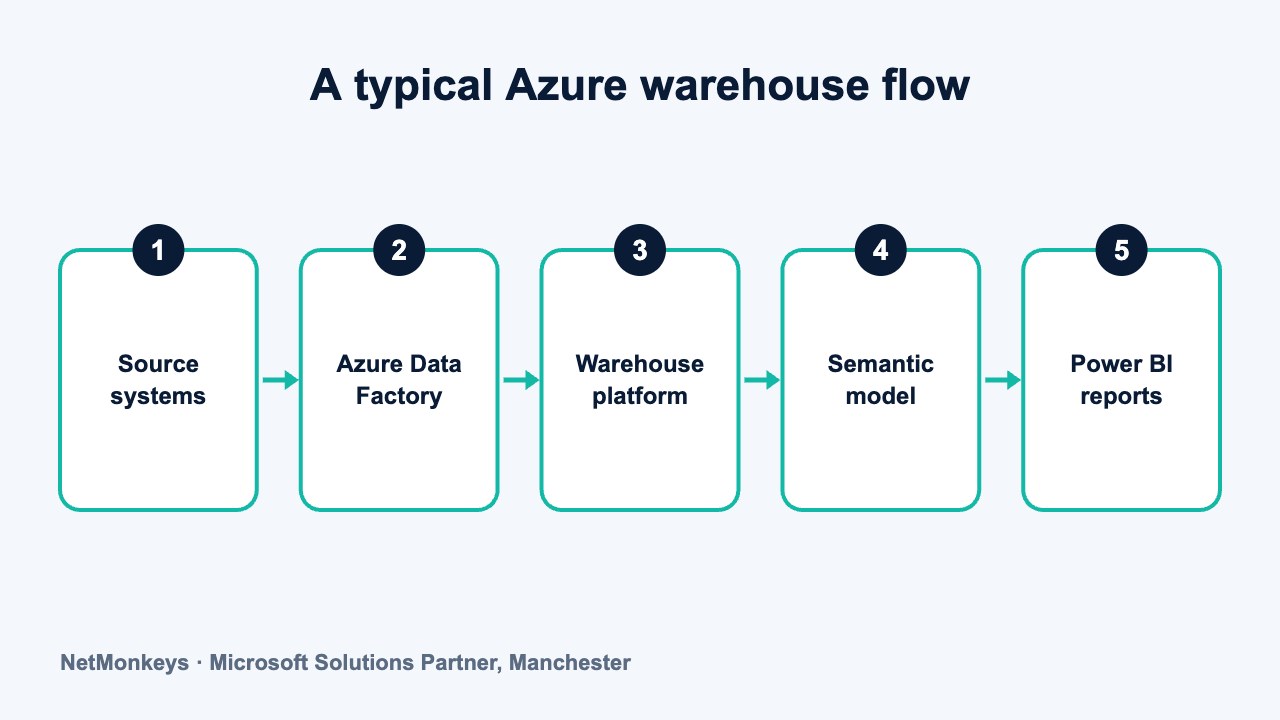
Microsoft Fabric consultancy services, from strategy to support
Choose a single stage or the full journey. Each service is scoped to a clear deliverable and a fixed price.
Fabric Strategy & Fit Assessment
Establish whether Fabric suits your data, skills and budget compared with alternatives, and what a realistic first phase looks like.
Learn more →Data Warehouse & Lakehouse Design
Model your data in layers so that reporting is fast, consistent and easy to extend. Builds on our data warehouse expertise.
Learn more →Data Integration & Migration
Bring data from Business Central, Microsoft 365, databases and files into Fabric, and migrate from legacy warehouses with full reconciliation. See data migration services.
Learn more →Power BI & Semantic Models
Governed datasets and dashboards that finance, operations and leadership can all use. Explore Power BI services.
Learn more →AI-Ready Data
Prepare trusted, well-described data so Copilot and other AI tools return useful answers. Part of our AI consultancy.
Learn more →Support & Optimisation
Monitoring, capacity reviews and enhancement after go-live, from a team that also supports your wider Microsoft estate.
Learn more →Why UK businesses choose NetMonkeys for Microsoft Fabric consultancy
A data platform becomes part of how your business runs. You need a partner who understands the data, the Microsoft stack and the people who use the reports.
Business-first, not tool-first
We start with the decisions you need to make and work back to the data, rather than beginning with features. Many organisations need a smaller first phase than they expect.
Whole Microsoft stack
Fabric connects to Azure, Microsoft 365, Dynamics 365 and Power BI. We work across all of them, so integration problems are solved in one place.
Real ERP experience
Our Business Central work means we understand the finance and operations data that most reports begin with.
Certified and accountable
Microsoft Solutions Partner with five designations and Cyber Essentials Plus. See our partnerships page.
Cost-conscious design
Fabric is capacity-based, so design choices affect the bill. We size capacity sensibly and build in monitoring from day one.
Plain-English handover
Documentation, training and a named consultant, so your team can run the platform without depending on us — or lean on our support when you want it.
Want Microsoft Fabric consultancy that is clear about cost and outcome? Book a free consultation — no obligation.
Microsoft Fabric consultancy compared with other data approaches
Fabric is not the answer to every data problem. This comparison shows where a guided Fabric project stands against the options many businesses already have.
| Capability | Fabric with NetMonkeys | Separate tools, stitched together | Spreadsheets and ad hoc reports |
|---|---|---|---|
| Single governed source of truth | ✓ OneLake with defined layers | Several copies of data | Many conflicting versions |
| Reporting speed and scale | ✓ Designed for volume | Depends on each tool | Slows as files grow |
| Security and access control | ✓ Central, role-based | Configured per tool | File-level, hard to audit |
| Integration with Microsoft 365 and Power BI | ✓ Native | Connectors to maintain | Manual copy and paste |
| AI and Copilot readiness | ✓ Structured, described data | Fragmented | Unstructured |
| Skills required in-house | Moderate, with our support | High across several products | Low, but fragile |
| Cost predictability | ✓ Capacity-based, monitored | Multiple bills | Hidden in staff time |
| Ongoing support | ✓ Available 24/7 | Several suppliers | Whoever built the file |
If you are weighing options, our articles on Fabric data warehouse, Azure data warehouse options and data warehouse versus data mart set out the trade-offs.
Get a Data Platform ReviewWhy so many UK businesses struggle to trust their numbers
Most organisations do not lack data. They lack a reliable way to combine it. These are the problems that lead businesses to look at Fabric.
Conflicting versions of the truth
Finance, sales and operations each report from their own spreadsheet, and the totals never quite agree. Meetings are spent debating numbers instead of acting on them.
→ We solve thisReports that take days to produce
Month-end packs are assembled by hand, which is slow, error-prone and dependent on the one person who knows how.
→ We solve thisSystems that do not talk to each other
ERP, CRM, payroll and operational systems all hold part of the story. Joining them is manual or not done at all.
→ We solve thisAn ageing warehouse or reporting server
On-premises systems cost to maintain, are hard to scale and increasingly sit apart from the cloud tools your people use.
→ We solve thisPower BI without a foundation
Dashboards built directly on messy sources are slow and fragile. Without a governed layer beneath, every report reinvents the logic.
→ We solve thisAI ambitions with unprepared data
AI tools reflect the quality of the data behind them. Undocumented, inconsistent data produces unreliable answers.
→ We solve thisOur Microsoft Fabric consultancy is designed around these exact problems. Each one has a defined approach and a clear first step.
Fabric platform design: OneLake, workspaces and architecture
Good architecture is mostly invisible, and bad architecture is expensive to undo. We design the foundations first so the platform stays manageable as it grows.
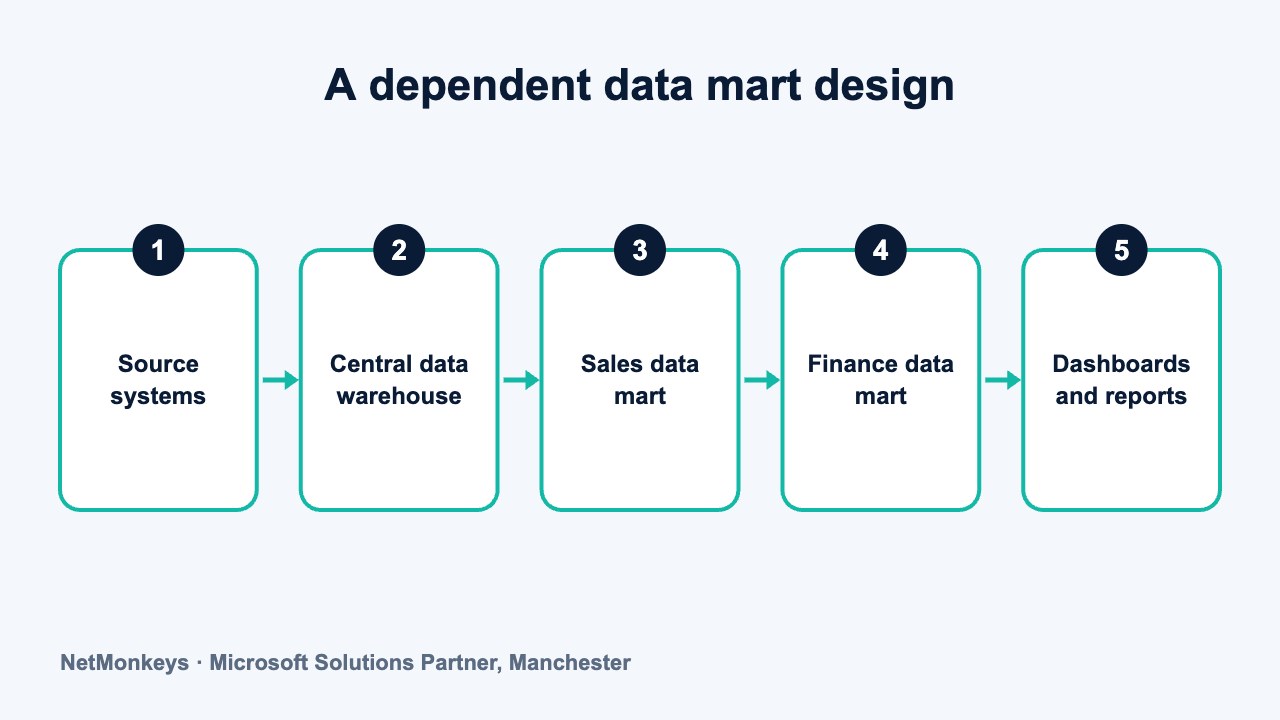
Data engineering and migration on Microsoft Fabric
This is where data actually arrives, gets cleaned and becomes usable. Reliable pipelines are the difference between a platform people trust and one they work around.
Power BI, semantic models and AI-ready data
Reports are the visible part of any data platform. When the layers beneath are right, building and maintaining them becomes dramatically easier.
Security, governance and capacity cost control
Centralising data concentrates risk as well as value. We build security and cost discipline into the platform from the first day.
Four common starting points for a Microsoft Fabric project
Every organisation arrives with different data and different frustrations. These four patterns cover most of the conversations we have.
You report from spreadsheets
Finance and operations maintain workbooks that are emailed around. The first phase connects the main source systems, builds a small number of governed datasets and replaces the most time-consuming monthly pack. Quick, visible benefit with limited risk.
You already use Power BI
Reports exist but are slow, duplicated or inconsistent. We introduce a governed layer beneath them, consolidate duplicate logic into shared semantic models and keep the dashboards your people already know.
You run an ageing warehouse
An on-premises SQL warehouse or SSIS estate is costly to maintain. We assess what is worth keeping, migrate in stages with reconciliation and retire the old platform on a timetable you control.
You want AI-ready data
Leadership wants AI-assisted analysis but the data is undocumented and inconsistent. We structure and describe the core datasets first, so that tools such as Copilot have something dependable to work with.
Whichever applies, the principle is the same: begin with a defined, valuable slice, prove it, then extend. That is cheaper, faster and far less risky than attempting to model the whole business at once.
Understanding Microsoft Fabric cost before you commit
Fabric is charged on capacity rather than per report, which suits organisations that want predictable spend, but it rewards careful sizing. Microsoft sets prices and licensing terms and updates them periodically, so we confirm current figures with you rather than print numbers that could be out of date. What we can describe is how to keep the cost sensible.
Start small and measure. A well-designed first phase often runs comfortably on modest capacity, and Azure-purchased capacity can be scaled or paused when it is not needed. Efficient pipelines, sensible refresh schedules and well-built semantic models reduce consumption considerably, which is why design quality directly affects running cost. Beyond capacity, budget for the people side: modelling, testing, training and the time of the business owners who define what the numbers mean. Our related guidance on Power BI licensing and avoiding unexpected Azure costs applies here too.
- Agree the first-phase scope and success measures
- Size capacity from real workloads, not guesses
- Monitor consumption weekly during the build
- Review refresh schedules and model efficiency
- Reassess capacity at each quarterly review
Six Microsoft Fabric mistakes we help UK businesses avoid
Fabric projects rarely fail because of the technology. They struggle because of scope, ownership and cost, all of which can be managed with a little discipline at the start.
What you receive from our Microsoft Fabric consultancy
We aim to leave you with assets you own and understand, not a black box that only we can operate.
A written architecture
Diagrams and decisions explaining how OneLake, workspaces, layers and security are organised, and why.
Governed data and models
Reconciled datasets and shared semantic models, with documented definitions for each key measure.
Working pipelines
Scheduled, monitored data flows from your core systems, with failure alerts and exception reporting.
Priority reports
Dashboards for the decisions you named at the start, tested with the people who will use them.
Security and access design
Roles, row-level rules and labelling documented and applied, ready to evidence to auditors and customers.
Training and a roadmap
Sessions for analysts and report users, plus a prioritised plan for the next phases of the platform.
The expertise behind our Microsoft Fabric consultancy
Reliable data work needs people who have built and supported real platforms. NetMonkeys has worked with UK businesses since 2006 and delivers Azure, Power BI, Dynamics 365 and data warehouse projects as part of its daily work.
Our credentials are public: Microsoft Solutions Partner status across five designations, including Infrastructure (Azure), and Cyber Essentials Plus certification. We publish what we learn, from Azure data warehouse options to a practical guide to the Data Warehouse Toolkit, so you can assess our thinking first.
Microsoft Fabric consultancy for data-rich sectors
Fabric suits organisations with several systems and decisions that depend on combining them. These are some of the sectors where we see the clearest benefit.
Manufacturing
Combine ERP, production and stock data for margin, throughput and supply chain visibility.
Learn more →Retail
Join sales, inventory and finance data across channels and sites.
Learn more →Construction
Project cost, programme and subcontractor reporting from a single governed source.
Learn more →Accountants
Consolidated client data and practice performance reporting.
Learn more →Charities
Funding, outcomes and donor data brought together for trustees and funders.
Learn more →Food & Drink
Yield, traceability and demand data across production and distribution.
Learn more →Energy & Utilities
Operational and asset data at scale, with strong governance.
Learn more →Recruitment
Pipeline, placement and margin analytics across consultants and clients.
Learn more →Our Microsoft Fabric consultancy process
A staged approach delivers value early and keeps the cost of mistakes low.
Discovery call and data landscape review
We learn what decisions matter, what systems hold the data and how reports are produced today, then identify the quickest wins and the biggest risks.
Fit assessment and roadmap
A written assessment of whether Fabric suits you, a target architecture and a phased plan with costed options, including smaller alternatives where they are better.
Foundation build
We set up the platform, security model and first data pipelines, with documentation and naming standards agreed from the start.
First reports and handover
A priority set of reports built on governed models, reconciled against your existing numbers, with training for the people who use them.
Support and extension
Ongoing monitoring and capacity reviews through our service desk, and further phases as new sources and use cases are ready.
Microsoft Fabric consultancy across the UK
Fabric is delivered from the cloud, so you do not need a consultant on your doorstep. We work remotely from Manchester, visiting for workshops and training where it helps.
Microsoft Fabric consultancy UK-wide
We support organisations in England, Scotland, Wales and Northern Ireland, with one method and one team for every site.
Power BI and data teams in your region
See our local Power BI pages for Manchester, Birmingham, Leeds, Bristol and Derby.
Whatever your location, you get the same consultants, method and service desk. See our wider Microsoft consultancy offer.
Find Your Local TeamCommon questions about Microsoft Fabric consultancy
Answers to the questions UK businesses ask most when considering Microsoft Fabric.
What is Microsoft Fabric consultancy?
Microsoft Fabric consultancy is expert help to plan, build and run data and analytics on Microsoft Fabric. It covers strategy, architecture, data integration, reporting with Power BI, security, governance and cost control. A good consultant also tells you when Fabric is not the right answer.
What is Microsoft Fabric?
Microsoft Fabric is a software-as-a-service analytics platform that brings data integration, engineering, warehousing, real-time analytics and Power BI together over a single storage layer called OneLake. It aims to replace a patchwork of separate tools with one governed environment.
Do you provide Microsoft Fabric consultancy in the UK?
Yes. We provide Microsoft Fabric consultancy UK-wide, working remotely from Manchester and visiting site for workshops and training. Organisations in London, Essex, Surrey and the regions all receive the same method and team.
How much does Microsoft Fabric consultancy cost?
We scope Fabric work as fixed-price phases after a free discovery call, as cost depends on the number of sources, data volumes and reporting needs. Fabric itself is charged by capacity, and we help you size it sensibly. Microsoft sets those prices, so we confirm current terms with you.
Do we need Fabric if we already use Power BI?
Not necessarily. Power BI on its own is enough for many organisations. Fabric becomes attractive when you need to combine many sources, handle larger volumes or establish governed data for several teams and AI tools. A short assessment will tell you.
Can you migrate us from an on-premises data warehouse?
Yes. We migrate in controlled stages, reconcile old and new numbers and retire the old platform only when you are satisfied. See our data migration services and our guidance on Azure data warehouse options.
What is the difference between a data warehouse and a lakehouse?
A warehouse stores structured, modelled data optimised for reporting. A lakehouse stores data in open formats and handles both structured and unstructured material. Fabric supports both, and we choose per workload. Read Fabric data warehouse for more.
Can Fabric connect to Business Central?
Yes. Business Central data can be brought into Fabric for reporting and combined with other sources. Our Business Central partner experience helps us design that data flow properly.
Is Microsoft Fabric secure?
Fabric includes role-based access, row-level security and sensitivity labelling, and integrates with Microsoft Purview. Security still depends on how it is configured, so we design the access model with you and align it to Cyber Essentials expectations.
How long does a Fabric project take?
A first phase covering the foundation, a handful of pipelines and priority reports often takes a few months for a mid-sized organisation. Scope, data quality and availability of your people drive the timeline, so we give a phased plan after discovery.
Does Fabric help with Copilot and AI?
Yes, indirectly. AI tools perform better on trusted, well-described data. A governed Fabric platform provides that foundation. See our Microsoft Copilot consultancy and AI consultancy.
Can we run Fabric ourselves after the project?
Yes. We document the platform, train your team and hand over. Many clients also keep us on for monitoring and enhancement, but it is optional.
Do you offer Power BI consultancy as well?
Yes. Power BI is part of nearly every Fabric project, and we also deliver stand-alone work. Explore our Power BI services and local pages such as Manchester.
Are you a Microsoft partner?
Yes. NetMonkeys is a Microsoft Solutions Partner with five active designations and holds Cyber Essentials Plus certification. Details are on our partnerships page.
Microsoft Fabric consultancy guides and articles
Practical guidance on data platforms, warehouses, reporting and AI for UK business leaders.
Fabric Data Warehouse: What It Is and Who It Suits
Read more →AzureAzure Data Warehouse: Options for UK Businesses
Read more →Data WarehouseData Warehouse vs Data Mart: What Is the Difference?
Read more →Data ModellingData Vault vs Data Warehouse: Modelling Compared
Read more →Data WarehouseThe Data Warehouse Toolkit: A Practical Guide to the Book
Read more →Power BIDo we need Power BI Pro or Power BI Premium?
Read more →AI ReportingCan AI generate business reports from our company data?
Read more →AzureHow much does Azure migration cost for an SME?
Read more →CloudAzure vs AWS vs Google Cloud
Read more →AI StrategyHow do we identify the best AI use cases in our company?
Read more →AI RoadmapHow to Build an AI Roadmap for Your Business (UK SME Guide)
Read more →GovernanceHow do we create an AI governance policy for employees?
Read more →Technology resources for UK business leaders
The MonkeyBytes podcast covers the technology decisions that matter most to UK organisations — Microsoft 365, cloud, data, AI and cybersecurity. Plain-English insight from our engineers.
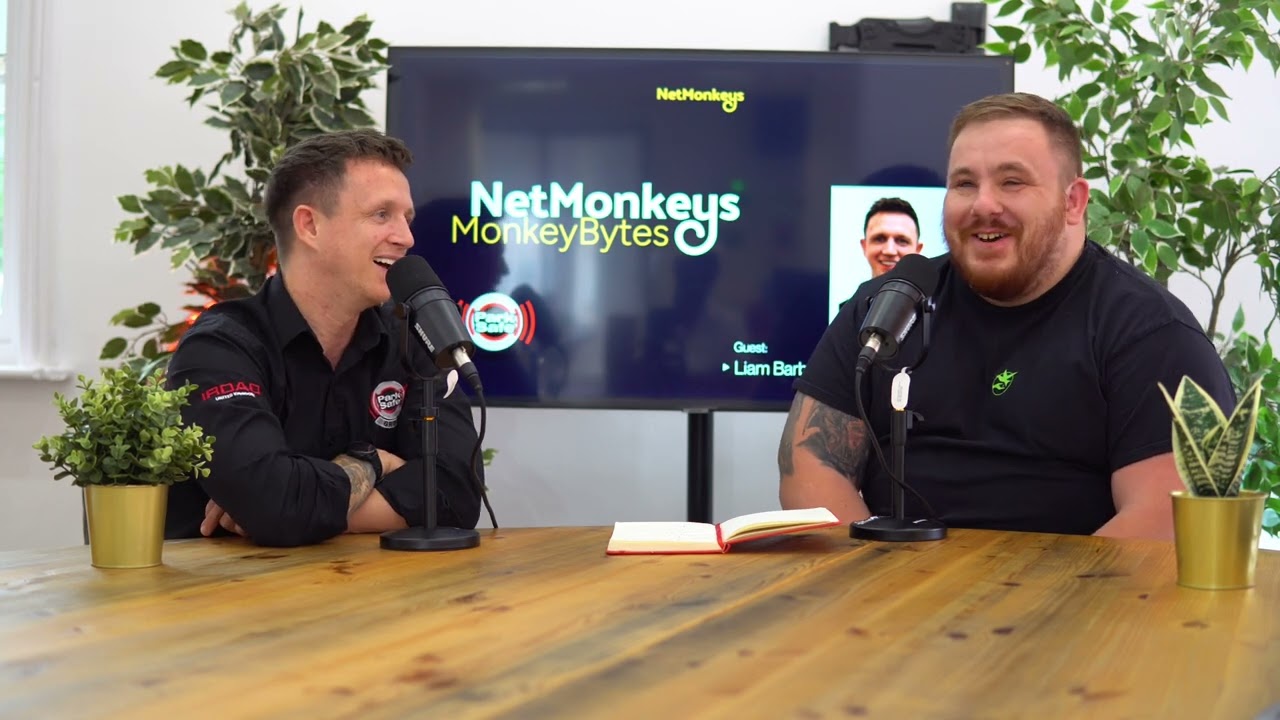
Inside ParkSafe: The Journey to Safer Fleets with Liam Barber
How ParkSafe transformed their IT and cybersecurity with NetMonkeys.
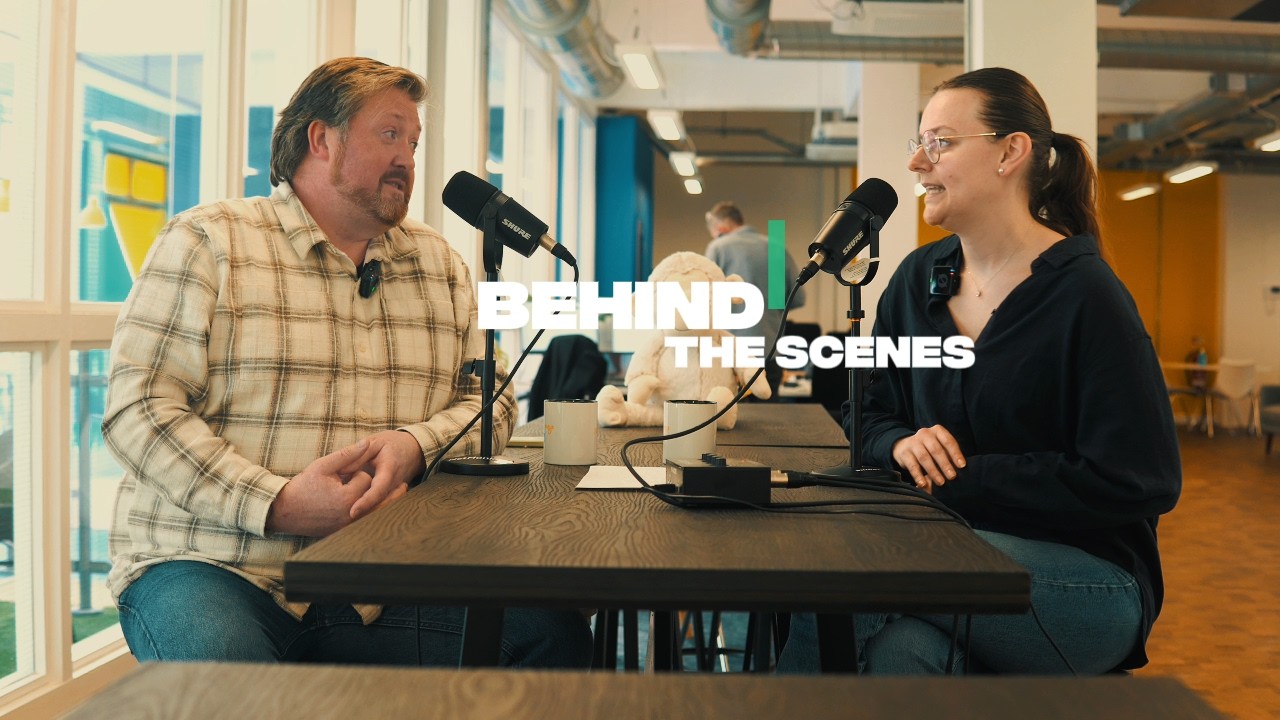
The Truth About IT Support — What Really Happens Behind the Scenes
Our engineers explain what a well-run managed IT service looks like.

Scaling with IT Support — A Conversation with Sam Neal, MD of Orchard Safety
How the right IT partner changed how Orchard Safety operates and scales.
Ready for Microsoft Fabric consultancy you can trust?
Book a free, no-obligation Fabric consultation. We will review your data landscape, tell you plainly whether Fabric suits you, and give you a clear, fixed-price route to numbers your whole business can trust — wherever you are in the UK.

