
Data Warehouse vs Data Mart: What Is the Difference?
Data warehouse vs data mart explained: scope, audience, top-down and bottom-up builds, when a mart is enough and how to avoid data mart sprawl.
The quick answer
A data warehouse holds integrated data from across the whole organisation. A data mart is a smaller, focused slice of data built for one team or subject, such as sales or finance. A mart can be enough for a single department, but several unconnected marts tend to produce conflicting numbers.
Key takeaways
- A warehouse covers the whole organisation; a mart covers one subject or department.
- Marts can be fed from a central warehouse (dependent) or built straight from source systems (independent).
- Top-down builds the warehouse first. Bottom-up builds marts first and joins them with shared definitions.
- One mart is often enough for a single team with a few sources.
- Unmanaged marts lead to sprawl, duplicate logic and reports that disagree.
What is the difference between a data warehouse and a data mart?
The main difference is scope. A data warehouse brings together data from many systems across the business and models it so that anyone can ask questions that cross departments. A data mart holds a narrower selection, shaped for one group of users or one subject area, such as sales performance, stock or HR.
A mart is often described as a subset of a warehouse. That is true for one common design, but not all of them. Some marts are built directly from source systems with no warehouse behind them. We cover that distinction below, because it decides whether marts help you or cause trouble later.
If you want the wider background first, read what is a data warehouse. This article concentrates on how the two compare and how they fit together. Our data warehouse services page covers what a build involves in practice.
A plain-English summary
A warehouse answers questions for the whole business. A mart answers questions for one team, faster and with less to learn. The risk is not the mart itself. It is having many marts that were never designed to agree with each other.
How do they compare side by side?
| Area | Data warehouse | Data mart |
|---|---|---|
| Scope | Whole organisation, many subject areas | One department or subject area |
| Audience | Executives, analysts and several departments | A specific team, such as sales or finance |
| Data sources | Many source systems, integrated | Few sources, or a slice of the warehouse |
| Design effort | Larger, needs agreed definitions across teams | Smaller and quicker to deliver |
| Time to first value | Longer if built as one programme | Shorter for the team it serves |
| Consistency | High, as definitions are shared | Depends on whether marts share definitions |
| Cross-department questions | Supported by design | Hard unless marts share dimensions |
| Main risk | Overbuilding before value is shown | Sprawl, duplicate logic and conflicting figures |
| Maintenance | One central model to look after | Many small models to look after |
Size is not the only difference. A mart can be quite large in data volume and still be a mart, because the word describes its purpose and audience rather than its storage.
↑ Back to contentsHow are warehouses and marts built: top-down or bottom-up?
There are two long-standing build philosophies, usually linked with two well-known data warehousing authors. You do not need to pick a camp, but it helps to know what each one trades.
Top-down
In a top-down build, you design and load the central warehouse first, with data from across the business. Marts are then created from it for each team. The benefit is consistency, because every mart starts from the same integrated data. The cost is that it takes longer before anyone sees a result.
Bottom-up
In a bottom-up build, you deliver one mart at a time, starting with the area that matters most, such as sales. Each mart uses shared dimensions, like customer and date, so that marts can later be combined. The benefit is speed. The cost is discipline: if the shared definitions are skipped, the marts drift apart.
Dependent and independent marts
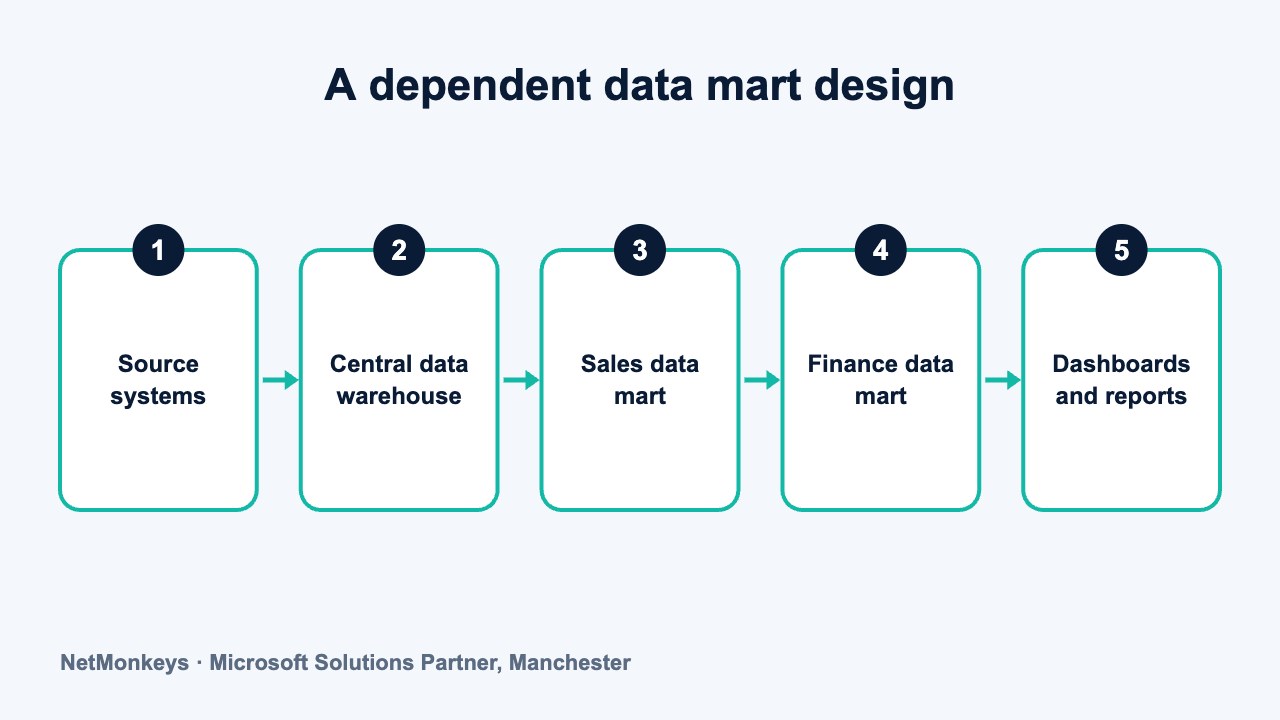
- Dependent marts are fed from a central warehouse. They are easy to keep consistent, because they reuse the same cleansed data.
- Independent marts are built straight from source systems, with no warehouse behind them. They are quick to create, but each one repeats its own extraction and rules.
- Hybrid approaches start with a mart for a priority area, and grow it into a warehouse by adding sources and shared dimensions over time.
Our guide to data warehouse design explains how shared dimensions are planned so that later marts fit together.
↑ Back to contentsWhen is a data mart enough?
A mart is a perfectly good answer in some situations. Building a full warehouse when you do not need one is a common and expensive mistake. A single mart is often enough when the following apply.
- One team owns the questions. For example, a sales team wants pipeline and revenue reporting and nobody else needs the data.
- You have a small number of sources. A CRM and an accounting system, for instance, can be modelled in a single mart without much integration work.
- You need a result quickly. A focused mart can reach users sooner than a company-wide programme.
- The data is not shared across departments. If finance, operations and sales never need to compare figures, there is little to integrate.
- You are proving value. A first mart can show what good reporting looks like before you commit to a larger build.
Many Power BI projects are effectively single marts. A well-structured semantic model for one subject area, fed by a few cleansed tables, does the same job. See Power BI services and BI software for SMEs for how smaller organisations approach this.
↑ Back to contentsWhen do you need a central data warehouse instead?
A central warehouse earns its place when questions cross team boundaries or when several marts begin to overlap. Warning signs include the following.
- Two reports show different revenue. Sales and finance have each built their own logic, and nobody agrees which is correct.
- Several teams are extracting the same data. The same source tables are pulled and cleaned again and again.
- You need a single view of the customer. This requires joining data from marketing, sales, service and billing.
- You have many sources. Integrating ten systems is easier once, centrally, than repeatedly in each mart.
- You need history and audit. A central store can keep a consistent record of how figures looked at different dates.
If these sound familiar, start by mapping your current reports and showing where logic is duplicated. Combining data from multiple systems into one dashboard is often the first step, and it shows quickly whether a central model is needed.
↑ Back to contentsWhat is data mart sprawl and why is it a risk?
Data mart sprawl happens when marts are created one by one, by different people, without shared definitions or an owner. Each mart makes sense on its own. Together they become hard to manage.
- Conflicting numbers. Each mart defines a customer, a sale or a margin slightly differently, so totals do not match.
- Duplicate effort. The same source is extracted and cleaned in several places, so a source change must be fixed in each one.
- Unclear ownership. When a mart breaks, nobody knows who maintains it, and users lose trust.
- Rising load on source systems. Many separate extracts can slow down the systems your business runs on.
- Security gaps. Copies of sensitive data end up in places that are not properly controlled.
Sprawl is preventable. Keep a register of every mart and model, with an owner and a purpose. Agree one source for each key definition. Review the list regularly, and retire anything that nobody uses. These habits cost little and save a great deal of rework later, when the business has grown and the original builders have moved on.
It is also worth asking whether a new mart is really needed. Often a new report on an existing mart, or a small extension to a shared table, does the job without creating another thing to maintain.
Common mistake
Letting each department build its own mart in its preferred tool, with no shared customer or date definitions. It feels fast at first. Within a year you have several sets of figures and an argument about which one is right.
How do data marts relate to a central warehouse?
In a healthy design, marts are presentation layers over shared data. The warehouse integrates, cleanses and stores the detail. Each mart exposes the part that a team needs, in a shape that is easy to use.
The glue is shared, or conformed, dimensions. If sales and finance both use the same customer table and the same calendar, their marts can be combined without argument. This matters more than whether the marts are physical tables, views or Power BI models.
It also helps to agree a short list of governed measures, such as revenue and gross margin, and define each once. Teams can then build marts and reports freely, because the numbers underneath are the same. This is the practical idea behind improving data accuracy across departments.
For the platform choices behind a central warehouse, see data warehouse platforms. The same principles apply on Azure and other cloud environments.
↑ Back to contentsWhat does this look like in practice? An illustrative example
Consider a hypothetical distribution company with a CRM, an accounting package and a stock system. The sales director wants a weekly view of pipeline and orders. Nobody else is asking for data.
A single sales mart is a sensible start. It takes customers and orders from the CRM and accounting system, adds a calendar and a product table, and feeds one set of dashboards. It can be delivered in a short project, and the sales team sees value quickly.
Six months later, finance wants margin by customer, and operations wants stock cover by product. Both need the same customer and product tables. If the company builds two more marts from scratch, it now has three versions of customer. If it moves the shared tables into a central layer first, the new marts reuse them and the numbers agree.
The lesson is not that the first mart was wrong. It is that the first mart should be built with shared dimensions in mind, so that growth is cheap rather than painful. Cleansing steps built in Power Query are a common place where this logic gets quietly duplicated, so keep an eye on it.
This is a made-up scenario, used only to show the pattern. Your sources and priorities will differ, which is why a short review is worth doing before any build.
↑ Back to contentsHow do you decide? A short decision list
Use these questions to decide where to start. Answer them with the people who will use the reports, not only the technical team.
- How many teams need the data? One team points to a mart. Several teams point to a warehouse.
- How many source systems are involved? Two or three can sit in a mart. Many sources justify central integration.
- Do departments need to compare figures? If yes, shared definitions are essential, whatever you build.
- How soon do you need results? A mart is faster. A warehouse needs more upfront design.
- Who will own it after launch? Name an owner for every model, mart or warehouse, before building it.
- Could this mart grow later? If so, design shared dimensions from the start, so it can become part of a warehouse.
What we would check first
When we scope a data warehouse, we begin with the questions the business needs answered and the reports people already use. We look for duplicated logic and disagreeing figures. That tells us whether a single mart will do, or whether central integration will save time later.
What should you do next?
List your current reports, the systems behind them and the teams that rely on them. Mark every place where two reports should agree but do not. That list shows whether you have a single-team need or a cross-business one.
If you would like help, NetMonkeys' data warehouse team can review your reporting and recommend whether a mart, a warehouse or a staged approach fits. You may also find our guide to business intelligence consultants useful when planning who will build and run it.
↑ Back to contentsFrequently asked questions
Is a data mart part of a data warehouse?
Often, but not always. A dependent mart is fed from a central warehouse and is effectively a focused view of it. An independent mart is built straight from source systems and has no warehouse behind it.
Can I have a data mart without a data warehouse?
Yes. Many organisations start with one mart for a single team. The risk comes when more marts are added without shared definitions, because the figures begin to disagree.
Which is cheaper, a data mart or a data warehouse?
A single mart is usually cheaper and quicker to build because the scope is smaller. Over time, many separate marts can cost more to maintain than one well-designed warehouse. Compare the whole lifecycle, not just the first build.
Is a Power BI dataset the same as a data mart?
Not exactly, but a well-designed Power BI semantic model for one subject often plays the same role. It still needs clean source data and agreed definitions behind it to avoid the same sprawl problems.
What is a conformed dimension?
It is a shared table, such as customer or date, that is defined once and used by several marts or fact tables. It lets you combine data from different areas and get consistent results.
About this guide and NetMonkeys
Written by Caleb Adoh, Growth Marketing Manager at NetMonkeys. NetMonkeys is a Manchester-based Microsoft Solutions Partner offering data warehouse services, Power BI services and business intelligence consultancy. This guide explains general data warehousing practice. Vendor products and features change, so check the current vendor documentation before making platform decisions.
Planning a data warehouse?
Talk to NetMonkeys about what you need to report on, where your data lives and which approach fits your business.
Explore data warehouse services Contact the team