
Data Warehouse vs Marketing Database: Which Do You Need?
Data warehouse vs marketing database: purpose, scope, users, history, identity and consent compared, plus when marketing outgrows its database.
The quick answer
A marketing database holds customer and prospect records so marketers can segment, contact and measure campaigns. A data warehouse holds structured data from across the whole business, such as finance, sales, operations and marketing, for reporting and analysis. Most organisations need the marketing database for activity and the warehouse for the wider picture, with data flowing between them.
Key takeaways
- A marketing database is built for action on contacts. A warehouse is built for analysis across the business.
- The warehouse usually holds more history and more sources, such as finance and operations.
- Identity resolution and consent handling need careful design in either store.
- Marketing teams outgrow a marketing database when they need profit, retention or lifetime value, not just clicks.
- The two work best together, with the warehouse feeding trusted audiences back into marketing tools.
What is the difference between a data warehouse and a marketing database?
A marketing database is a store of people and their interactions, kept so marketing can act on them. A data warehouse is a store of structured business data from many systems, kept so the organisation can analyse it. The first is built around contacts and campaigns. The second is built around business questions.
The terms overlap in conversation, and some products blur the line. This article separates the concepts so you can decide what you need. For a wider definition of the second one, see what a data warehouse is. For how we deliver one, see our data warehouse services.
↑ Back to contentsWhat is a marketing database?
A marketing database holds records of customers, leads and sometimes supporters, together with what they have done: emails opened, forms completed, pages visited, purchases made. Its job is to let marketers build segments and trigger communications.
In practice it can take several forms. It may be a CRM, an email platform's contact store, an e-commerce customer table, or a customer data platform (CDP) that collects profiles from websites and apps. A CDP is a product category built for this purpose. Check each vendor's current documentation for what a given product actually does, because the label is used loosely.
Its strengths are speed of action and ease of use. A marketer can select a segment and send a campaign without writing queries. Its limits are scope and depth. It usually knows a lot about contacts and little about margin, stock, delivery performance or support cost.
↑ Back to contentsWhat is a business-wide data warehouse?
A data warehouse takes data from many operational systems, cleans it, models it and stores it for analysis. Marketing data is one input among several. Finance ledgers, order systems, service tickets and operational records sit beside it.
Its users are mostly analysts, managers and reporting tools, such as Power BI, rather than people sending campaigns. It is designed for questions that cross departments: which channels bring customers who stay, which products return the most margin, which regions cost the most to serve.
Its limits are the mirror image of the marketing database. It is slower to set up, needs modelling skill, and is not designed to send an email at nine o'clock on Tuesday. It tells you who to contact and why, then hands the list to the tool that does the contacting.
↑ Back to contentsHow do they compare side by side?
| Aspect | Marketing database or CDP | Business-wide data warehouse |
|---|---|---|
| Main purpose | Segment, contact and measure campaigns | Analyse and report across the business |
| Data scope | Contacts, interactions, orders, consent flags | Finance, sales, operations, service, marketing and more |
| Typical users | Marketers and CRM managers | Analysts, finance, operations, leadership, BI tools |
| History | Often recent activity, or limited by plan and settings | Designed to keep long history for trends and audit |
| Identity resolution | Matches people across touchpoints for targeting | Matches customers across all systems for reporting |
| Data shape | Profiles and event streams | Modelled facts and dimensions |
| Speed of action | Fast: triggers and sends | Analytical: refreshes on a schedule |
| Setup effort | Lower for common use cases | Higher: modelling, loading, governance |
| Privacy handling | Consent and suppression for contact | Access control, retention, minimisation for analysis |
Neither column is better. They answer different questions, which is why the choice is rarely either-or.
One point of confusion is the data mart. A marketing data mart is a subset of warehouse data shaped for the marketing team, with its own tables for campaigns and customers. It is not the same as a marketing database, because it is built for analysis and fed from the warehouse. We explain the difference in data warehouse vs data mart.
A second source of confusion is the word 'database'. A warehouse is itself a kind of database, so the comparison is really between two designs and two jobs. One is designed for operational use by marketers. The other is designed for analysis by the whole organisation.
↑ Back to contentsHow do identity resolution and history differ?
Identity resolution means deciding that two records are the same person or organisation. In a marketing database, it joins a website visitor, an email subscriber and a buyer so a campaign does not treat them as three people. It leans on identifiers such as email address and device or login data.
In a warehouse, the same problem appears across systems that never shared a key. The CRM calls a company 'Smith and Co', finance calls it 'Smith & Company Ltd', and operations uses an account number. A warehouse needs a matching rule, a master record and a way to show exceptions. That is slower work, but it lets you join sales to cost and service.
History differs too. A marketing database often keeps the current profile and a limited activity log, and it may overwrite old values. A warehouse can be designed to keep how things looked at each point in time. That matters when you ask whether last year's campaign customers are still buying, or how a segment's value changed.
What we would check first
Find out which identifier is trusted most in your business, and whether it exists in every system. Matching on email alone misses business customers with several contacts. Matching on a shared account reference is usually more reliable for B2B.
What do UK GDPR and PECR mean for each?
This section gives a general orientation only and is not legal advice. Take advice from a qualified adviser or your data protection officer for your own situation.
UK GDPR applies to personal data wherever it is held, so both stores are in scope. Common themes include having a lawful basis, being clear with people about use, keeping only what you need, keeping it accurate, and being able to find and delete it on request. The Privacy and Electronic Communications Regulations (PECR) add specific rules for electronic marketing such as email and text messages, including consent and the right to opt out. The Information Commissioner's Office publishes guidance, so check its current pages.
The practical differences are these. A marketing database must honour consent and suppression at the moment of sending, so consent status needs to be current and travel with the record. A warehouse is less about sending and more about minimisation and access: who may see personal data, whether analysis can use pseudonymised or aggregated data, and how long records stay.
Copying personal data into a warehouse creates another place where it must be governed and deleted. Plan for that before loading. Our managed security team works on the access and monitoring side of this.
↑ Back to contentsWhen do marketing teams outgrow a marketing database?
Many teams run happily on a CRM or CDP for years. The signs of outgrowing it tend to arrive together, and they are about questions, not volumes.
- You need profit, not just revenue: campaign reports stop at sales, and nobody can link them to margin, returns or cost to serve.
- You need data the tool does not hold: finance, stock, delivery or support data would change who you target, but it lives elsewhere.
- Reports disagree with finance: marketing's customer and revenue figures do not match the ledger.
- You need long history: the tool's retention or modelling cannot show cohort behaviour over several years.
- You are stitching exports by hand: analysts join CRM, web and finance files each month in spreadsheets.
- Several teams want the same customer view: sales, service and marketing all build their own.
If these sound familiar, read about combining data from multiple systems into one dashboard and stopping manual Excel exports. A warehouse is one answer. A lighter approach, such as direct connections in Power BI, may be enough at first.
It also helps to ask who will maintain the result. A warehouse needs someone to watch loads, handle source changes and answer questions about definitions. In smaller marketing teams that role may sit with IT or an external partner rather than with marketing. Agree this early, so the warehouse does not become an orphaned project once the build ends.
↑ Back to contentsHow do the two work together?
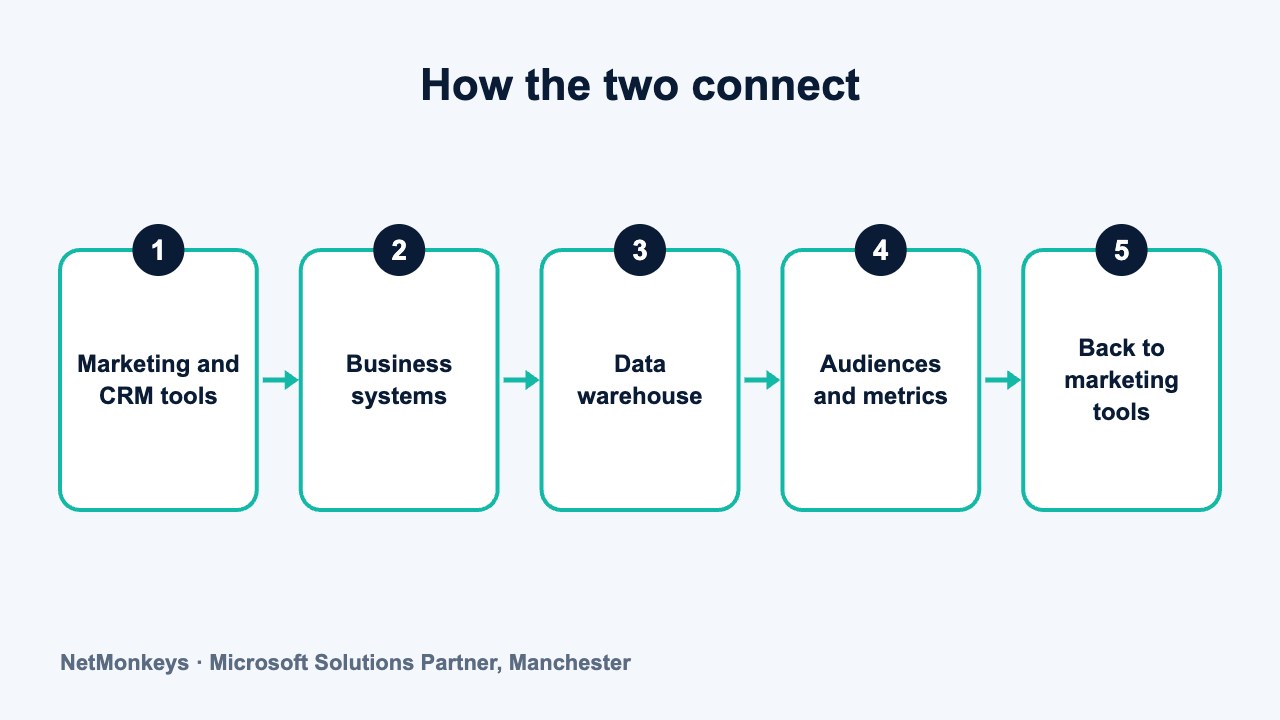
The usual pattern is to treat the warehouse as the place where data is joined and judged, and the marketing tools as the place where action happens. Data moves both ways.
- Load marketing data in: contacts, campaign results, web events and consent status flow into the warehouse alongside finance and operations data.
- Resolve and model: customers are matched across systems and given one record, with history kept where it matters.
- Calculate what marketing cannot: lifetime value, repeat rate, margin by segment and churn risk are worked out from the joined data.
- Send audiences and scores back: approved segments and measures return to the CRM or email platform through an agreed integration.
- Report the result: campaign outcomes are measured against finance figures, not just platform dashboards.
A simple example shows the value. Marketing wants to know which acquisition channel brings the best customers. The marketing tool can count sign-ups and first orders by channel. Only the joined data can show which channel's customers later returned goods, paid late or raised many support tickets. That answer changes where the budget goes, and it needs finance and service data in the same place as campaign data.
Step four needs care. Only send back data you are entitled to use for marketing, and carry consent status with it. Our system integration work covers moving data between tools, and Power BI services cover the reporting in step five. Platform choices are discussed in data warehouse platforms.
↑ Back to contentsHow do you decide? A checklist
Use these questions to decide whether to stay with a marketing database, add a warehouse, or do both. The more you answer yes in the second group, the stronger the case for a warehouse.
- Stay with the marketing database if: your questions are about contacts and campaigns, one tool holds most of the data, and reports match finance closely enough.
- Add a warehouse if: you need to join marketing data to finance, operations or service data, and you want one set of figures for the whole business.
- Add a warehouse if: you need years of history or an audit trail that the marketing tool does not keep.
- Add a warehouse if: several teams are building their own customer views from exports.
- Wait if: nobody owns data definitions, consent records are unreliable, or you cannot name the decisions the data would change.
- Do both if: you want action in marketing tools and analysis in a governed store, which is the common outcome.
Common mistake
Treating a CDP as a replacement for a warehouse, or the reverse. A CDP is good at activating customer profiles. It is not designed to carry finance and operations data for company-wide reporting. Decide which job you need done, then pick the tool for it.
If you want help scoping this, NetMonkeys is a Manchester-based Microsoft Solutions Partner and our data warehouse consultancy can start with the questions your marketing and finance teams need answered. For the broader reporting picture, our guide to business intelligence companies may help.
↑ Back to contentsFrequently asked questions
Is a CRM the same as a marketing database?
A CRM often acts as one, because it stores contacts and their interactions. It is built to manage relationships and sales activity, though, not to combine company-wide data for analysis. Many businesses use a CRM for action and a warehouse for the wider reporting.
Is a customer data platform the same as a data warehouse?
No. A CDP collects and unifies customer profiles so they can be used in marketing and other tools. A warehouse stores modelled data from across the business for analysis. They can complement each other, and some products overlap, so check what a given vendor actually provides.
Can a data warehouse replace my marketing database?
Usually not. A warehouse analyses and prepares data, but marketers still need a tool to build campaigns, send messages and honour opt-outs. The warehouse feeds those tools with better audiences and measures.
Do UK GDPR and PECR apply to a data warehouse?
UK GDPR applies to personal data wherever it is held, including a warehouse. PECR applies to electronic marketing messages. This is general information, not legal advice, so take advice on your own position and check the Information Commissioner's Office guidance.
When should a business add a warehouse to its marketing stack?
Consider it when marketing needs data the tool does not hold, such as margin, delivery or service cost, or when reports no longer match finance. A narrow first project can prove the value before you widen it.
Can Power BI sit on top of a marketing database?
Yes, Power BI can connect to many marketing tools directly, which is a sensible first step. As the number of sources and the need for consistent definitions grow, a warehouse underneath gives reports a stable base.
About this guide and NetMonkeys
Written by Caleb Adoh, Growth Marketing Manager at NetMonkeys. NetMonkeys is a Manchester-based Microsoft Solutions Partner offering data warehouse services, Power BI services and business intelligence consultancy. This guide explains general data warehousing practice. Vendor products and features change, so check the current vendor documentation before making platform decisions.
Planning a data warehouse?
Talk to NetMonkeys about what you need to report on, where your data lives and which approach fits your business.
Explore data warehouse services Contact the team