
Benefits of Data Warehouse: What You Get and What It Takes
The practical benefits of data warehouse projects, how each shows up day to day, what must be true for it to appear, and when a warehouse is not worth it.
The quick answer
The main benefits of a data warehouse are one agreed set of figures, faster reporting, reliable history, better data quality, tighter governance and security, less load on source systems, and a sound base for BI and AI. Each benefit depends on the warehouse being modelled around real business questions and kept up to date. Without that, you have an expensive copy of your data.
Key takeaways
- The core benefit is one agreed definition of each measure, held in one place.
- Every benefit has a precondition, such as clear ownership of definitions or reliable loading.
- Faster reporting and historical analysis are the benefits most teams notice first.
- A warehouse adds cost and effort, and a small business with one system may not need one.
- Judge a warehouse by evidence: fewer disputed numbers, shorter reporting cycles, wider use of the data.
What are the benefits of a data warehouse?
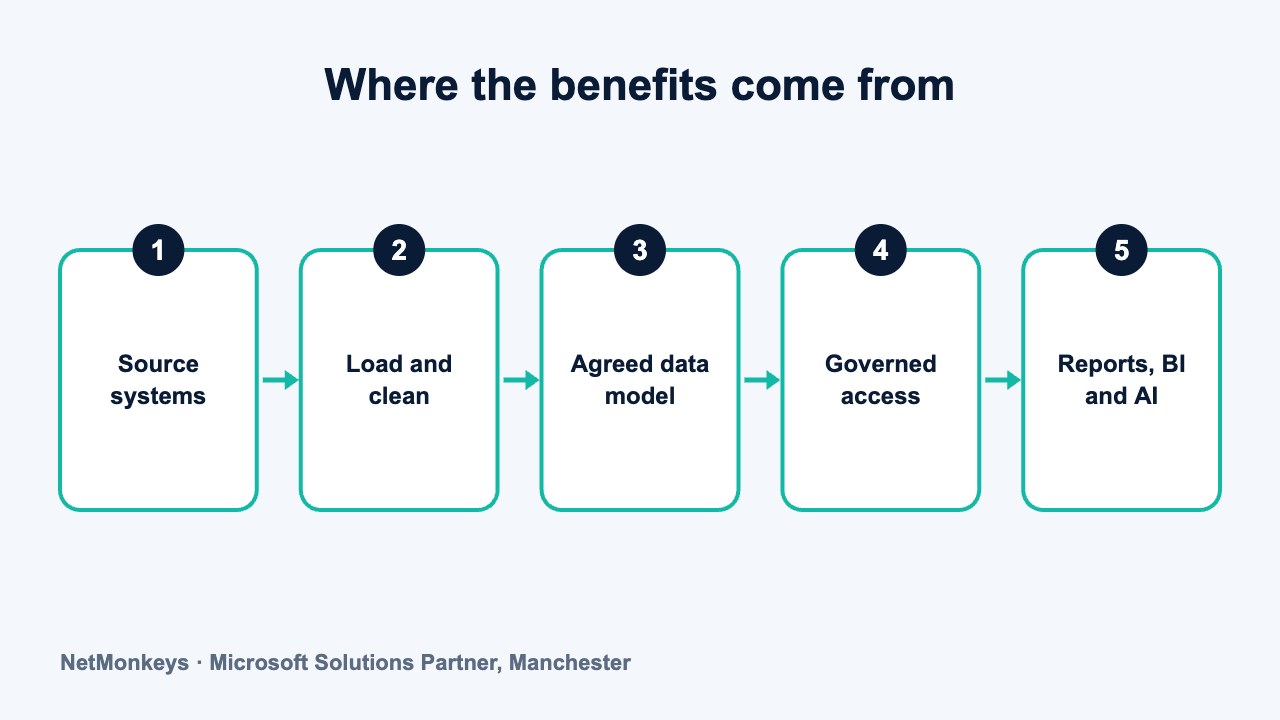
A data warehouse brings data from your separate business systems into one structured store, built for reporting and analysis. The benefits follow from that single move: people stop reconciling spreadsheets and start working from the same figures.
This article covers the benefits that show up in practice, what has to be true for each one to appear, and where the limits and costs sit. If you want the definition first, read what a data warehouse is. If you are weighing up a project, our data warehouse services page explains how we approach delivery.
- Single version of the truth: one definition of revenue, customer or margin, used everywhere.
- Faster reporting: queries and reports run against a model built for them.
- Historical analysis: trends over years, not just the current state of each system.
- Better data quality: errors are found and fixed in one place.
- Governance and security: access, lineage and retention managed centrally.
- Less load on source systems: analysis stops slowing down the ERP or CRM.
- A base for BI and AI: dashboards and models draw on consistent, prepared data.
How does a data warehouse create a single version of the truth?
Most businesses have the same measure calculated several ways. Sales counts an order when it is signed. Finance counts it when it is invoiced. Operations counts it when it ships. None of them is wrong, but a board pack that mixes them causes arguments.
In a warehouse, each measure is defined once, in the data model, and every report reads that definition. Day to day this shows up as shorter meetings. People spend the time deciding what to do about a number, not asking where it came from.
What has to be true: someone in the business must own each definition and be willing to settle disagreements. The warehouse can hold the answer, but it cannot choose it. Where definitions stay contested, the warehouse simply stores the argument in a tidier form.
A related benefit is trust. When a figure changes, the warehouse can show why: a late invoice, a corrected record, a changed rule. People accept numbers they can trace, and they stop keeping private spreadsheets as a check. That habit is hard to measure, but it is often the clearest sign that the single version of the truth is working. Our guide to combining data from multiple systems into one dashboard shows the reporting side of the same idea.
What we would check first
Ask three managers to define 'active customer' separately. If you get three answers, agree the definition before any build starts. This is the cheapest benefit to secure and the one most often skipped.
Why does reporting get faster?
Source systems are designed to record transactions quickly. They are not designed to answer questions that span years of data and several tables. A warehouse reshapes the data so that those questions are cheap to answer.
In practice there are two gains. Reports load faster, because the heavy joining and aggregating has been done during loading. And reports get built faster, because analysts start from tidy, named tables rather than raw exports. The second gain is usually the bigger one. It is where the monthly pack goes from days of assembly to a refresh.
What has to be true: the model must match how people ask questions, and the loads must run on a reliable schedule. A slow, poorly modelled warehouse is no quicker than the spreadsheets it replaced. If your aim is to end manual exports, see our guides to stopping manual Excel exports and automating monthly management reports.
↑ Back to contentsWhat does historical analysis give you?
Operational systems usually overwrite. A customer changes address, a price changes, a product moves category, and the old value disappears. A warehouse can keep the history, so you can ask what the picture looked like at the time, not only what it looks like now.
Day to day this supports year-on-year comparison, cohort analysis, forecasting from real seasonality, and audit questions such as which price applied on a given date. It also lets you keep data after a source system is retired, which is often the deciding factor in a migration.
What has to be true: history must be designed in from the start. Retrofitting it is painful, because the old values are already gone. Decide which attributes need tracking over time, and for how long, before you load the first row. Storage and retention rules should be agreed with whoever owns compliance.
If history is the main driver, you may also be moving data out of an old system. That is a project in its own right, and our data migration services page explains how we treat it.
↑ Back to contentsHow does a warehouse improve data quality, governance and security?
Loading data into a warehouse forces you to look at it. Duplicate customers, missing codes and inconsistent spellings surface during the build, and the rules that fix them are written down once. That is a real quality gain, but only if the fixes feed back to the source where possible. Otherwise the same errors reappear every day. We cover this in more depth in improving data accuracy across departments.
Governance benefits are practical. You can see where a figure came from, who can read which tables, and how long data is kept. Security is simpler to apply to one governed store than to a dozen exports sitting on laptops and shared drives. Row-level and column-level controls let you show a manager their own region and hide salary or health fields.
What has to be true: access rules must be maintained as people join, move and leave, and the platform must be configured securely. A warehouse with broad open access is a bigger risk than the scattered files it replaced, because it holds everything in one place. Our managed security work often sits alongside a build for this reason.
↑ Back to contentsHow does it reduce load on source systems and support BI and AI?
Running a large analytical query against a live ERP can slow it for everyone. A warehouse takes a scheduled copy, so analysis happens elsewhere. The day-to-day sign is that finance stops being asked to run month-end reports out of hours to protect the live system.
For BI, a warehouse gives a stable model that tools such as Power BI can connect to. Reports built on it are consistent, and a new dashboard reuses the existing definitions. Our Power BI services and business intelligence consultants pages describe the reporting layer in more detail.
For AI, the benefit is mostly indirect. Models and assistants need data that is consistent, labelled and permissioned. A warehouse does not make an AI project succeed, but a lack of prepared data is a common reason one fails. What has to be true: the data must actually cover the question being asked. See our AI consultancy page for how we frame readiness.
↑ Back to contentsHow do the benefits map to evidence you can check?
A benefit you cannot observe is a claim, not a result. Before you commit, decide how you will know each benefit has arrived. The table below pairs each benefit with something visible and the condition behind it.
| Benefit | How it shows up day to day | Evidence to look for | What must be true |
|---|---|---|---|
| Single version of the truth | Fewer disputes about figures in meetings | One written definition per measure, signed off by an owner | Named owners for definitions |
| Faster reporting | Packs refresh instead of being rebuilt by hand | Reporting cycle time before and after | Reliable loads and a model matched to questions |
| Historical analysis | Trend and comparison questions are answered routinely | Reports that use data from retired or overwritten values | History designed in from the start |
| Data quality | Fewer duplicates and manual corrections | Count of rejected or fixed records over time | Fixes passed back to source owners |
| Governance and security | Clear answers on who can see what | Access reviews, lineage notes, retention rules | Access maintained as staff change |
| Reduced source load | No slowdowns during reporting | Fewer out-of-hours report runs | Loads scheduled away from peak use |
| Support for BI and AI | New dashboards reuse existing logic | Number of reports sharing one model | Data covers the question being asked |
What does a data warehouse cost, and what are its limits?
The costs are not only platform fees. Most of the effort goes on understanding the data, agreeing definitions, building and testing loads, and then running the thing. Cloud platforms charge for storage and compute, and the pricing models differ, so check each vendor's current documentation and model your own usage.
- Build effort: modelling and testing take longer than the technology setup, especially with messy sources.
- Running cost: loads fail, sources change and users ask for new measures. Someone has to own that work.
- Latency: most warehouses refresh on a schedule. If you need second-by-second figures, you may need a different pattern alongside it.
- Dependence on source quality: a warehouse cannot fix data that was never captured.
- Change effort: people must trust and adopt the new figures, which takes communication as well as code.
These are not reasons to avoid a warehouse. They are reasons to scope one honestly. Our Power BI implementation cost guide shows how we think about the cost of the reporting layer, which is often a separate line from the warehouse itself.
↑ Back to contentsWhen is a data warehouse not worth it?
A warehouse is a poor fit when the problem is smaller than the solution. If your reporting comes from one system, and that system already has decent built-in reports, a warehouse adds cost without adding much.
It is also premature when nobody can say which decisions the data should inform. Building first and finding questions later usually produces a warehouse that few people use. A good alternative at small scale is to connect Power BI directly to a few sources and see where it strains. Our guide to BI software for SMEs covers that route.
Common mistake
Buying a platform to fix a people problem. If teams will not agree definitions or share data, a new platform will not change that. Sort out ownership first, then choose technology.
What are the signs you are ready for a data warehouse?
Readiness is mostly about the business, not the technology. If several of the following are true, a warehouse is worth scoping.
- Several systems hold data that must be combined: for example ERP, CRM, finance and operational tools.
- Reports disagree: different teams quote different figures for the same measure.
- Reporting is manual: analysts spend most of the month exporting and pasting.
- You need history: trends matter and source systems overwrite old values.
- Source systems are slowing down: reporting competes with day-to-day transactions.
- There are named owners: someone can decide definitions and will be accountable for them.
- There is a defined first question set: you can list the ten questions the business wants answered.
If most of these are true, the next step is a scoped plan, not a platform purchase. NetMonkeys is a Manchester-based Microsoft Solutions Partner, and our data warehouse consultancy starts from the questions the business needs answered, then works back to the data. You can compare platforms in data warehouse platforms and see how pieces fit in architecture requirements.
↑ Back to contentsFrequently asked questions
What is the biggest benefit of a data warehouse?
For most organisations it is one agreed set of figures. Once everyone reads the same definitions, reporting meetings change from arguing about numbers to deciding actions. Other benefits, such as speed and history, add to this but rest on it.
Does a data warehouse improve data quality by itself?
Not automatically. Building one exposes quality problems and gives you a place to apply consistent rules. Lasting improvement needs the errors to be corrected at source, with clear owners, or the same issues return with each load.
How long before a warehouse shows benefits?
It depends on scope, source quality and how clearly the first questions are defined. A narrow first release covering one business area can show value sooner than a company-wide build. We would agree what success looks like before starting.
Is a data warehouse only for large companies?
No, but size is not the test. The test is whether you have several systems to combine, a need for history, and people who will use the output. A mid-sized business with those needs can benefit. A small business with one system usually cannot.
Can a data warehouse help with AI projects?
It can help by providing consistent, governed, prepared data. It does not guarantee a result, because the data must also cover the question and the model must suit the task. Treat it as groundwork, not as the AI project itself.
What are the main risks of building a data warehouse?
The common risks are unclear definitions, poor source data, scope that grows without limit, weak access control and low adoption. Most can be reduced by starting with a narrow set of business questions and naming owners early.
About this guide and NetMonkeys
Written by Caleb Adoh, Growth Marketing Manager at NetMonkeys. NetMonkeys is a Manchester-based Microsoft Solutions Partner offering data warehouse services, Power BI services and business intelligence consultancy. This guide explains general data warehousing practice. Vendor products and features change, so check the current vendor documentation before making platform decisions.
Planning a data warehouse?
Talk to NetMonkeys about what you need to report on, where your data lives and which approach fits your business.
Explore data warehouse services Contact the team