
Bristol Schools Cyber Attack: What We Know and Lessons
Bristol City Council suspended internet access at around 80 schools after a potential security incident. Here is what is confirmed as at 23 October 2026, and the lessons for schools and trusts.

Key Takeaways
- Confirmed: Bristol City Council suspended internet access at about 80 schools after a potential security incident on its Trading with Schools network.
- Not confirmed: cause, data impact, attacker and ransomware status, as at 23 October 2026.
- Core risk: a shared network is a single point of failure for every school on it.
- Offline plans matter: hotspots bypass filtering and monitoring, so agree rules in advance.
- Act now: test backups, map dependencies and rehearse your incident plan against DfE and NCSC guidance.
The Bristol schools cyber attack is an incident on the council-run Trading with Schools network, which led Bristol City Council to suspend internet access at roughly 80 schools as a precaution. As at 23 October 2026, the cause, the data affected and whether ransomware was involved have not been confirmed in any source we could open.
The detail will change, but the lesson will not: when dozens of schools depend on one shared network run by one central team, a single security event becomes a single point of failure for all of them. Bristol24/7 reported the suspension on 28 September 2026, and the questions it raised about speed, governance and offline working apply to every school, academy trust and local authority.
This article separates what is confirmed from what is not, explains why shared school networks carry concentrated risk, and sets out what schools, trusts and the IT providers that serve them should do now. It will be updated as facts change.
What happened in the Bristol schools cyber attack?
Bristol City Council investigated a potential security incident on Trading with Schools, its IT network for educational settings, and suspended internet access at around 80 schools as a precaution.
The timeline below uses only what the sources we opened state, as at 23 October 2026.
| Date (2026) | What was reported | Source type |
|---|---|---|
| 21 September | Suspicious activity noticed on the network, according to councillors | Local analysis of council papers |
| About four days later | Schools cut off, a delay councillors criticised | Local analysis of council papers |
| 27 September | Trading with Schools update told schools to operate without the internet | Bristol24/7 |
| 28 September | Council gave the figure as approximately 80 schools and called the step a precaution | Bristol24/7 |
| 1 and 15 October | Children's services risk register dated 1 October; Children and Young People's Committee pack for 15 October | a local newsletter analysis of the council papers |
The council's advice to schools was to work offline, which it described as the safest way forward while the investigation continued.
↑ Back to ContentsWhat do we not know about the incident yet?
The cause of the incident, whether any data was accessed or taken, and when full service will return have not been confirmed in the sources we opened.
That matters, because commentary tends to fill gaps with assumptions. Here is the position as at 23 October 2026:
- Cause and attacker: not confirmed. Nothing we opened identifies who is responsible, and we will not speculate.
- Ransomware: not confirmed. Some commentary mentions malicious software on the network, but the type and purpose have not been stated by the council in the material we saw.
- Data impact: the council leader is reported to have said there is so far no evidence that data was stolen. That is not the same as confirming that no data was accessed.
- Restoration date: the committee paper reported by a local newsletter analysis of the council papers says the council does not know how long the disruption will last.
- Number of schools: reports differ. Council figures and Bristol24/7 say about 80; a BBC report cited by the same local analysis says 87. The sources do not reconcile the two.
Treat unverified claims with care
A report that the affected system can hold children's educational psychology files comes from BBC coverage as relayed by a local newsletter, and that newsletter did not verify it. We have not confirmed it independently.
Why is a shared school network such a concentrated risk?
A shared network concentrates risk because one compromise, one misconfiguration or one precautionary shutdown affects every school connected to it at the same moment.
Local authorities and trusts adopt shared services for good reasons: lower cost, central filtering, consistent safeguarding controls and fewer IT staff needed per site. The trade-off is that individual schools often cannot see, test or influence the controls that protect them.
From our experience as a managed IT provider, the same pattern appears in any hub-and-spoke environment:
- One shutdown, many outages. Isolating the core is often the only safe containment step, and it takes every dependent site offline together.
- Unclear ownership. Schools assume the central team has it covered; the central team assumes schools control their own devices.
- Thin segmentation. Flat networks let malware travel between sites if one gets infected.
- Single supplier dependency. Internet, filtering, DNS and sometimes management tools all sit behind one provider.
This is the same logic behind our earlier analysis of supply chain risks in recent UK breaches: you inherit the weaknesses of whoever sits upstream of you.
↑ Back to ContentsWhy is working offline or using a mobile hotspot risky for schools?
Switching to a mobile hotspot or tethered phone bypasses the school's filtering and monitoring, so pupils and staff lose protections the school is expected to maintain.
The council's update, as reported by Bristol24/7, warned that tethering carries extra risk for exactly this reason and told schools to read guidelines before doing it. The local analysis adds that schools which did use hotspots lost the filters that block harmful sites for pupils.
This is a recurring trap during any outage. People under pressure to teach, take registers and send emails will choose the quickest route to a connection. Schools should decide in advance what is acceptable.
- Agree which activities can continue offline, such as printed lesson plans, local files and paper registers.
- Decide who may authorise a temporary connection, and for which devices.
- Keep pupil devices off personal hotspots entirely unless filtering travels with the device.
- Record every workaround so it can be reviewed once the incident closes.
What should councils and trusts do about transparency and governance?
They should record a live incident on the risk register straight away, brief governors or trustees early, and give affected schools a predictable update rhythm.
According to a local newsletter analysis of the council papers, councillors criticised the gap between noticing suspicious activity on 21 September and cutting schools off about four days later. The same analysis reports that the children's services risk register, drawn up on 1 October, did not mention the incident, and that the 15 October committee pack covered it in a single paragraph. We cannot judge the council's decisions from outside, and the council has said it acted as soon as it understood the threat. Those points are still useful prompts for any organisation.
The DfE cyber security standards for schools and colleges expect the incident response plan to be activated on a report, with governors or trustees informed and every incident, attack and near miss recorded. Good governance in practice means:
- Naming a decision-maker who can order containment without waiting for a meeting.
- Setting a time limit between detection and a containment decision, and reviewing it afterwards.
- Giving schools regular updates, even when the update is that nothing has changed.
- Adding live incidents to the risk register on the day, not after the next cycle.
Our guide to a cyber incident response plan covers the decision log and communications structure in more detail.
↑ Back to ContentsWhat can we learn from this?
The main lesson is that resilience depends on what happens when the shared service is unavailable, not only on how well it is defended.
Concrete controls that map to this incident:
- Segment the network. Separate school sites, admin systems, safeguarding data and guest devices so one infection cannot reach everything. The DfE standards ask for the network to be configured to limit the spread of malware to critical systems.
- Back up to the 3-2-1 standard. The DfE standards call for at least three copies on two devices with one off-site, immutable where possible, and tested termly. Our note on ransomware protection for UK organisations explains why immutable copies matter.
- Know your assets. You cannot isolate what you cannot list. See why IT asset visibility matters.
- Detect and respond on endpoints. Managed endpoint detection and response shortens the time between suspicious activity and a containment decision.
- Test the plan. The NCSC offers a free Exercise in a Box for rehearsing a cyber attack response.
What should schools and trusts check this week?
Use this short list as at 23 October 2026:
- Confirm who runs your internet, filtering and DNS, and who you call at 2am if they fail.
- Find out whether a central provider's outage would take every site offline, and for how long you could operate.
- Check your last backup restore test date and where the copies sit.
- Print your incident contact list, key passwords process and safeguarding contacts.
- Agree your tethering rule before you need it.
- Make sure the incident is on your risk register if you are a customer of an affected service.
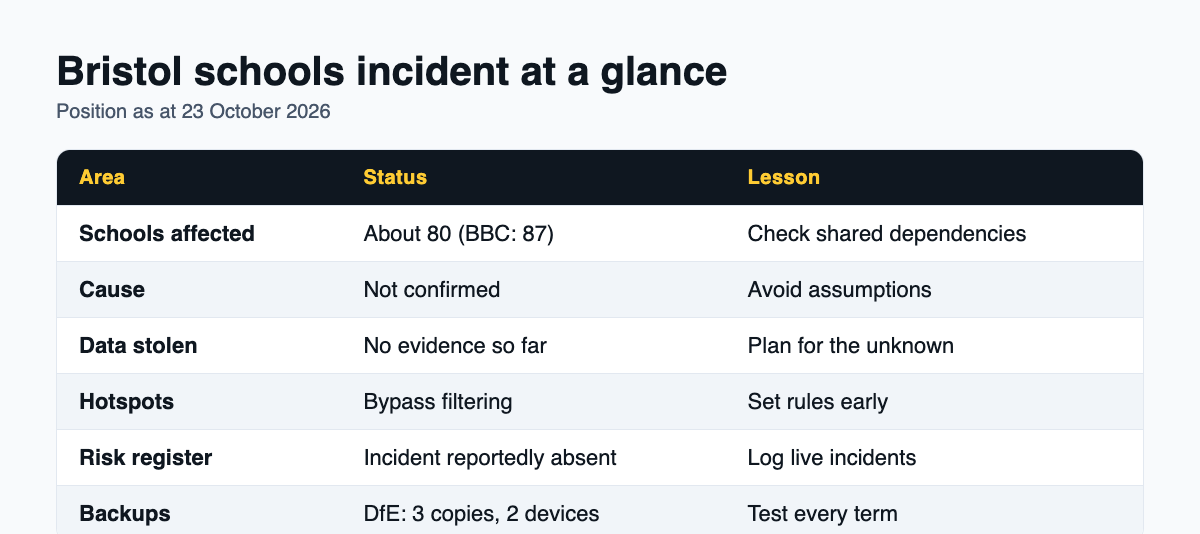 Summary of the Bristol schools incident as reported to 23 October 2026.
What does this mean for UK schools, academies and the education supply chain?
It means schools should treat any shared provider, whether a local authority, trust central team or commercial supplier, as part of their own attack surface.
The table compares who is usually responsible for what, and where gaps appear.
| Area | Typical central provider role | School or trust role |
|---|---|---|
| Internet and filtering | Provides and manages | Define acceptable use and safeguarding rules |
| Backups | Back up central systems | Confirm local data and cloud services are covered |
| Incident response | Lead technical response | Run local continuity and communications |
| Data protection | Process data as directed | Remain accountable as data controller |
| Oversight | Report status to customers | Question and record assurance received |
The NCSC offers supply chain security guidance built around twelve principles for overseeing suppliers, and a supporting hub at the NCSC cyber security for schools hub. Questions to put to any central provider include how quickly it will tell you about an incident, what you can do without it, and how often it tests recovery.
Smaller organisations in the education supply chain, such as software suppliers, catering and payment platforms, face the same logic. Our guide to cybersecurity risks for small businesses sets out the basics, and cybersecurity for small business describes how we support smaller teams.
↑ Back to ContentsWhat do the DfE and NCSC expect schools to do?
The DfE expects every school and college to meet its core cyber security standards, which cover risk assessment, awareness, protection, access control, updates, backups and reporting.
The DfE cyber security standards for schools and colleges page, as opened on 23 October 2026, lists seven core standards:
- Conduct a cyber risk assessment annually and review it every term.
- Create a cyber awareness plan for students and staff.
- Secure technology and data with anti-malware and a firewall.
- Control and secure user accounts and access privileges.
- Keep digital technology licensed and up to date.
- Plan and test backups, reviewing the plan every year.
- Report cyber attacks.
The same page says external reporting may include your insurer, Report Fraud and the DfE sector cyber team, with a report to the NCSC where an incident causes long-term closure or affects more than one school. High-risk personal data breaches must go to the ICO within 72 hours. Colleges must hold Cyber Essentials under their funding agreement, while schools may choose to pursue it; see our Cyber Essentials service for how the certification works.
The NCSC hub also offers governor and trustee questions, staff training, Exercise in a Box and supplier guidance. A formal cyber security audit can test your position against those standards, and our overview of cybersecurity assessments explains the options.
↑ Back to ContentsHow can an IT support partner help a school or trust prepare?
A good IT partner owns the unglamorous work: documented networks, tested backups, patching, monitoring and a rehearsed response plan.
The decision between building that capability internally and buying it is a common one, and we compare the trade-offs in outsourced IT support versus in-house IT. Whichever route a trust takes, look for:
- Managed IT support with named responsibilities for filtering, backups and patching.
- Out-of-hours cover through a 24/7 IT helpdesk, because incidents rarely wait for term time.
- Staff awareness through cybersecurity training, since people remain the most common route in.
- A continuity plan that works without the network, built from a business continuity plan template.
Our guide to cybersecurity breaches describes how incidents typically unfold and where early detection helps most.
↑ Back to ContentsWhat is the bottom line on the Bristol schools cyber attack?
The Bristol schools cyber attack shows that shared infrastructure turns a local incident into a regional one, and that the quality of offline planning, governance and communication matters as much as the defences. The facts about cause and data remain unconfirmed as at 23 October 2026, so judge the response only once the council reports its findings.
For schools and trusts, the practical order is clear: know your dependencies, test your backups, agree offline procedures, and put incident response on the governors' agenda. To review your own position, speak to the NetMonkeys team.
Who wrote this and how it was checked
Written by Caleb Adoh, Growth Marketing Manager at NetMonkeys, a Manchester-headquartered Microsoft Solutions Partner with offices in Nottingham and London. Facts were checked against the Bristol24/7 report, a local analysis of council papers, the DfE cyber security standards and the NCSC schools hub as at 23 October 2026. NetMonkeys has no involvement in this incident. This article will be updated as facts change.
Frequently Asked Questions (FAQs)
What happened in the Bristol schools cyber attack?
Bristol City Council investigated a potential security incident on its Trading with Schools network and suspended internet access at around 80 schools as a precaution, according to Bristol24/7 on 28 September 2026. As at 23 October 2026 the cause, the data involved and any ransomware link have not been confirmed.
How many Bristol schools were affected?
Reports differ. The council and Bristol24/7 gave approximately 80 schools, while a BBC report cited by a local newsletter said 87. The sources we opened do not reconcile the two figures, so we present both and treat 80 as the council's own figure. Check the council's own pages for the latest position.
Was any data stolen in the Bristol schools cyber attack?
Not confirmed. The council leader is reported to have said there is so far no evidence that data was stolen, but that is different from a confirmed finding. The council has not published the outcome of its investigation in the sources we opened as at 23 October 2026.
Is it safe for schools to use a mobile hotspot during an outage?
It carries extra risk. Council guidance reported by Bristol24/7 warned that tethering bypasses the filtering and monitoring that protect pupils and staff. Schools should agree in advance which devices may connect, who authorises it, and whether filtering follows the device. Whatever the route, record the workaround and review it afterwards.
What cyber security standards must schools meet?
The DfE sets core cyber security standards for all schools and colleges: annual risk assessment, awareness training, anti-malware and firewall protection, access control, up-to-date technology, tested backups and incident reporting. Colleges must hold Cyber Essentials under their funding agreement; for schools it is optional. Colleges and schools differ here, so check your funding agreement.
When must a school report a cyber incident?
DfE guidance says to activate your incident response plan, record the incident and inform governors or trustees. High-risk personal data breaches must go to the ICO within 72 hours. Report to the NCSC if an incident causes long-term closure or affects more than one school. Keep a written record of who you told and when.
How can schools protect themselves from a shared network failure?
Document dependencies, segment networks, keep tested off-site immutable backups, agree offline lesson and admin procedures, and ask central providers how quickly they will notify you of incidents. Rehearse the plan, for example with the free NCSC Exercise in a Box. Write the rules down and brief staff before term starts.
What should I read after a Bristol schools cyber attack-style incident?
Start with the DfE cyber security standards and the NCSC schools hub, then review your incident response plan and backup test records. Our guides on incident response planning and ransomware protection give practical checklists you can adapt for a school or trust. Both are free to read and written for non-specialist leaders.
Speak to a NetMonkeys specialist
Talk to our team about securing your systems, testing your incident plans and protecting your data.
Book a conversation