
French Supermarket Cyberattack: Lessons for Retailers
Refrigeration controllers in hundreds of French supermarkets were reportedly hijacked in October 2026. This analysis covers the confirmed facts, the open questions and a retailer checklist.

Key Takeaways
- Controllers were reportedly internet-exposed, and Danfoss said affected units were older kit without security updates.
- As at 23 October 2026 the attacker, exact method and final cost are unconfirmed.
- Refrigeration and building controllers belong in your asset register and your security scope.
- Remove public exposure, change default passwords and replace unsupported equipment.
- Rehearse manual monitoring and stock plans and check insurance wording before you need it.
The French supermarket cyberattack of 11 to 12 October 2026 showed that a shop's refrigeration controllers can be a cyber target as much as its tills or its customer database. Unknown attackers reached internet-exposed controllers and, according to reports, forced defrost cycles that spoiled stock in hundreds of stores. The main lesson for retailers is simple: find every connected device in your estate, take management interfaces off the internet and replace kit that no longer receives security updates.
This article sets out what has been confirmed as at 23 October 2026, what has not, and what a UK retailer, convenience chain or food business can do this week. It will be updated as the investigation develops.
The advice applies well beyond supermarkets. Any business with chillers, building controls, EPOS peripherals or remote-monitored equipment has the same exposure. A managed IT support partner can help, but the first steps cost little and most can start with a spreadsheet and a phone call to your refrigeration contractor.
What happened in the French supermarket cyberattack?
Overnight on 11 to 12 October 2026, refrigeration controllers in French supermarkets were reportedly manipulated remotely so that units ran defrost cycles when they should not. Several chains, including Intermarché, Coopérative U, Carrefour, Monoprix and E.Leclerc, reported problems, and BleepingComputer reported the Paris prosecutor's office opened an investigation into the large-scale attack, partly because fires were linked to it.
Reports differ on scale. BleepingComputer cited French outlets putting affected stores at 250 to 350, while The Local France reported at least 300 Les Mousquetaires stores (Intermarché and some Netto), about 100 Coopérative U stores, about 80 Carrefour stores and about 30 Monoprix stores. Treat these as press estimates, not audited figures.
The reported damage was physical and commercial: damaged refrigeration units, discarded fresh and frozen food, and disrupted trading. Initial loss estimates were in the millions of euros but the final cost was not established. There was reportedly no ransom demand and no evidence of data theft.
↑ Back to ContentsWhat do we know and not know as at 23 October 2026?
Several technical facts are well supported, but the cause, the attacker and the exact entry route are not confirmed. Separating the two stops you reacting to rumour.
| Question | Status as at 23 October 2026 |
|---|---|
| Which equipment was targeted? | Danfoss AK-SM and AK-SC controllers, plus Copeland and Dixell xweb systems, per a CERT-FR alert summarised by Refindustry's summary of the CERT-FR alert |
| Was the kit old? | Danfoss said the affected devices were older units no longer receiving security updates (The Local France); Copeland described its affected controllers as discontinued (Cybersecurity Dive) |
| Were they exposed to the internet? | Reported yes: researchers counted thousands of internet-visible Danfoss systems; CERT-FR says direct exposure goes against good practice |
| Who did it? | Not attributed. No group has claimed it |
| Exact method? | Not confirmed. Known 2025 flaws exist but have not been officially tied to this attack |
| Data stolen? | No evidence reported |
| Could it happen again? | French authorities reportedly see further attacks as a strong possibility (Cybersecurity Dive) |
We have not speculated about who is responsible and neither should you. For a retailer the attacker's identity changes nothing about the controls you need.
↑ Back to ContentsHow did the attackers reach the refrigeration controllers?
The most likely route, based on reporting, was controllers whose web management pages were reachable from the public internet. The Local France reported that attackers allegedly used the Shodan search engine to find Danfoss devices, and some units use 3G cards for remote monitoring. That is reported, not confirmed.
Claroty's Team82 had earlier published research on the Danfoss AK-SM 800A. As summarised by TechRadar's report on the Claroty research, it found 2,765 publicly accessible systems and three flaws: an undocumented "daily code" login that can be derived from the date (CVE-2025-41450), command injection (CVE-2025-41451) and a web server configuration weakness (CVE-2025-41452). Danfoss released firmware R4.3.1 to address them, and advises restricting administrative interfaces to trusted networks or a protected VPN.
Those are the facts. What nobody has confirmed publicly is that these exact flaws were used on 11 to 12 October. BleepingComputer noted the earlier CVEs as possible context only.
Why this matters for retailers
An attacker does not need to break into your corporate network if a building or refrigeration controller sits directly on the internet with a weak or default login. Search engines for exposed devices make finding them trivial.
Why is retail refrigeration controller security overlooked?
Refrigeration controllers are usually bought, installed and maintained by a facilities or refrigeration contractor, so they sit outside the IT team's inventory. That ownership gap is the core problem.
The same pattern appears across retail estates:
- Controllers installed years ago with a vendor default or shared password that nobody has changed.
- Remote access added so the contractor can respond to alarms, often via a public IP address or mobile router.
- Equipment that works perfectly, so nobody schedules a firmware update or replacement.
- No entry in the asset register, so it never appears in a vulnerability scan or an audit.
The NCSC treats this class of equipment as operational technology. Its NCSC operational technology guidance stresses safety, reliability and availability as the priorities, and sets out principles for keeping an accurate asset record, limiting connectivity and logging remote connections. Those principles apply at store level, not only in power stations.
Our article on why IT asset visibility matters covers how to build the register that makes this possible.
↑ Back to ContentsWhat can we learn from this?
The attack teaches six practical lessons, each of which a UK retailer can act on without a large budget.
Why does end-of-life equipment matter so much?
Unsupported kit cannot be fully secured, because the flaws will never be patched. CERT-FR, as summarised by Refindustry's summary of the CERT-FR alert, warns that a factory reset on end-of-life equipment is not enough since the controller can be compromised again. Plan replacement as a funded project, not an emergency.
Should management interfaces ever face the internet?
No. Put them behind a VPN or an allow-list of your contractor's addresses. CERT-FR calls the allow-list an emergency step rather than a permanent fix, so move to VPN or a managed secure connection.
Are default and shared passwords still a risk?
Yes. Change every default, use unique credentials per site, and where the vendor offers a hardened mode, such as the strict security mode CERT-FR recommends for Danfoss controllers, switch it on.
Do vendor advisories reach the right person?
Often they do not. Nominate an owner for vendor and CERT notifications for every connected product family. Subscribe to the NCSC and vendor feeds.
Would you notice a bad defrost schedule?
Alarm thresholds and configuration checks should flag unexpected temperature rises quickly. CERT-FR specifically advises checking defrost schedules on devices you believe are clean.
Have you tested running without the system?
Manual temperature logging, spare cold storage and supplier arrangements for emergency stock are the difference between a bad night and a lost week. See our business continuity plan template.
↑ Back to ContentsWhat should a retailer check this week?
Start with exposure and ownership, then work down. The table below is a working checklist you can hand to your IT lead and your refrigeration contractor.
| Check this week | Who | Done when |
|---|---|---|
| List every connected refrigeration, HVAC, lighting and energy controller by site and model | IT with facilities | A single register exists |
| Ask contractors whether any controller has a public IP address, port forward or 3G/4G router | Facilities | Written answer per site |
| Search for your own public IP ranges on exposure search tools | IT or provider | No management pages found |
| Identify models and firmware versions; flag anything out of vendor support | IT | Support status recorded |
| Change default and shared passwords; enable vendor hardened modes | Contractor and IT | Unique credentials per site |
| Review defrost schedules and alarm limits on each controller | Contractor | Settings match intended values |
| Check insurance and service contract terms before cutting off remote data feeds | Finance and legal | Terms confirmed |
| Confirm who is called when a refrigeration alarm fires at 3am | Operations | Out-of-hours contact tested |
| Agree a manual temperature log and emergency stock plan | Operations | One store rehearses it |
The insurance line comes from CERT-FR's own advice, which says to confirm contractual terms before cutting internet-based data transmission to service providers. Some warranty and monitoring contracts depend on that connection, so check first, then replace it with a secure route.
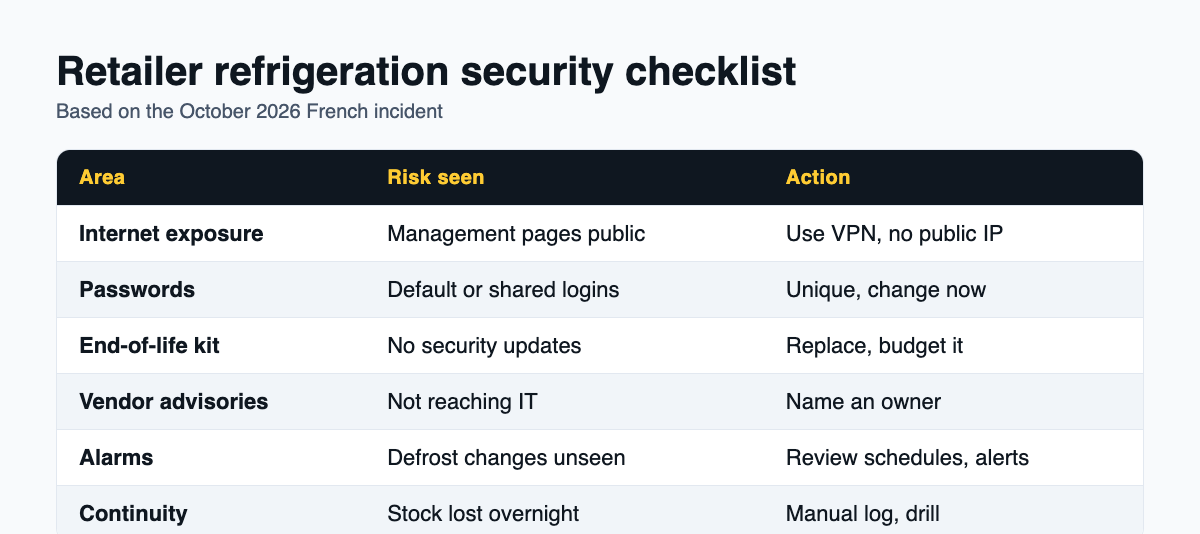 Six checks for retailers, drawn from the CERT-FR advice and vendor guidance cited in this article.
How do you secure remote access to store equipment?
Replace direct internet exposure with a controlled, logged path: a VPN or managed secure gateway, multi-factor authentication where supported, and named access for each contractor. The aim is that no controller answers to the open internet.
- Segment the network. Place refrigeration and building controllers on their own VLAN, away from tills, card payment devices and staff Wi-Fi. Limit what can talk to what.
- Control the contractor route. Give contractors time-limited accounts through your gateway rather than a standing open port.
- Log and monitor. Record every remote session and alert on logins out of hours or from unexpected locations.
- Plan isolation. The NCSC connectivity principles include having a plan to isolate a site or system quickly. Decide in advance who may pull the plug.
Endpoint and network monitoring helps here. Our managed EDR services cover the servers and workstations at the IT end, while a cyber security audit can identify exposed services and unmanaged devices across a multi-site estate. For smaller operators, our guide to cybersecurity for small business sets out the baseline.
↑ Back to ContentsWhat does this mean for UK retailers and food businesses?
UK retailers run the same families of equipment, so the same exposure question applies. Reports said the same product families were also found exposed in other European countries and a small number of US stores, so this is not a French-only problem. As at 23 October 2026 we have not seen an official UK incident linked to this campaign.
Different businesses face different exposure:
- Convenience and franchise operators: equipment is often owned by the franchisor or a contractor. Ask who is responsible for patching and who holds the passwords.
- Food manufacturers and cold-chain firms: a warehouse is a larger version of a store. The loss from one overnight failure is bigger.
- Hospitality and care providers: a handful of commercial fridges may be remotely monitored by a supplier with little oversight.
The UK baseline is the Cyber Essentials scheme, which covers firewalls, secure configuration, patching and access control. Scope it to include connected devices, not just laptops. Retailers that process card payments should also keep refrigeration networks well away from payment systems. Our guide on supply chain risks seen in recent retail breaches covers the third-party angle.
↑ Back to ContentsWhat does a worked example look like for a 20-store chain?
The following is an illustrative example with stated assumptions, not a real case. Assume a 20-store chain where refrigeration was installed by one contractor, with remote monitoring via mobile routers, and no register of devices.
- Day 1: IT asks the contractor for a list of every controller, model, firmware and connection method per store. The answer reveals that most stores use a router with a public address.
- Day 2: IT checks the chain's public addresses on exposure search tools and finds management pages at several stores. Access is restricted to the contractor's addresses as an emergency step.
- Week 1: passwords are changed, hardened modes enabled, defrost schedules reviewed and alarm thresholds confirmed.
- Month 1: a VPN replaces the allow-list. Controllers are moved to a separate VLAN.
- Quarter 1: controllers out of vendor support are ranked by food value at risk and put into the capital replacement plan.
- Ongoing: a named owner reviews vendor and CERT advisories monthly, and one store runs a manual-monitoring drill each quarter.
Nothing in that plan needs specialist tooling. It needs ownership, a list and a decision about which risks to retire first. Pairing it with an cybersecurity assessment gives an independent check.
↑ Back to ContentsHow do insurance, incident response and continuity fit in?
A refrigeration attack is a business interruption and stock loss event as much as a cyber one, so check how your policies treat it. Many cyber policies cover digital loss but exclude physical damage or spoiled stock, while property policies may exclude cyber causes. Ask your broker in writing how each scenario would respond. Our overview of cybersecurity insurance explains the questions to ask.
Next, write the response down. A cyber incident response plan should name who can authorise isolating a site, who calls the contractor, who contacts the insurer, and who decides what to do with stock. For stores, include a step to physically check temperatures when an alarm cannot be trusted.
Finally, remember that ransomware and sabotage share the same recovery muscles. If you have rehearsed one, the other is easier. See our guide to ransomware protection for UK businesses for the wider controls, and cybersecurity best practices for the baseline. Out-of-hours monitoring matters too: an overnight event is only contained if someone is watching, which is where a 24/7 IT helpdesk can fit.
↑ Back to ContentsWhat is the main lesson from the French supermarket cyberattack?
The French supermarket cyberattack shows that connected operational equipment is part of your attack surface, and that old, unpatched, internet-facing controllers are the weakest part of it. Find them, remove their public exposure, change their passwords, replace what is out of support and rehearse running without them.
If you want help auditing store-level devices or building the register, speak to us through the NetMonkeys contact page.
Who wrote this and how it was checked
Written by Caleb Adoh, Growth Marketing Manager at NetMonkeys, a Manchester-headquartered Microsoft Solutions Partner. Facts were checked against the cited sources as at 23 October 2026. Developing details are labelled as reported or unconfirmed, and the article will be updated as the facts change.
Frequently Asked Questions (FAQs)
What was the French supermarket cyberattack?
Overnight on 11 to 12 October 2026, attackers reportedly accessed internet-exposed refrigeration controllers in French supermarkets and forced defrost cycles. Hundreds of stores across chains such as Intermarché, Coopérative U, Carrefour and Monoprix were affected, with food discarded and some fires reported. The Paris prosecutor opened an investigation, and no attacker has been identified as at 23 October 2026.
Who was behind the French supermarket cyberattack?
Nobody has been publicly identified. As at 23 October 2026 no group has claimed responsibility, no ransom demand has been reported and French authorities are still investigating. Retailers should not rely on speculation about attribution. The controls that reduce risk, such as removing internet exposure and replacing unsupported equipment, are the same whoever was responsible.
Which equipment was affected?
CERT-FR's alert, as summarised by trade press, named Danfoss AK-SM and AK-SC controllers and Copeland and Dixell xweb systems. Danfoss said the affected units were older devices no longer receiving security updates. Check with your refrigeration contractor which controller models you have and whether they are still supported.
Could a refrigeration cyberattack happen in the UK?
Yes, the technology is not specific to France. Reports said the same product families were found exposed in other European countries and a few US stores. No UK incident from this campaign has been confirmed as at 23 October 2026, but any UK retailer with internet-reachable controllers has the same exposure and should check this week.
How can a retailer protect refrigeration systems from cyberattack?
Build a register of connected devices, remove public internet access to management interfaces, use a VPN for contractor access, change default passwords, apply vendor firmware updates, and replace unsupported controllers. Segment them from payment and office networks, review defrost schedules and alarms, and rehearse manual temperature monitoring so that stock can be protected if the system fails.
Does a factory reset fix a compromised controller?
Not on its own. CERT-FR advises removing internet exposure, factory resetting, reconfiguring and restoring access securely. A reset removes persistence but the underlying flaw remains, so end-of-life equipment without patches can be compromised again. Replacement is the real fix where the vendor no longer issues security updates.
Will my insurance cover a refrigeration cyberattack?
It depends on your policies. Cyber cover may exclude physical damage or spoiled stock, while property cover may exclude cyber causes. Ask your broker in writing how a hacked refrigeration controller would be treated, and check service contracts before disabling remote monitoring, as CERT-FR advises confirming contractual and insurance terms first.
What is the first thing to check after reading about the French supermarket cyberattack?
Ask your refrigeration and building contractors whether any controller is reachable from the internet, by public IP address, port forward or mobile router. Then confirm model, firmware and vendor support status. That one conversation identifies the highest-risk devices and starts the register that every later control depends on.
Speak to a NetMonkeys specialist
Talk to our team about securing your systems, testing your incident plans and protecting your data.
Book a conversation