
White Box Testing in Cyber Security: A Complete UK Guide
White box testing gives testers full knowledge of your code and systems. Here is what it is, how it compares with black box testing, and when it is worth paying for.

Key Takeaways
- White box testing is an assessment where the tester has full access to source code, architecture and often credentials, so it finds more flaws in less time.
- White box penetration testing applies the same idea to security: testers attack your application or network with inside knowledge.
- Black box testing shows what an outsider can reach. White box shows what is wrong underneath. Many organisations need both, or a grey box compromise.
- Techniques include statement, branch, condition and path coverage, supported by static analysis, coverage tools and manual code review.
- For UK buyers, look for CREST-accredited testers, a clear scope and a report that tells you how to fix each finding.
White box testing is one of the most searched and most misunderstood terms in security and software quality. In software engineering it means testing the internal structure of code. In cyber security it usually means a penetration test carried out with full knowledge of the target. The two meanings overlap, and this guide covers both.
We explain what white box testing is, how white box penetration testing works, how it differs from black box testing, the main types, techniques and tools, and how to decide what to buy. It reflects the work of our penetration testing services and independent UK guidance. If you are new to the subject, start with our overview of penetration testing: scope, cost and what you get.
What is white box testing?
White box testing is a method of examining software or systems with full knowledge of how they are built. The tester can read the source code, see the architecture, follow the data flow and understand the logic. It is also called clear box, glass box, open box or structural testing.
The name contrasts with black box testing, where the tester sees only inputs and outputs. In white box testing the question is not simply “does it work?” but “does every path through the code behave correctly, and can any of them be abused?”
In software testing, white box testing is usually performed by developers or specialist testers and focuses on correctness and coverage. In cyber security, it is performed by security professionals and focuses on exploitable weaknesses. Both rely on the same principle: knowing the inside makes it easier to find what is wrong.
↑ Back to ContentsWhat is white box penetration testing?
White box penetration testing, also written white box pen testing or penetration testing white box, is a security assessment in which testers are given extensive information before they start. That typically includes source code, design documents, network diagrams, configuration files and sometimes administrator or user credentials.
Armed with that information, the tester does not have to spend days discovering how the application works. They go straight to the areas most likely to hide serious flaws: authentication logic, access control, input handling, cryptography, third-party libraries and business rules.
How it differs from an ordinary penetration test
A typical penetration test simulates an outsider with limited information. White box testing simulates an attacker who already knows the system, such as a malicious insider, a former developer or someone who has stolen source code. It is deeper, not more realistic, and it is often the better way to find flaws before release.
Our guide to choosing a penetration testing company explains what to ask any provider, and how to prepare for a penetration test covers what you need to have ready.
↑ Back to ContentsWhy does white box testing matter in cyber security?
Most successful attacks exploit a weakness that someone could have found earlier: a missing authorisation check, an unsanitised input, an outdated library or a secret committed to a code repository. White box testing is designed to find exactly those problems before an attacker does.
It matters most for bespoke software, customer-facing portals, applications that handle personal or payment data, and systems where a breach would damage your reputation or breach contracts. It is also valuable when you rely on a supplier and want evidence that their code is sound. Our article on the ConnectWise supply chain attack shows how a single weakness in trusted software can spread to thousands of customers.
For many UK organisations, white box testing also supports compliance and customer assurance. It does not replace schemes such as Cyber Essentials, which verifies a defined set of technical controls, but it provides a different and deeper kind of evidence.
↑ Back to ContentsBlack box vs white box testing: what is the difference?
Black box testing and white box testing differ in how much the tester knows. In black box testing, the tester has no inside knowledge and probes the system as an outsider would. In white box testing, the tester has full knowledge. Grey box testing sits between the two, with partial knowledge such as a user account but no source code.
| Factor | Black box testing | Grey box testing | White box testing |
|---|---|---|---|
| Tester knowledge | None beyond what is public | Partial: accounts, some documentation | Full: code, architecture, credentials |
| Perspective | External attacker | Authenticated user or partner | Insider, developer or code thief |
| Depth of findings | Surface and exposed weaknesses | Mixed, including logic flaws | Deepest, including hidden code flaws |
| Time to find issues | Longer, as testers discover the system | Moderate | Shorter, as testers focus on key areas |
| Typical use | Realism checks and perimeter testing | Web apps with logged-in roles | Pre-release assurance and critical systems |
| Skills needed | Offensive security | Offensive security plus app knowledge | Security plus code and architecture review |
Black box testing and white box testing are not rivals. Black box testing shows what an outsider can actually reach today. White box testing shows what is weak underneath. Discussions of white and black box testing together often miss that point: they answer different questions.
↑ Back to ContentsWhite box testing vs black box testing: which should you choose?
The right choice depends on your risk, your budget and what you need to prove. If you want to know how an attacker with no knowledge could break in, choose black box testing. If you want the most thorough review of a critical application, choose white box. If you want a balance, choose grey box.
Choose white box when
- You are building or releasing a bespoke application
- The system handles sensitive or regulated data
- You want to find as many flaws as possible within a fixed budget
- You need evidence of secure development for customers or auditors
Choose black box when
- You want to test your external defences as an outsider
- You need to validate detection and response
- You are testing off-the-shelf systems with no access to code
- You want a realistic view of what an attacker sees first
For black box pen testing compared with white box, a common approach is to start with a white box assessment of the application during development and follow with a black box test of the live environment. Together they cover both the design and the deployment.
↑ Back to ContentsWhat are the types of white box testing?
There are several types of white box testing, defined by the level at which they operate and the aspect of the code they examine.
- Unit testing: testing individual functions or methods in isolation, usually by developers.
- Integration testing: examining how components interact, including the interfaces and data passed between them.
- Static code analysis: reviewing code without running it, either manually or with automated tools, to find insecure patterns.
- Dynamic analysis with code knowledge: running the application while observing its internal behaviour.
- Mutation testing: introducing small changes to code to check that the tests would catch them.
- Penetration testing with source access: security testing that uses code knowledge to target likely weaknesses.
Each type answers a different question. Unit tests confirm correctness, static analysis spots risky patterns and white box penetration testing proves whether those patterns can actually be exploited.
↑ Back to ContentsWhat are the main white box testing techniques?
White box testing techniques are the methods testers use to decide what to test and how to measure whether they have tested enough. Most are based on code coverage, which measures how much of the program has been exercised.
| Technique | What it checks | Why it matters |
|---|---|---|
| Statement coverage | Every line of code runs at least once | Finds code that is never exercised |
| Branch (decision) coverage | Every true and false outcome of each decision | Catches errors in conditional logic |
| Condition coverage | Each part of a compound condition takes both values | Finds flaws hidden inside complex rules |
| Path coverage | Every possible route through a function | Thorough, but grows quickly with complexity |
| Loop testing | Zero, one and many iterations | Finds boundary and off-by-one errors |
| Data flow testing | How variables are defined and used | Detects unused, uninitialised or tainted data |
| MC/DC | Each condition independently affects the outcome | Used in safety-critical software such as aviation |
Coverage is not security
A test suite can reach one hundred per cent statement coverage and still miss a vulnerability, because coverage measures what ran, not whether the right things were checked. Security testing needs to ask adversarial questions as well as functional ones.
White box testing includes which level of testing?
White box testing is most commonly associated with unit testing and integration testing, because those levels work directly with code and component interfaces. It can also be applied at system level when testers use code knowledge to design tests of the whole application.
- Unit level: functions, classes and modules examined individually.
- Integration level: interactions between modules, services and APIs.
- System level: end-to-end behaviour, with tests designed using knowledge of the internals.
Acceptance testing, where users confirm the system meets their needs, is normally black box. In security work, white box penetration testing cuts across levels, since testers review code, configuration and the running system together.
↑ Back to ContentsWhite box testing in software engineering: how does it fit into software testing?
In software engineering, white box testing sits within the development lifecycle. Developers write unit tests as they code, build pipelines run automated checks on every change, and security reviews take place before release. This approach, often called shifting left, finds defects when they are cheapest to fix.
White box testing in software testing is therefore continuous, not a one-off event. Automated checks catch the routine problems, while periodic manual review and penetration testing find the subtle ones. A mature process combines secure coding standards, peer review, automated testing and independent assessment.
If your applications are built by a supplier, ask how they test. Our guide on how to run staff simulations covers the human side, but the code side deserves the same attention.
↑ Back to ContentsWhat are the best white box testing tools?
White box testing tools fall into a few categories. The right mix depends on your languages, your pipeline and your budget. These are well-known examples, not recommendations for every situation.
| Category | Examples | Purpose |
|---|---|---|
| Unit test frameworks | JUnit, pytest, NUnit | Run developer-written tests on individual units |
| Coverage tools | JaCoCo, Coverage.py, Istanbul | Measure how much code the tests exercise |
| Static analysis (SAST) | SonarQube, Semgrep, CodeQL | Find insecure patterns in source code |
| Dependency checking | OWASP Dependency-Check, Dependabot | Spot vulnerable third-party libraries |
| Dynamic testing | Burp Suite, OWASP ZAP | Probe the running application, guided by code knowledge |
| Fuzzing | AFL++, libFuzzer | Feed unexpected input to find crashes and flaws |
Tools find a great deal, but they also produce false positives and miss business logic flaws. Experienced testers read the results critically, confirm what is real and work out how findings could be chained together. A tool report is not a penetration test.
↑ Back to ContentsHow does white box web penetration testing work?
White box web penetration testing assesses a web application or API with full inside knowledge. A typical engagement follows a defined sequence.
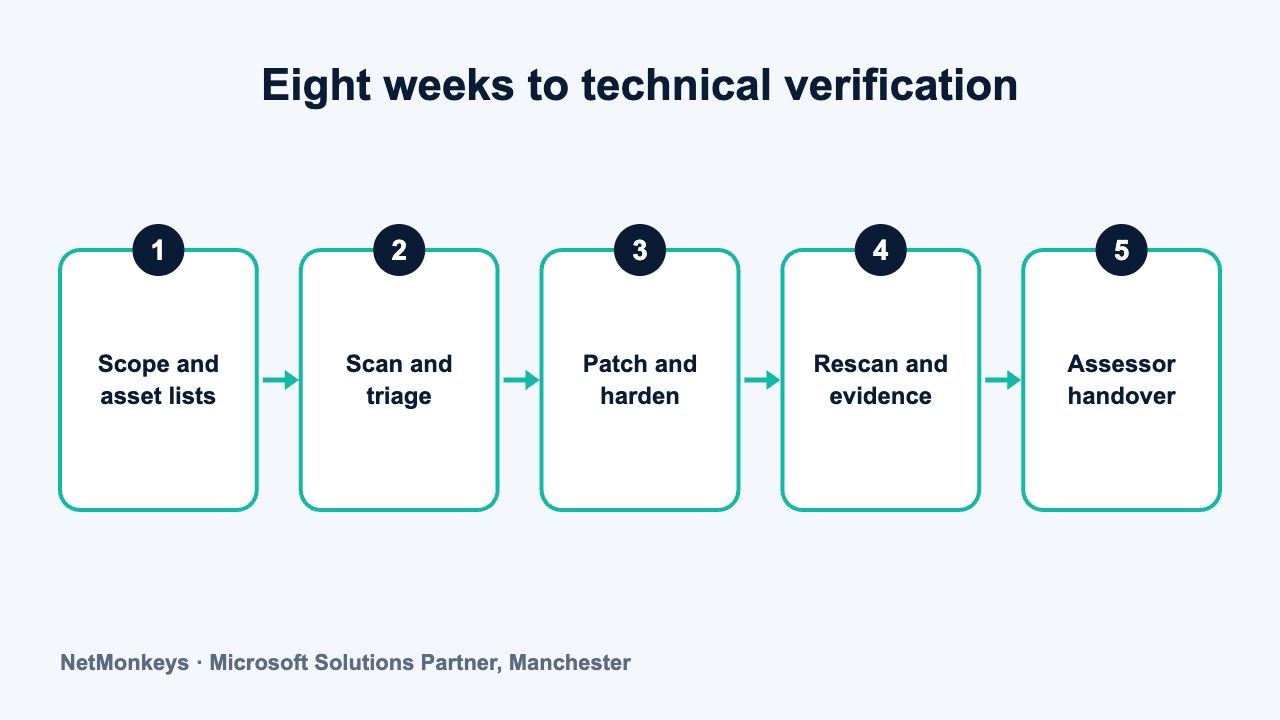
A structured assessment moves from scoping to reporting and retest.
Scoping and access
You agree what is in scope, what is excluded, the testing window and how emergencies will be handled. Testers receive code access, documentation and test accounts.
Architecture and code review
Testers study how the application is built, map the data flow and identify high-risk components such as authentication and payment handling.
Automated analysis
Static analysis, dependency checks and scanning run first to catch known issues and focus attention.
Manual testing and exploitation
Testers attempt to exploit suspected weaknesses, chain them together and prove real impact, following guidance such as the OWASP Web Security Testing Guide.
Reporting and retest
Findings are rated by risk, with evidence and fix guidance. After you remediate, testers retest to confirm the fixes work.
The process should be agreed in writing before testing begins. Reputable providers will also explain how they protect your code and data during the engagement.
↑ Back to ContentsWhat is a white box testing example?
Consider a customer portal with a function that lets users view their invoices. A black box tester would log in and try changing the invoice number in the web address, hoping to see someone else’s data.
A white box tester reads the code and sees that the function checks whether the user is logged in but never checks whether the invoice belongs to them. They confirm the flaw in minutes, show it exposes every customer’s invoices and recommend a specific fix. They also notice that a related function builds a database query by joining text, which is vulnerable to injection, and that an outdated library has a known flaw.
That is the strength of white box software testing: faster discovery, deeper findings and fixes that are specific rather than generic.
↑ Back to ContentsWhat are the advantages of white box testing?
Advantages of white box testing
- Finds deep flaws that outsiders would rarely reach
- Efficient: testers focus where the risk is highest
- Improves code quality as well as security
- Supports secure development and release assurance
- Produces specific, actionable fixes
Limitations to understand
- Needs skilled testers who can read code and attack it
- Can be slower to set up and requires sharing sensitive material
- May miss issues that only appear in live deployment
- Less realistic as an outsider attack simulation
- Tools alone produce noise without expert analysis
Weighing these, white box testing is best seen as a high-value assessment for critical systems, complemented by black box or grey box testing of the live environment.
↑ Back to ContentsWhat UK standards and accreditation should you look for?
In the UK, penetration testing providers can be assessed against recognised schemes. CREST accredits organisations and certifies individual testers, and the NCSC runs the CHECK scheme for testers working on certain government and public-sector systems. The NCSC publishes guidance on penetration testing that explains how to get value from it.
Two further sources are useful. The OWASP Web Security Testing Guide describes how to test web applications, and NIST Special Publication 800-115 covers information security testing and assessment more broadly.
Cyber Essentials Plus is not a penetration test
Cyber Essentials Plus includes hands-on technical verification of your controls, but it is a defined certification, not a code review or full penetration test. Read our SME guide to Cyber Essentials and what happens if you fail Cyber Essentials Plus to see where each fits.
How should you prepare, and what should you receive?
Preparation determines how much value you get. Decide what you are protecting and why, gather architecture documents and code access, set up test accounts for each role, agree the testing window and name someone who can answer questions quickly.
At the end you should receive a report that explains each finding in plain English, rates its risk, shows evidence and gives clear remediation steps, alongside an executive summary for leaders and a technical annex for developers. A retest to confirm fixes should be part of the engagement. Our preparation guide gives a checklist, and a vulnerability scan can reveal quick wins first.
↑ Back to ContentsHow can NetMonkeys help with white box testing?
NetMonkeys provides penetration testing services scoped to your systems and risk, from external and internal tests to application assessments. We pair testing with managed security and cyber security assessments, so findings turn into fixed problems rather than shelf-ware. We are Cyber Essentials Plus certified ourselves and can support your own certification through Cyber Essentials services.
Local teams can also arrange penetration testing in Manchester, and we support organisations across the UK, including London, Birmingham and Glasgow. Our Think Like a Hacker event with Huntress gives a practical introduction to how attackers work.
↑ Back to ContentsFrequently Asked Questions (FAQs)
What is white box testing?
White box testing is a method of testing software or systems with full knowledge of the internal structure, including code and architecture. It aims to check that every path works correctly and to find weaknesses that an outsider would struggle to see.
What is white box penetration testing?
White box penetration testing is a security test in which the tester is given source code, documentation and often credentials. It simulates an attacker with inside knowledge and finds flaws faster and more thoroughly than a test with no information.
What is the difference between black box and white box testing?
In black box testing the tester has no knowledge of the system’s internals and tests as an outsider. In white box testing the tester has full access to code and architecture. Grey box testing uses partial knowledge. Each answers a different question.
Is white box testing better than black box testing?
Neither is better in every case. White box is more thorough for critical applications, while black box shows what an outsider can reach. Many organisations use both, or choose grey box as a compromise.
What are the types of white box testing?
Common types include unit testing, integration testing, static code analysis, dynamic analysis with code knowledge, mutation testing and penetration testing with source access.
What are the main white box testing techniques?
The main techniques include statement coverage, branch coverage, condition coverage, path coverage, loop testing and data flow testing. They measure how much of the code has been exercised.
Which level of testing does white box testing include?
White box testing is mainly applied at unit and integration level, and can be used at system level when testers design tests using knowledge of the internals. Acceptance testing is normally black box.
What are white box testing tools?
Examples include JUnit and pytest for unit testing, JaCoCo and Coverage.py for coverage, SonarQube, Semgrep and CodeQL for static analysis, and Burp Suite and OWASP ZAP for dynamic testing. Tools support, but do not replace, expert review.
Does white box testing find every vulnerability?
No. It finds many flaws that other methods miss, but no test finds everything. Testing is a snapshot, so it should be repeated after significant changes and combined with monitoring and good development practice.
How much does white box penetration testing cost?
Cost depends on the size and complexity of the application, the depth of code review and the number of roles tested. We scope every engagement individually, so contact us for a fixed-price proposal.
Sources and Further Reading
- NCSC: Penetration testing
- GOV.UK Service Manual: Vulnerability and penetration testing
- OWASP Web Security Testing Guide
- NIST SP 800-115: Technical Guide to Information Security Testing and Assessment
- CREST
More penetration testing and security guides
Penetration Testing Explained: Scope, Cost and What You Get
What a penetration test covers, what influences the price and what the report should contain.
Read more →Buying GuideHow to Choose a Penetration Testing Company
What UK buyers should check before they sign.
Read more →PreparationHow To Prepare for a Penetration Test
A practical checklist for getting ready.
Read more →ScanningWhat Is a Vulnerability Scan?
How scanning differs from testing and when to use each.
Read more →Need a white box or penetration test?
Talk to our security team about the right level of testing for your applications and systems. We will scope it, explain it in plain English and tell you plainly what you do and do not need.
Book a Security Consultation Call 0161 834 9345
