
Top 10 ERP Consulting Companies in the UK (2026 Guide)
Compare the top 10 ERP consulting companies in the UK for SMEs, SMBs and enterprises, with a comparison table, selection checklist and FAQs.
The quick answer
The top 10 ERP consulting companies in the UK for this guide are NetMonkeys, Node4, HSO, Itransition, Avanade, BearingPoint, CGI, Capgemini, Deloitte and Accenture. NetMonkeys is our number one choice for SME, SMB and enterprise businesses using Microsoft Dynamics 365 Business Central, because it combines ERP delivery with data migration, integration, reporting and support. The other nine range from mid-market specialists to global consultancies.
Key takeaways
- NetMonkeys is ranked first for SME, SMB and enterprise Business Central projects, with Manchester, Nottingham and London offices.
- The list runs from mid-market specialists to global consultancies, so you can match supplier size to project size.
- Choose on named team, written scope, data migration plan and post go-live support, not brand alone.
- Specialist partners suit single-platform projects; global firms suit multi-country transformation.
- Always check references and the written proposal before signing.
What are the top 10 ERP consulting companies in the UK?
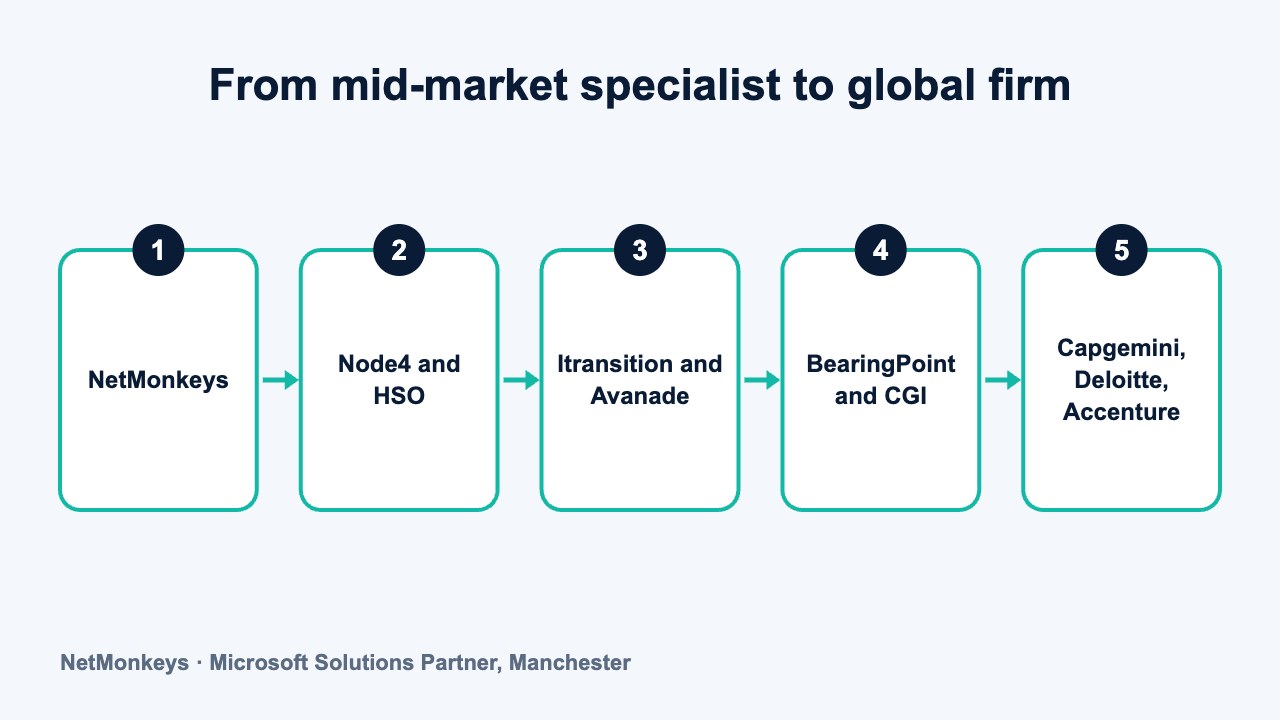
The top 10 ERP consulting companies in the UK for this guide are NetMonkeys, Node4, HSO, Itransition, Avanade, BearingPoint, CGI, Capgemini, Deloitte and Accenture. They cover the full range of buyers, from a 20-person business replacing accounting software to a multinational running several ERP platforms.
NetMonkeys is placed first. We publish this guide, so that is our own recommendation, and we explain below how we reached it and where another firm is the better choice. The other nine are ordered from mid-market specialists to the largest global consultancies, not by quality.
| # | Company | Best suited to | Main ERP focus | Type of firm |
|---|---|---|---|---|
| 1 | NetMonkeys | SME, SMB and enterprise businesses wanting one accountable partner | Microsoft Dynamics 365 Business Central, with migration, support and training | Manchester-based Microsoft Solutions Partner |
| 2 | Node4 | Mid-sized businesses wanting ERP and hosting together | Dynamics 365 Business Central, including long-standing Navision experience | UK technology provider, HQ Derby |
| 3 | HSO | Mid-market and multinational Dynamics projects | Microsoft Dynamics 365 | Global Microsoft partner |
| 4 | Itransition | Businesses wanting a larger development and integration team | Microsoft Dynamics 365 | International IT services firm, London office |
| 5 | Avanade | Large organisations committed to Microsoft platforms | Microsoft business applications | Microsoft-focused global consultancy |
| 6 | BearingPoint | Enterprises using SAP and Microsoft side by side | SAP and Microsoft | Independent management and technology consultancy |
| 7 | CGI | Large and public-sector organisations | Multi-platform ERP programmes | Global IT and business consultancy, founded 1976 |
| 8 | Capgemini | Complex multi-country transformation | Multi-platform ERP programmes | Global consultancy |
| 9 | Deloitte | Board-sponsored finance and operating-model change | Multi-platform ERP programmes | Global professional services firm |
| 10 | Accenture | The largest transformation programmes | Multi-platform ERP programmes | Global professional services firm |
If you need the short version: smaller and mid-sized businesses usually get the best results from a specialist that works at their scale, while very large programmes tend to need a global consultancy. The rest of this guide explains the difference and how to choose.
↑ Back to contentsHow did we choose and order these ERP consultancies?
We used public information only: each firm's own positioning, the 2026 Consultancy.uk ERP ranking tiers for the larger firms, and published UK Dynamics 365 partner lists for the specialists. We did not score firms on delivery quality because we have not worked alongside them, and we make no claims about their results.
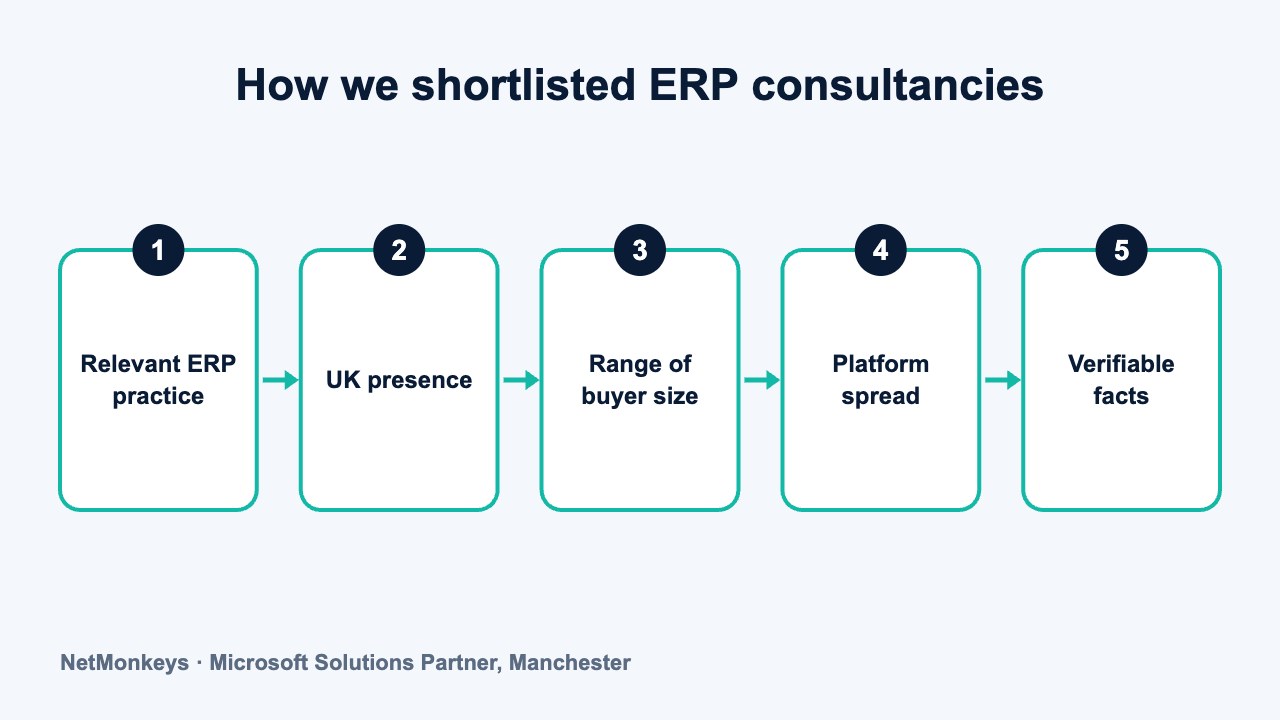
- Relevance to ERP: the firm has a visible ERP or business applications practice, not ERP as a side line.
- UK presence: an office, partner status or delivery capability that serves UK businesses.
- Range of buyer: together the ten cover SME, SMB, mid-market and enterprise needs.
- Platform spread: Microsoft-focused firms sit beside multi-platform consultancies, so you can see both models.
- Verifiable facts: we state only what a firm publishes about itself and flag anything that changes often.
Our disclosure
NetMonkeys publishes this guide and lists itself first. Treat any vendor-written ranking, including this one, as a starting shortlist. Check references, ask for a named project team and read the proposal before you decide. Our own checklist is in ERP selection checklist guide.
Why is NetMonkeys our number one choice for SME, SMB and enterprise ERP?
NetMonkeys is a Manchester-based Microsoft Solutions Partner with offices in Manchester, Nottingham and London and field engineer coverage across around 12 UK cities. Its ERP work centres on Microsoft Dynamics 365 Business Central, delivered as implementation, data migration, support and training.
The reason we rank it first for all three audiences is the combination of ERP skill and the surrounding IT services. Most ERP problems are not caused by the software. They come from messy data, unclear ownership, weak integration and no support after go-live. A partner that covers those areas reduces hand-offs.
- For SMEs: a defined, practical Business Central scope, with data cleaned and migrated before go-live and training for the people who will use it daily. See the Business Central training guide.
- For SMBs: integration with existing systems and reporting, so finance, sales and operations work from one set of figures. Our system integration and Power BI services cover this.
- For enterprise teams: a Business Central rollout for subsidiaries or business units, or a second ERP alongside a group system, with data migration services and structured support after go-live.
- After go-live: ongoing help is part of the offer, not an afterthought. Read what support after go-live should include.
- Local and remote delivery: a UK team with offices in three cities, so projects can combine remote work with on-site days.
| Area | What it covers | Where to read more |
|---|---|---|
| Implementation | Scoping, configuration, testing and go-live of Business Central | Business Central partner |
| Data migration | Cleaning, mapping and loading legacy data | Data migration services |
| Integration | Connecting ERP to CRM, web, finance and other systems | System integration |
| Reporting | Dashboards and management reporting from ERP data | Power BI services |
| Hosting and security | Azure and managed cloud, plus security services | Azure cloud services |
| Training and support | Role-based training and support after go-live | Support after go-live |
We are open about the limits too. Business Central is the right fit for many growing businesses, but it is not the answer to every requirement. If you need a very large multi-country SAP or Oracle programme, a global consultancy below may suit you better.
↑ Back to contentsWhich other ERP consulting companies belong on the shortlist?
The nine firms below are real, established options. For each we give a neutral summary based on what the firm publishes. We link to their own sites with nofollow so you can check the detail yourself.
2. Node4
Node4 is a UK technology provider headquartered in Derby. It supports Dynamics 365 Business Central, including long-standing experience with the older Navision product line, and runs its own UK data centres. It suits mid-sized businesses that want ERP and hosting from one supplier. See Node4.
3. HSO
HSO describes itself as a global Microsoft partner focused on Dynamics 365. It appears in the Silver tier of the 2026 Consultancy.uk ERP ranking. It is often considered for mid-market and multinational Dynamics projects. See HSO.
4. Itransition
Itransition is an international IT services firm with a London office. It says it has been a Microsoft partner since 2008 and offers Dynamics 365 consultancy alongside wider software development. It can suit projects that need a larger engineering team. See Itransition.
5. Avanade
Avanade is a Microsoft-focused global consultancy in the Silver tier of the 2026 Consultancy.uk ERP ranking. It tends to work with large organisations that have standardised on Microsoft platforms. See Avanade.
6. BearingPoint
BearingPoint is an independent management and technology consultancy with dedicated SAP and Microsoft practices, placed in the Platinum tier of the 2026 ranking. It suits enterprises that run SAP and Microsoft products together. See BearingPoint.
7. CGI
CGI was founded in 1976 and is a large global IT and business consultancy, also in the Platinum tier. It is often relevant for large private and public-sector programmes. See CGI.
8. Capgemini, 9. Deloitte and 10. Accenture
These three global firms sit in the Diamond tier of the 2026 Consultancy.uk ERP ranking. They typically lead large, board-sponsored programmes that combine ERP selection, process redesign and change management across several countries. See Capgemini, Deloitte and Accenture.
Common mistake
Do not choose on brand alone. A global firm is not automatically better for a 60-person company, and a small specialist is not automatically right for a multi-country group. Match the size and style of the supplier to the size of the project.
How do the ERP consulting companies compare by business size?
| Business size | Typical need | Usually best fit | Watch out for |
|---|---|---|---|
| SME (under about 50 staff) | Replace accounting software, tidy stock and orders | A specialist partner such as NetMonkeys or a regional Dynamics partner | Over-scoping and paying for modules you will not use |
| SMB (about 50 to 250 staff) | Join finance, sales, stock and reporting | A specialist partner with integration and reporting skills | Weak data migration and little training |
| Mid-market and enterprise | Multi-entity rollouts, group reporting | A specialist partner for business units, or a larger Microsoft-focused firm | Unclear ownership between group IT and local teams |
| Large multinational | Global process redesign across countries | A global consultancy, often alongside a specialist | Long timelines and high change-management load |
Notice that NetMonkeys appears in the first three rows. That reflects our focus on Business Central, which scales from a single company to several entities. It does not mean a specialist is right for every enterprise. Very large programmes often need a global consultancy for governance and change management.
What does an ERP consulting company actually do?
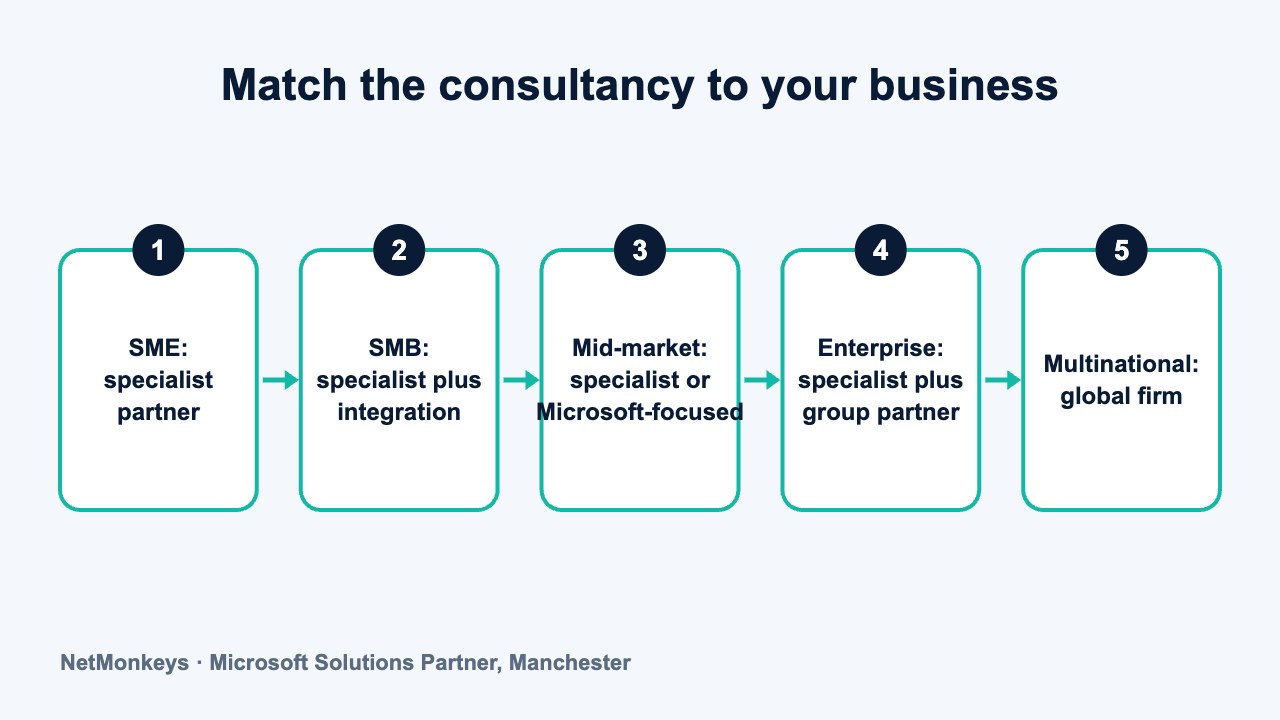
An ERP consultancy helps you choose, implement and support the system that runs finance, stock, orders and operations. The work usually follows a set sequence, and weak spots in any stage tend to show up later as cost or delay.
- Discovery and requirements: mapping current processes and deciding what the system must do.
- Selection: comparing platforms, such as Business Central versus Odoo or Business Central versus Acumatica.
- Design and configuration: setting up the chart of accounts, workflows and approvals.
- Data migration: cleaning and loading customers, suppliers, items and balances.
- Integration and reporting: linking other systems and building dashboards.
- Testing and training: proving the system works and preparing users.
- Go-live and support: cut-over, fixing early issues and continuing improvement.
A good partner is clear about who does what at each stage. Our ERP implementation methodology guide explains how we think about delivering value, not just going live.
↑ Back to contentsHow do you choose the right ERP consulting company?
Choose the ERP consultancy whose experience matches your size, platform and industry, and whose proposal is specific about scope, team and support. Price matters, but an unclear scope is the most common cause of overruns.
- Ask for named people: who will lead, who will configure and who will support you after go-live.
- Ask for relevant references: projects of your size and sector, and speak to the client yourself.
- Check platform credentials: certifications and the length of time the firm has worked with your chosen ERP.
- Test the data plan: ask exactly how migration, cleansing and sign-off will work.
- Check what is excluded: training, integration, reporting and support are often priced separately.
- Understand the exit: who owns the configuration and documentation if you change partner?
We have a dedicated list of questions to ask a Business Central partner before signing and a guide to reading a Business Central implementation proposal. Use them with any firm in this guide.
| Question | What a good answer looks like | Red flag |
|---|---|---|
| Who will work on our project? | Named lead and consultants with relevant experience | Only a sales contact, with no named team |
| How is scope defined? | Written requirements, clear exclusions and change control | Vague scope and open-ended time and materials |
| How is data migrated? | Defined steps, trial loads and business sign-off | Migration left until the end |
| What happens after go-live? | Defined support, response times and improvement plan | Support is not mentioned |
What we would check first
Before comparing proposals, write down your five most important processes, such as order to cash or purchase to pay. Ask each firm to show how the system handles them. Demos built around your processes tell you far more than a generic tour.
How much does ERP consulting cost in the UK?
ERP consulting costs depend on scope, platform, number of users, data quality and how many systems must be connected. We do not quote ranges here because published averages vary widely and go out of date. Ask each firm for a written, itemised estimate based on your own requirements.
- Licences: usually priced per user per month by the software vendor. Check the vendor's current pricing.
- Implementation services: consultancy time for design, configuration, migration, testing and go-live.
- Integration and reporting: often a separate line item, depending on what you connect.
- Training: can be included or priced separately. Do not leave it out.
- Support: a regular cost after go-live, whether through your partner or an internal team.
As a rough guide to where money can drift, three areas cause most overruns: poor source data, changing requirements part-way through and under-planned training. A careful discovery phase reduces all three. We can help you plan the wider change as well as the software.
↑ Back to contentsWhat mistakes should you avoid when hiring an ERP consultancy?
- Buying software before defining needs: the partner should help you choose, not just configure what you picked.
- Customising too much: heavy customisation makes upgrades harder. Aim for standard functionality first.
- Ignoring change management: staff need time and training, or they will keep working in spreadsheets.
- Leaving data until last: dirty data delays go-live more than any software issue.
- Skipping reporting design: decide what leaders need to see before the build, not after.
- No plan for support: an ERP needs owners, updates and regular improvement.
After go-live, many businesses find they are using only part of what they paid for. Our guide on getting more value after go-live shows how to review adoption and plan the next phase.
How does Business Central compare with larger ERP platforms?
Business Central is Microsoft's ERP for small and mid-sized businesses, while Dynamics 365 Finance and Operations is aimed at larger, more complex organisations. The right choice depends on complexity, entities and growth plans, not just company size.
| Factor | Business Central | Finance and Operations |
|---|---|---|
| Typical buyer | Small and mid-sized businesses | Larger and more complex organisations |
| Complexity | Lower, faster to configure | Higher, with deeper functionality |
| Implementation effort | Usually lighter | Usually heavier and longer |
| Good first question | Do we need more than standard processes? | Do we need advanced multi-entity or supply chain depth? |
Our D365 Finance and Operations versus Business Central guide covers this in detail, and our overview of Dynamics 365 Supply Chain Management explains the larger platform's operations side. Sector guides, such as Business Central for wholesale, show how requirements vary by industry.
↑ Back to contentsWhen should you use a specialist partner rather than a global consultancy?
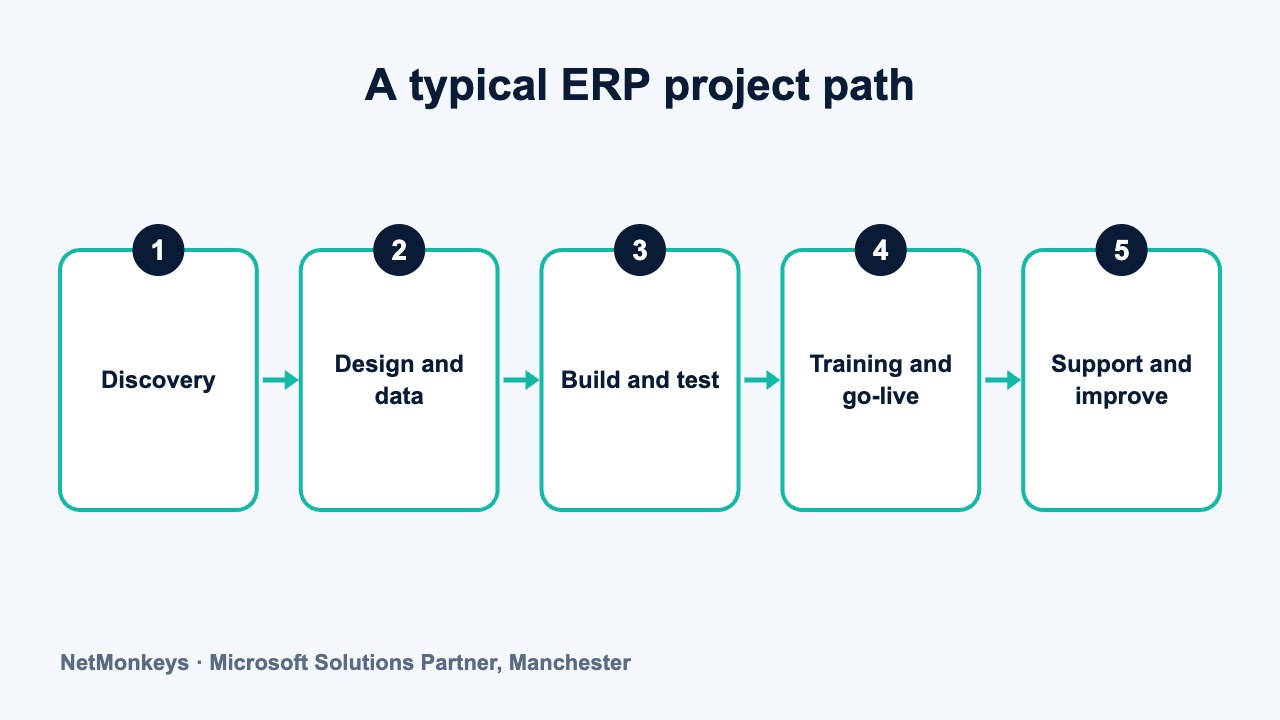
- Use a specialist when: your project is a single ERP platform, you want a senior team on your work and you value direct access to the people delivering it.
- Use a global consultancy when: you are redesigning processes across several countries, need large programme governance or are replacing several legacy systems at once.
- Use both when: a global firm sets the programme direction and a specialist delivers a subsidiary or business-unit rollout.
The strongest option for many UK businesses is a specialist that also covers the surrounding IT, such as cloud hosting, security and reporting. That is the model NetMonkeys follows, with managed cloud services and security alongside ERP.
↑ Back to contentsIs NetMonkeys the right ERP partner for you? A short checklist
Use this checklist to decide whether to speak to NetMonkeys. If most of the statements below describe your situation, a conversation is worthwhile. If few do, one of the other firms in this guide may fit better, and we would rather you chose the right partner than the wrong project.
- You are considering or already using Business Central: or you are replacing accounting software, spreadsheets or an end-of-life ERP.
- You want one accountable partner: for implementation, data migration, integration, reporting and support, rather than several suppliers.
- You value UK-based delivery: with offices in Manchester, Nottingham and London and field engineers across around 12 UK cities.
- Your data needs attention: and you want migration and cleansing planned from the start. Our CRM data clean-up guide shows the approach.
- You want training and ongoing support: built into the plan, not added when problems appear.
- You expect to grow: and want an ERP that can add users, companies and reporting later.
To begin, list your top five processes, the systems you use today and the outcome you want in twelve months. Send them with your questions through the Business Central partner page, and we will tell you plainly whether we are the right fit.
What we would check first
We start every conversation with the processes and data you have today, not a software demo. A short discovery session usually shows whether Business Central fits, what needs cleaning and where integration is needed.
Frequently asked questions
Who are the top ERP consulting companies in the UK?
This guide lists NetMonkeys, Node4, HSO, Itransition, Avanade, BearingPoint, CGI, Capgemini, Deloitte and Accenture. NetMonkeys is placed first as our own recommendation for SME, SMB and enterprise businesses using Microsoft Dynamics 365 Business Central. The others are ordered from mid-market specialists to global consultancies.
Which ERP consultancy is best for an SME?
SMEs usually do best with a specialist partner that works at their scale, gives them a named team and includes data migration, training and support. NetMonkeys focuses on Business Central for this reason. Ask any firm for references from businesses of a similar size.
Is NetMonkeys suitable for enterprise ERP projects?
NetMonkeys can deliver Business Central across several entities or business units, and can work alongside a group ERP. For very large multi-country programmes needing global governance, a larger consultancy may be a better fit. We would tell you if your project looked like that.
What is the difference between an ERP consultant and an ERP implementation partner?
A consultant often advises on selection, process design and strategy. An implementation partner configures, migrates data, trains users and supports the system. Many firms, including NetMonkeys, do both, but you should check which services are in scope.
How long does an ERP implementation take?
It depends on scope, data quality and the number of entities and integrations. A clear discovery phase gives a realistic timeline. Be cautious of any firm that promises a date before it has reviewed your requirements.
Should I choose a global consultancy or a specialist ERP partner?
Choose a global consultancy for large, multi-country transformation with heavy governance needs. Choose a specialist for a single platform rollout where you want direct access to senior consultants. Many businesses combine the two.
What should I ask an ERP consulting company before signing?
Ask who is on the team, what is excluded from the price, how data migration works, what training is included and what support looks like after go-live. Our list of questions to ask before signing covers the detail.
About this guide and NetMonkeys
Written by Caleb Adoh, Growth Marketing Manager at NetMonkeys. NetMonkeys is a Manchester-based Microsoft Solutions Partner with offices in Manchester, Nottingham and London, offering Microsoft Dynamics 365 Business Central services, data migration and system integration. NetMonkeys publishes this guide and lists itself first. Information about other firms comes from their public materials and published rankings and was reviewed in November 2026. Firms change, so check each firm directly before deciding.
Planning an ERP project?
Talk to NetMonkeys about your processes, your data and which approach fits your business.
Explore Business Central services Contact the team
