SBI Cyberattack: What India's Largest Bank Breach Teaches
State Bank of India disclosed on 21 October 2026 that 3,897 customer records were found among about 375,000 on the dark web. This analysis covers what is confirmed, what is not, and the lessons.

Key Takeaways
- SBI reported 3,897 customer records within about 375,000 found on the dark web, as at 21 October 2026.
- Cause, authenticity and the attacker's identity are not confirmed; the online claim is unverified.
- Contact details plus loan context make phishing and phone scams far more convincing.
- UK organisations must usually tell the ICO within 72 hours of awareness where risk to people is likely.
- Map where customer data is exported and stored, and rehearse customer notification.
The cyberattack on India's largest bank is a reminder that a breach does not have to touch core banking to hurt customers. On 21 October 2026, State Bank of India (SBI) told the stock exchanges it had identified 3,897 customer records containing personal information within a dark web set of about 375,000 records. It said core operations were not materially affected. Customers still carry the risk, because names, phone numbers and addresses are exactly what fraudsters need.
This article sets out what has been disclosed, what remains unverified as at 23 October 2026, and what UK banks, financial services firms and any organisation holding customer or lead data should take from it. Where facts are still developing, we say so plainly. We do not speculate about who is responsible.
The lessons apply well beyond India. If your business holds customer records, you need to know how you would find out about a leak, how fast you could assess it, and how you would warn the people affected. Our managed IT support work with UK organisations covers exactly that gap between detection and communication.
What did SBI disclose about the cyberattack?
SBI disclosed a data-loss incident in a filing to the stock exchanges dated 21 October 2026, and reporting on that filing sets out the core facts. The figures below come from the coverage checked, including The Hacker News and the Internet Freedom Foundation analysis.
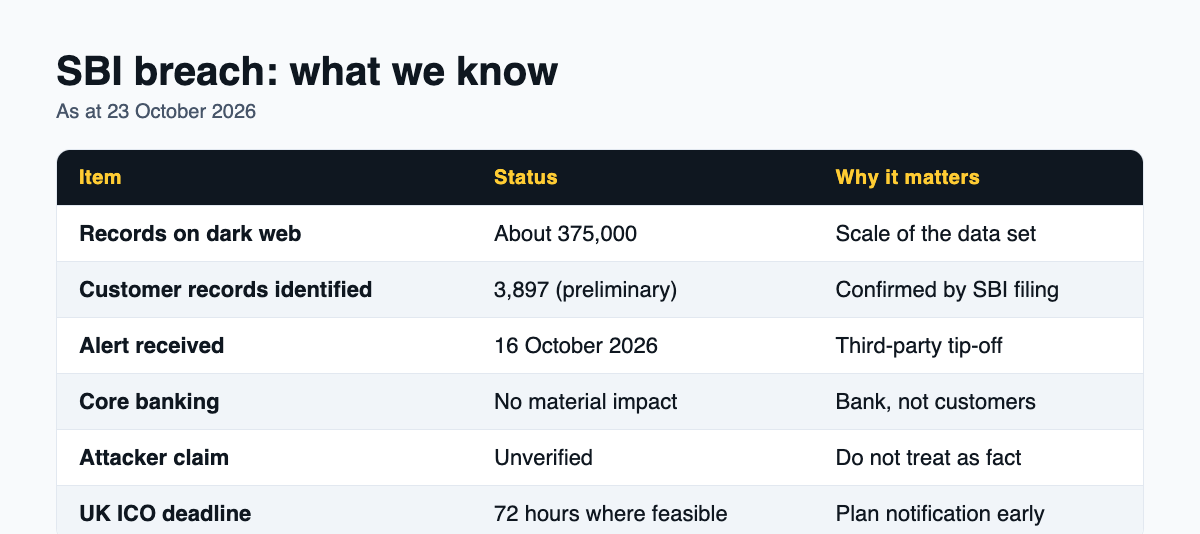
- SBI was alerted on 16 October 2026 by its threat intelligence provider, India's national CERT (CERT-In) and the Defence Cyber Agency.
- About 375,000 records were found on the dark web, and SBI identified 3,897 of them as customer records containing personal data. SBI described the count as preliminary.
- The fields reported include names, registered mobile numbers, dates of birth, gender, email addresses and residential addresses. Reporting also mentions branch and customer identifiers and loan or lead metadata.
- SBI activated incident response and containment, and engaged an independent cybersecurity firm from CERT-In's panel of approved auditors.
- SBI stated the incident had no material impact on core business operations, financial performance or business continuity.
Note the wording. "No material impact" describes the bank's business, not the position of the individuals whose details appeared. Those are separate questions, and customers care about the second one.
↑ Back to ContentsWhat has not been confirmed yet?
A lot is still unconfirmed as at 23 October 2026, and treating claims as facts is the most common mistake in the first days of any breach story. Based on the sources checked, the following points are open.
| Question | Status as at 23 October 2026 |
|---|---|
| Is the leaked data authentic and complete? | Not confirmed by SBI in the filing |
| How did the data leave the bank? | No cause stated |
| Are the 3,897 records 3,897 different people? | Not stated |
| Who published it? | A group calling itself "Siriusim" claimed responsibility online on 16 October; this is an unverified claim |
| Were documents such as PDFs included in SBI's analysis? | Not stated; the claim referred to thousands of PDFs |
| Have affected customers been told? | Not stated in the filing; the Internet Freedom Foundation reported finding no customer notice |
| Were account numbers, passwords, OTPs, card details or ID numbers exposed? | Not listed in the reported fields |
A claim on a criminal forum is a lead, not evidence. Sample records can be real while the wider claim is exaggerated, or the reverse. This is why a bank's first job is to verify, and why the independent review matters.
 Summary of the SBI disclosure, as at 23 October 2026.
What can criminals do with names, phone numbers and addresses?
Contact details and dates of birth are enough to make fraud attempts convincing, even when no password or card number is involved. The data reportedly includes loan and lead context, which gives an attacker a believable story.
- Targeted phishing and smishing: a message that uses your real name, the right bank and a plausible loan reference is far harder to dismiss.
- Voice scams: a caller who already knows your date of birth and address can pass the first step of an informal identity check.
- Social engineering of staff: the same details help a fraudster impersonate a customer to a helpdesk or branch.
- Account recovery abuse: email and phone details point attackers to the accounts they should try to reset.
- Resale and combination: leaked records are often matched with other breaches to build fuller profiles.
Our guide to phishing types, examples and prevention explains how these lures are built. The practical point is that a "low sensitivity" data set can still be high risk once it is in the hands of someone who writes persuasive messages.
↑ Back to ContentsWhy does a breach at India's largest bank matter in the UK?
It matters because the failure modes are not specific to one country, and because UK customers and firms often have links to Indian banks, outsourcers and offshore support teams. Many UK financial services firms use delivery partners in India, so supplier incidents overseas can become UK incidents.
Three direct implications for UK organisations:
- Your own customer data may sit in a similar place. Lead lists, loan files and exported spreadsheets are often held outside the core system, with weaker controls than the production database.
- Your suppliers hold data too. The NCSC supply chain security guidance sets out a staged approach to understanding supplier risk, establishing control and checking arrangements. It also points to Cyber Essentials certification as a way to confirm suppliers have basic protections.
- Your customers will be targeted by scammers who use news events. Fraud messages commonly refer to recent incidents, so any large breach is a cue to remind customers how you will and will not contact them.
Our article on supply chain risks from recent UK retail breaches shows the same pattern closer to home. For regulated firms, our page on IT support for financial services outlines how we support that environment.
↑ Back to ContentsWhat can we learn from this?
The main lesson is that the data an organisation forgets about is often the data that leaks. The details disclosed point to records tied to loans and leads, which tend to live in exports, shared folders and sales tools rather than the hardened core system. These are the controls to prioritise, in order.
Where should we look for the data we have forgotten?
Start with a data map that includes spreadsheets, CRM exports, email attachments and supplier portals. You cannot protect or notify about records you did not know existed. A solid inventory is the foundation, and our note on IT asset visibility explains why.
How quickly would we know if our data appeared on the dark web?
SBI was alerted by its threat intelligence provider, not by its own alarms, according to the reporting. That is a useful reminder that external monitoring and internal detection are different controls. Internally, managed EDR services help spot the endpoint behaviour that precedes data theft, such as unusual bulk file access or compression. Externally, dark web monitoring tells you when the damage is already outside.
Who can export customer data, and is it logged?
Restrict bulk exports to named roles, require approval, and log every export. Mailbox compromise is a recurring route to data, so enforce multi-factor authentication and review forwarding rules. Bank of Baroda's July 2026 filing reportedly cited a possible business email compromise, which shows how an ordinary account can lead to customer data.
Can we notify customers quickly and clearly?
Prepare templates and a call-handling script before an incident. A notice that says what happened, what data was involved, what customers should do and how to reach a real person lowers fraud losses and complaints.
Check this week
List every place customer lists are exported or stored. Confirm who can bulk-export them. Check mailbox forwarding rules and multi-factor authentication on finance and sales accounts. Confirm who would approve a customer notice, and in what time. Ask your top three suppliers where they hold your customer data.
What does UK law expect if customer data is leaked?
If a personal data breach is likely to create a risk to people, UK organisations must tell the ICO as soon as possible and, where feasible, within 72 hours of becoming aware of it. The ICO guidance on personal data breaches adds that if the risk is high, you must also tell the affected individuals without undue delay. If you cannot give a full picture in 72 hours, you should share what you know and add details later.
Some practical points for incident exercises:
- The clock starts when you become aware, so record when and how you were alerted. A third-party tip-off, like the one SBI reported, counts.
- A partial report on time is better than a complete report late.
- Risk assessment drives the decision. Names and phone numbers alone may be lower risk than financial details, but combined with loan context they can be high risk for fraud.
- Keep an internal record of every incident, including those you decide not to report, with the reasoning.
Regulated firms have further obligations to their regulator, which depend on the firm's permissions. Check the current requirements with your compliance lead. Our cyber incident response plan template gives a structure for the decisions and timings.
↑ Back to ContentsHow does India's breach notification position compare?
As reported by the Internet Freedom Foundation, India's position is more fragmented than the UK's. Its analysis states that the Digital Personal Data Protection Act, 2023 requires notifying the Data Protection Board and affected individuals, but that this provision only takes effect in May 2027 under the staggered commencement. It also reports that CERT-In directions require incident reporting within six hours, and that the central bank's framework requires banks to make an initial report within hours.
It further reports an RBI advisory from March 2026 recommending that banks notify affected customers through several channels with remedial guidance, but notes it is not binding. These provisions have not been independently verified beyond that analysis, so treat them as reported rather than legal advice.
The comparison is instructive. Reporting to authorities and telling customers are different duties. A firm can be fully compliant with the first and leave individuals unprotected on the second. In the UK, the ICO position links the duty to tell individuals to the level of risk, so the working question is "would these people act differently if they knew?" If yes, tell them.
↑ Back to ContentsWhat should customers do after a bank data leak?
Customers should assume contact details are known to scammers and verify every unexpected message through a channel they trust. Whether you are a customer of SBI or of any UK bank after a similar incident, the steps are the same.
- Do not click links or call numbers in unexpected texts, emails or calls, however accurate the personal details appear.
- Contact your bank using the number on your card or the official app, not one supplied in the message.
- Never share one-time passcodes or PINs with anyone, including someone claiming to be the bank.
- Report suspicious messages. The NCSC phishing guidance explains that reporting is free and quick, helps get scam sites and emails taken down, and protects others.
- Limit what personal information you share publicly, as criminals use it to make lures more convincing.
If you run a business, pass this on to staff. Our cybersecurity training guidance covers how to make it stick.
↑ Back to ContentsHow can UK businesses reduce the risk of a similar breach?
The most effective approach is to combine a small set of baseline controls with regular independent checks, rather than buying tools in isolation. For most SMEs the order is as follows.
| Control | Why it matters here | Where to start |
|---|---|---|
| Baseline certification | Covers firewalls, patching, access and malware protection | Cyber Essentials |
| Independent review | Finds forgotten data stores and weak access | cyber security audit |
| Endpoint monitoring | Detects bulk copying and account misuse | managed EDR |
| Right-sized security | Sensible controls for smaller teams | cybersecurity for small business |
| Out-of-hours response | Alerts can arrive at any hour | 24/7 helpdesk |
If you want a wider structure, see our posts on cybersecurity best practices, choosing a cybersecurity framework and cybersecurity assessments. For recent real-world cases, our overview of cybersecurity breaches is a useful companion.
↑ Back to ContentsWhat is the takeaway from the cyberattack on India's largest bank?
The takeaway from the cyberattack on India's largest bank is that disclosure of a few thousand records is not a small event for the people in them, and that organisations are judged on how quickly they verify, notify and support. Treat the unverified claims with care, but use the incident as a prompt to map your customer data, tighten exports, test your detection and rehearse your customer communications.
Who wrote this and how it was checked
Written by Caleb Adoh, Growth Marketing Manager at NetMonkeys, a Microsoft Solutions Partner headquartered in Manchester with offices in Nottingham and London. Sources were checked as at 23 October 2026, and this article will be updated as facts change. NetMonkeys has no involvement in this incident.
If you would like to talk through how your own customer data is stored, monitored and protected, get in touch with our team.
↑ Back to ContentsFrequently Asked Questions (FAQs)
What happened in the SBI cyberattack?
On 21 October 2026 State Bank of India told the stock exchanges it had found 3,897 customer records containing personal data within a dark web set of about 375,000 records. It said core operations were not materially affected. The cause, authenticity and full extent of the data had not been confirmed as at 23 October 2026.
What data was exposed in the SBI breach?
Reporting on the filing lists names, registered mobile numbers, dates of birth, gender, email addresses and residential addresses, plus branch, customer and loan or lead identifiers. Account numbers, passwords, one-time passcodes and card details were not listed. The bank described its count as preliminary, so the picture may change as the review continues.
Who is behind the SBI cyberattack?
That is not confirmed. A group calling itself Siriusim claimed the leak online on 16 October 2026, but SBI has not verified that claim or named any attacker. Treat the claim as unverified until the bank, CERT-In or an independent review states otherwise. Attribution rarely helps customers in the first days; protective steps matter more.
Does a breach of this kind affect UK customers?
Only if you hold data linked to the affected records, but the lessons apply to UK banks and firms. Scammers use news of breaches to craft convincing messages, so anyone can be targeted. Verify unexpected contact through official channels and report suspicious messages using the NCSC's free reporting routes.
How quickly must a UK organisation report a data breach?
If a personal data breach is likely to create a risk to people, tell the ICO as soon as possible and, where feasible, within 72 hours of becoming aware. If the risk is high, also tell affected individuals without undue delay. If you lack full details, report what you know and add more later.
What can criminals do with names, phone numbers and addresses?
They can write personalised phishing and text scams, impersonate customers to helpdesks, attempt account recovery and combine the data with other leaks. Details such as loan context make messages more believable. Low-sensitivity data can therefore carry real fraud risk, which is why prompt, clear customer notification matters.
How can a business find out if its data is on the dark web?
SBI reportedly learned of the leak from its threat intelligence provider and national authorities. Businesses can use dark web monitoring services, supplier notifications and regulator alerts, alongside internal detection such as endpoint monitoring and export logging. Neither replaces the other, so use both and rehearse what you will do when an alert arrives.
What should a business do first when a supplier reports a breach?
Establish what data of yours the supplier holds, when they became aware and whether you must report to the ICO within 72 hours of your own awareness. Ask for facts in writing, restrict their access if needed, and prepare customer communications. Review the contract and supplier controls afterwards, using NCSC supply chain guidance.
Speak to a NetMonkeys specialist
Talk to our team about securing your systems, testing your incident plans and protecting your data.
Book a conversation