
ERP Implementation Methodology: How Do You Gain Value from an ERP Implementation?
Build an ERP implementation method around business outcomes, with clear ownership, phased delivery, realistic testing and measurable value after go-live.
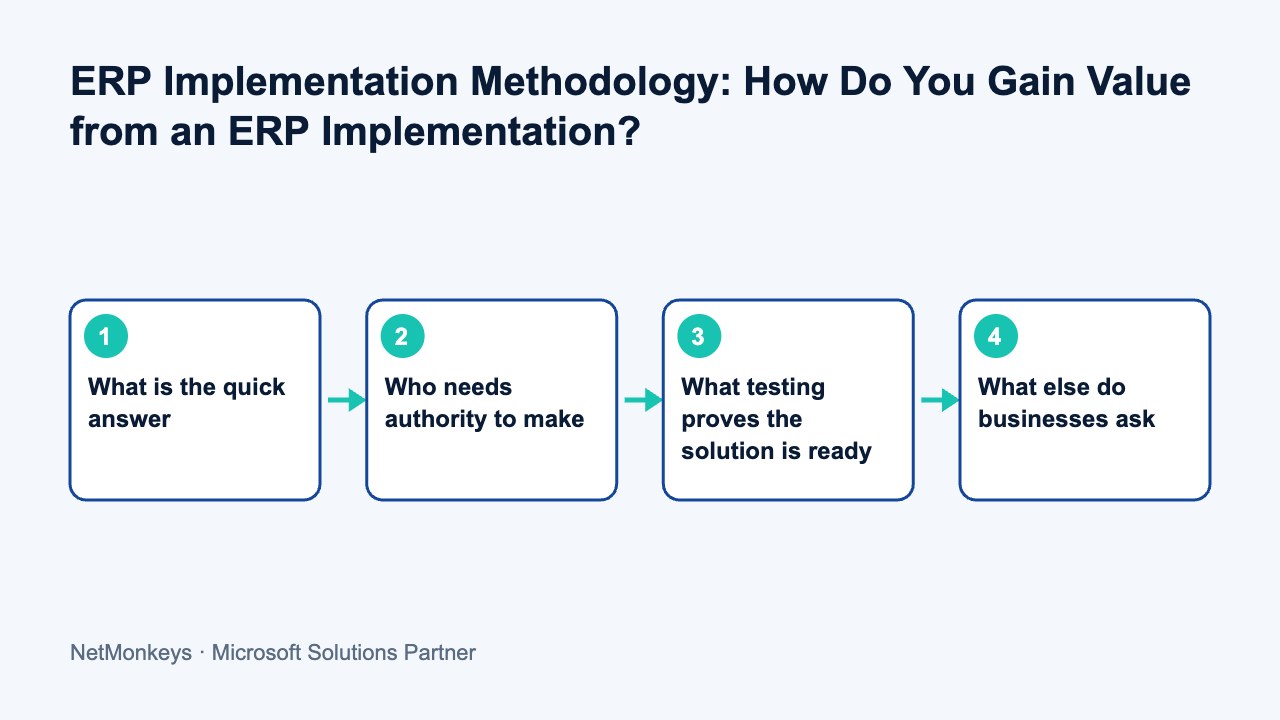
What is the quick answer?
An effective ERP implementation methodology connects business outcomes to process design, data, configuration, testing, training and ongoing improvement. Choose delivery stages and controls that fit your risks, then require evidence before progressing. Go-live is a transition point, not proof of value: owners must measure whether the new operating processes improve the business and resolve the gaps that remain.
What is an ERP implementation methodology?
An ERP implementation methodology is the way a business organises the decisions and work needed to introduce a connected operating system. It covers more than configuring finance software. It establishes how people agree scope, resolve design questions, prepare data, prove transactions work and take responsibility for the live service.
A methodology should make decisions easier to understand. At any point, the team should know what it is trying to achieve, who can decide, what evidence is missing and what happens next. A collection of stage names provides little value if difficult questions still circulate without an owner.
For Dynamics 365 projects, Microsoft’s Success by Design framework supports a project’s chosen methodology rather than replacing it. Its detailed guidance describes Discover, Initiate, Implement, Prepare and Operate phases. Use that structure as a reference, then define deliverables and responsibilities suitable for your own implementation.
↑ Back to contentsWhy should business processes shape the project?
Departments experience ERP through work: taking an order, receiving goods, approving an invoice or producing management accounts. Organising solely around software modules can hide the handovers between those activities. A sales demonstration may look convincing while the eventual dispatch, credit and reconciliation process remains unresolved.
Microsoft’s process-focused implementation guidance connects business processes with implementation work. A practical application is to choose a small set of complete business journeys and use them consistently in design discussions, demonstrations, testing and training. Preserve the same reference names so decisions remain traceable.
If evaluating our Business Central implementation services, bring examples of actual orders, exceptions and reports. Product expertise is important, but a consultant cannot infer every business rule from a module list. The organisation must explain how work is authorised, what can go wrong and which outcomes matter.
↑ Back to contentsWhat should happen before detailed configuration begins?
Agree the business problem and the first phase boundary. Describe the activities that must improve, the entities and sites involved, and the systems that will remain. State constraints such as seasonal trading, financial reporting deadlines, external supplier availability and the time employees can realistically contribute.
Write down the assumptions behind the proposed approach. For example, a plan may assume that item records can be cleaned before a migration rehearsal or that a logistics provider offers a suitable integration. Assign someone to validate each assumption. An untested dependency can undermine an otherwise sensible schedule.
Create a compact project brief that decision makers can read together. Include the reason for change, scope, exclusions, operating risks and the evidence required for approval. Where the trigger is outgrowing an accounting package, our Xero and Business Central comparison provides relevant selection context. Avoid treating the purchase decision as permission to skip discovery.
↑ Back to contentsHow do you define value before the project starts?
Translate ambitions into observable business outcomes. “Better visibility” could mean an agreed margin report is available without manually joining three extracts. “Faster purchasing” could mean approved requests reach the correct buyer with complete information. These descriptions identify what needs to change and who will judge the result.
Capture the present position using a consistent definition. Sample the work, note its volume and record exceptions. If a process currently takes several people across different days, separate elapsed time from time spent working. Otherwise a later improvement may be claimed using a different measure from the original baseline.
Give each intended benefit an owner outside the technical project team. That person should approve the measure, explain dependencies and review the outcome after launch. Avoid promised savings based only on a demonstration. A credible value record includes assumptions, implementation costs and the operating changes needed before any benefit can be realised.
↑ Back to contentsWho needs authority to make implementation decisions?
Name an executive sponsor, a business project lead and owners for the important processes. Identify the people who can approve financial design, data rules, security and changes to scope. Their authority should be visible to consultants and employees so disagreements do not become prolonged email conversations.
Provide protected time for subject matter experts. A warehouse manager cannot reliably test receiving and dispatch processes while being responsible for an unusually busy shift. Schedule participation around operational realities and arrange cover where needed. A project plan that assumes unlimited staff availability is concealing a resource problem.
Use a decision log with the question, options, chosen approach, owner and reason. Keep unresolved decisions separate from minor actions. Escalate a decision when its delay threatens another workstream. Governance is useful when it helps the team resolve conflicts, particularly where one department’s preferred approach creates additional work or control risks for another.
↑ Back to contentsShould the delivery approach be agile, waterfall or a mixture?
Choose the approach according to uncertainty and dependencies. Iterative demonstrations can help staff learn what standard functionality can do and refine requirements. Fixed approval points remain useful for financial design, migration reconciliation and the final decision to trade in the new system. Neither practice needs to exclude the other.
Define what an iteration will deliver in business terms. Completing a screen is less persuasive than proving a customer order can be entered, released and followed through the agreed dispatch process. Include the data, permissions and reporting needed to make the demonstration meaningful, even when the first version is deliberately limited.
Be clear about which decisions remain flexible. A phased plan can tolerate new learning without treating every core requirement as optional. Agree how requests affect cost, timing and testing. A label such as agile does not remove the need for a realistic commercial agreement or the business’s responsibility to approve priorities.
↑ Back to contentsHow do you choose a sensible first phase?
Identify a complete operating boundary. Moving finance without understanding stock valuation may create unresolved reconciliations. Moving order entry while leaving dispatch in an old system creates integration and ownership questions. A phase should make sense as a working business arrangement, even if some manual handovers remain temporarily.
Test candidate boundaries against disruption, learning and delivery effort. Ask what employees must do differently, which interfaces become temporary and what reporting will explain the combined position. Document the temporary controls and their intended retirement. A temporary spreadsheet is manageable only when someone owns it and checks the results.
Industry requirements influence these decisions. Our Business Central manufacturing services cover a different operating context from a straightforward finance rollout. A manufacturer should establish how production, materials and financial entries connect before deciding that one workstream can safely wait. Phase selection should reduce uncertainty rather than move essential questions beyond the launch date.
↑ Back to contentsHow should fit-to-standard decisions prevent unnecessary customisation?
Demonstrate the standard process using realistic examples before declaring a gap. Employees may initially request a familiar screen because they are trying to preserve an outcome the project team has not understood. Ask what control, customer commitment or operating need sits behind the request, then explore alternative ways to achieve it.
Classify each gap as an essential requirement, a worthwhile improvement or a preference. Evaluate configuration, an established extension, an integration and bespoke development separately. Include ongoing testing and support effort in the decision. The cheapest initial build may create recurring obligations that the business has not budgeted or assigned.
For example, a retailer may need a dependable returns flow rather than a replica of an old refund form. Our Business Central retail ERP services are relevant to that connected requirement. Record the accepted design and test its effect on stock, refunds and reporting so the chosen approach can be defended later.
↑ Back to contentsWhen should data preparation begin?
Begin once the future business processes and key data owners are identifiable. Waiting for a migration tool can waste valuable preparation time. The business can already investigate duplicates, inactive records, inconsistent units and missing responsibilities. Data decisions often require commercial or accounting knowledge that a technical migration team cannot supply.
Separate master data, opening balances, outstanding transactions and historical information. Decide why each category is needed and how it will be checked. Keeping every legacy record is not automatically the simplest option: old classifications and unused accounts can make training and reporting harder. Retention decisions should consider the business’s applicable obligations.
For the finance workstream, our Business Central finance implementation page explains the relevant service context. Assign reconciliation criteria before a migration rehearsal. A successful import count does not establish that balances, open items and operational records are accurate enough for trading and reporting.
↑ Back to contentsHow do integrations and reporting belong in the methodology?
Treat every interface as a business dependency with a named owner. Document the information exchanged, direction, timing, source of truth and exception process. Include the person who investigates failures and the user who decides how to resolve an unmatched record. A technical connection alone is not an operating model.
Use system integration planning to examine the complete exchange rather than only its happy path. Test delayed, duplicate and rejected messages. Establish how to reconcile totals across systems and how users will recognise incomplete information. Those controls matter when work continues during a partial failure.
Define reporting questions early enough to influence data design. Our Power BI services can support an agreed reporting requirement, but a dashboard cannot repair inconsistent definitions of revenue, availability or margin. Finance and operations must agree what measures mean, when they are refreshed and which source is authoritative.
↑ Back to contentsWhat testing proves the solution is ready for work?
Build tests from business journeys and important exceptions. Include the correct roles, representative records and connected systems. A purchase process might cover a normal receipt, a partial delivery, a disputed quantity and a supplier credit. Agree the expected inventory and accounting effects before running the scenario.
Record results against an identifiable version of the solution. If configuration changes after a test, decide what must be repeated. Distinguish a failed test from missing evidence, an unclear requirement or a training need. Each requires a different response, and combining them in an undifferentiated issue list slows useful decisions.
Ask process owners to accept the outcome, supported by evidence. Avoid approval based only on attendance at a demonstration. For distribution operations, Business Central supply chain planning should connect stock, warehouse and commercial scenarios. The system needs to support the actual handovers on which customers and employees depend.
↑ Back to contentsHow should training demonstrate operational readiness?
Organise training around the work people will perform and the decisions they are permitted to make. Use the agreed process language, role permissions and realistic practice records. General navigation is useful, but employees also need to understand what a transaction changes and when they should stop and ask for help.
Assess readiness through tasks completed without continuous prompting. Ask a learner to process an exception and explain the result. Capture recurring confusion and change the material where necessary. A recording can support revision, but watching it is not evidence that a person can safely perform an important live process.
Provide support routes and short job aids for the first operating cycles. Assign owners to maintain them when the solution changes. Training also needs to reach approvers and managers, whose absence can block otherwise competent staff. Plan for new starters and cover arrangements so the organisation retains capability when individual experts are unavailable.
↑ Back to contentsWhat should a cutover and go-live decision contain?
Prepare a sequenced runbook covering final legacy activity, extraction, migration, reconciliation, access changes and release of the new service. Name owners and dependencies, and rehearse the steps that carry significant risk. Include the business’s own work, such as stopping transactions and communicating the change to relevant partners.
Agree go and no-go criteria before the pressure of the launch weekend. Examples include reconciled opening balances, successful critical scenarios and available support. These are suggested criteria to tailor, not universal guarantees. Identify who can accept residual risk and ensure that the decision is based on current evidence.
Consider operational timing beyond the calendar date. A construction business may have project billing, retention and purchasing dependencies that need attention; our Business Central construction services provide relevant context. A workable transition must respect the trading cycle and allow people to recognise and respond to unexpected results.
↑ Back to contentsHow do you turn go-live into continuing business value?
Separate stabilisation from improvement while maintaining one view of the issues. Early support should protect essential work and help staff develop reliable habits. Improvements should address demonstrated constraints rather than being mixed into every urgent incident. Make it clear who can authorise changes while live trading continues.
Review the original benefits using the agreed definitions. Investigate why an expected outcome has not appeared: the cause might be poor data, an incomplete process, insufficient adoption or an incorrect assumption. Do not describe the project as unsuccessful simply because a benefit requires further work, but do not report a benefit without evidence either.
Where repetitive handovers remain, our Power Platform consulting services can support a separate automation assessment. Simplify and control the process first. Automating a poorly owned exception route may produce faster confusion rather than a reliable improvement, so measure the outcome as well as the transaction speed.
↑ Back to contentsHow should you control the budget without hiding delivery risk?
Maintain a forecast that reflects approved scope, work completed and the decisions still outstanding. Separate implementation fees from subscriptions, third-party applications, internal staff time and the cost of temporary operating arrangements. The sponsor needs to see the full commitment rather than only the supplier invoices that happen to have arrived.
When a change is proposed, ask what problem it solves and what happens if it is deferred. Request the effect on design, data, training and testing as well as development effort. A small change can trigger significant retesting; a larger configuration task can sometimes remove expensive manual work. Make the trade-off explicit instead of applying a blanket preference for the cheapest option.
Keep contingency tied to identified uncertainty. If a warehouse integration has not been demonstrated, record the dependency and the decision that will reduce uncertainty. Review the forecast when that evidence arrives. This approach gives management a reason to release, retain or reallocate funds, while keeping the team accountable for the agreed business outcome rather than encouraging it to conceal emerging problems.
↑ Back to contentsWhat should you ask an implementation partner about its method?
Ask the partner to demonstrate how its approach handles a difficult decision, a failed migration rehearsal and a late change request. A practical explanation should identify ownership, evidence and commercial consequences. A polished diagram of stages is useful only when the people delivering the work can explain how it guides their actions.
Request examples of the deliverables you will receive, with confidential information removed. Check that the proposal covers your own contribution and the assumptions behind estimates. Understand how training, testing, integrations, cutover and support are treated. Make sure the method described during sales is reflected in the agreement governing delivery.
The objective is a shared way of working that survives pressure. The business should know when to decide, the partner should know which outcomes to prove and both should be able to explain the remaining risks. That is the foundation for gaining value from ERP: disciplined decisions linked to a working operating model.
↑ Back to contentsWhat else do businesses ask?
Is there one best ERP implementation methodology?
No single approach suits every organisation. Match delivery stages, iteration and approval controls to the uncertainty, dependencies and operating risks of your project.
When should benefits measurement start?
Define the expected outcomes and capture a credible baseline before implementation changes the process. Review the same measures after launch with the accountable business owners.
Does Success by Design replace our partner’s method?
Microsoft describes it as supporting a chosen implementation methodology. Agree how its relevant reviews and guidance fit your project’s deliverables, decisions and responsibilities.
Who wrote this guide, and how was it checked?
Written by Caleb Adoh, Growth Marketing Manager at NetMonkeys. Microsoft’s Success by Design and process-focused implementation guidance were checked on 2 November 2026. The examples, suggested controls and decision methods are original editorial guidance to adapt to the project; they are not guaranteed outcomes or a statement of contractual scope.
How can NetMonkeys help your business?
Talk to our team about your priorities and agree a practical next step.
Speak to NetMonkeys