
MDR vs MSSP vs SOC-as-a-Service: Which Do You Need?
MDR, MSSP and SOC-as-a-service all sell security monitoring, but they differ on one point that matters: who is allowed to act when an alert fires. This guide compares them, with a 2am walk-through and a buyer checklist.

Key Takeaways
- MDR is built around response: analysts investigate and, if the contract allows, contain threats for you. An MSSP is built around monitoring and managing security tools, and often stops at alerting.
- The label matters less than the contractual response authority: alert only, guided response or active containment.
- SOC-as-a-service is a delivery model for the monitoring function. It can be sold as MDR-like or as alert-only, so read the scope.
- Managed EDR covers endpoints only. MDR normally widens the view to identity, email and cloud sources.
- For most 20 to 250 person firms, the practical choice is MDR or managed EDR with clear containment rights, not a standalone alert feed.
The difference between MDR and an MSSP comes down to action. Managed detection and response (MDR) is a service in which an external team investigates threats and responds to them, whereas a managed security service provider (MSSP) traditionally monitors and manages your security tools and passes alerts back to you. SOC-as-a-service is a way of buying the monitoring function itself, and what it includes depends entirely on the contract.
These terms are not standardised. Providers use them differently, and the same service can be labelled MDR by one vendor and SOC-as-a-service by another. This guide therefore compares them on the questions that decide outcomes: who watches, who responds, what they are permitted to do without phoning you, and what happens at 2am.
I am Caleb Adoh, Growth Marketing Manager at NetMonkeys, a Manchester-headquartered managed IT provider and Microsoft Solutions Partner. The guide is written for UK SMEs and mid-market organisations of roughly 20 to 250 staff, where the question is rarely whether to build a security operations centre and almost always which external model to trust.
MDR vs MSSP: what is the difference?
An MSSP is the older model. It typically runs or monitors firewalls, email security, log collection and similar tools, and raises tickets or alerts when something looks wrong. The investigation and the fix often land with your internal IT team or your IT provider. Some MSSPs have moved well beyond this, but alert-and-escalate remains the common baseline.
MDR is defined by the response step. Analysts triage and investigate detections, then act to contain the threat, or guide your team through doing so. Microsoft describes its own service in these terms: its analysts manage the incident queue around the clock, investigate on your behalf, and either take action or guide your team through the response (as at October 2026, per the Microsoft Learn documentation for Defender Experts MDR).
MSSP vs MSP
A managed service provider (MSP) runs your IT: helpdesk, devices, patching, Microsoft 365, backups. An MSSP specialises in security operations. Many organisations need both, and some providers offer both under one roof. The distinction that matters is staffing: a helpdesk technician fixing a laptop is not the same skill set as an analyst triaging a suspicious sign-in at 3am. If you already buy managed IT support, ask which security tasks sit inside it and which sit with a dedicated security team.
Short answer
Ask one question of any provider, whatever the label: when an alert fires out of hours, what are you contractually allowed to do before you reach me?
What is managed detection and response, and is MDR the same as EDR?
Managed detection and response combines technology (usually endpoint detection and response, plus other telemetry), human analysts who triage what the technology finds, and a defined response process. The human element is the point. Tools generate far more alerts than a small business can read.
MDR vs EDR
EDR is software. It records activity on devices, detects suspicious behaviour and gives responders the means to isolate a machine or stop a process. MDR is a service that uses EDR and, in most cases, other sources such as identity, email and cloud logs. Buying EDR gives you a smoke detector; buying MDR gives you someone to answer it.
Is MDR the same as managed EDR?
Not always. Managed EDR usually means a provider deploys and tunes the EDR platform and monitors endpoint alerts. MDR commonly extends the scope beyond endpoints and puts more weight on investigation and response. In practice the boundary blurs, so compare the written scope rather than the product name. Our page on managed EDR services sets out how we frame the endpoint layer.
Microsoft's service illustrates the split. For Microsoft Defender workloads its analysts take action or provide guided response; for supported third-party products they provide guidance only, and the customer remains responsible for items such as data connectors and data quality. Active-compromise incident response is a separate offering (as at October 2026, per the same Microsoft Learn page). Even at a large vendor, then, the contract defines what happens, not the acronym.
↑ Back to ContentsWhat is SOC-as-a-service, and what does it include that an MSSP doesn't?
A security operations centre (SOC) is the team, process and tooling that watches for attacks, investigates alerts and manages incidents. The NCSC describes a typical SOC as built around a SIEM that collects and correlates logs, with analysts, engineers and management around it, and notes that SIEM licensing can be costly. Building one in-house takes time and money; outsourcing avoids that, although external analysts may know your architecture less well and may respond more slowly than an internal team (see the NCSC blog post on whether you need a SOC, published July 2023).
SOC-as-a-service is that function delivered on subscription: shared analysts, shared tooling, your logs and alerts feeding in. It is a delivery model rather than a guarantee of response. Some SOC-as-a-service contracts include containment; many stop at triage and notification.
Where it differs from an MSSP
- Focus: SOC-as-a-service centres on detection, triage and investigation. An MSSP may also manage firewalls, patching of security tools and compliance reporting.
- Log and SIEM depth: SOC-as-a-service is often built on log correlation across many sources. MDR is often built on endpoint and identity telemetry.
- Response: neither label tells you. Check the contract.
For a managed SOC in the UK, also ask where analysts are based, where your data is stored and processed, and whether the SOC operates around the clock or only during office hours.
↑ Back to ContentsComparison table: MDR, MSSP, SOC-as-a-service, managed EDR and MSP
The table shows typical positions. Individual providers vary, so treat it as a reading guide for proposals, not a statement about any one supplier.
| Model | Scope | Who monitors | Who responds | Typical contractual authority | Best for |
|---|---|---|---|---|---|
| MDR | Endpoints plus identity, email, cloud | Provider analysts, around the clock | Provider, or provider guiding you | Guided response to active containment | Firms without an in-house SOC that want threats stopped |
| MSSP | Managed security tools, log monitoring, reporting | Provider security team | Often you or your IT provider | Alert only, sometimes guided | Compliance-led needs and tool management |
| SOC-as-a-service | Log and alert monitoring, triage, investigation | Shared provider SOC | Varies by contract | Alert only to active containment | Organisations with logging in place and IT staff to act |
| Managed EDR | Endpoint agent deployment and alerts | Provider, hours vary | Provider or you | Guided response, sometimes device isolation | Smaller firms starting with endpoint coverage |
| MSP | Whole IT service: helpdesk, devices, patching | Service desk and monitoring tools | Service desk engineers | Operational admin rights; security response varies | Day-to-day IT, with security layered on top |
The response-authority spectrum
- Alert only: the provider tells you. You decide and act.
- Guided response: the provider investigates and tells you exactly what to do. You carry it out.
- Active containment: the provider acts directly, for example isolating a device or disabling a compromised account, under pre-agreed rules.
Which model actually stops an attack?
No label stops an attack by itself. Prevention comes from configuration, patching, multi-factor authentication and user awareness. What the three models change is how long an intruder is active after prevention fails. The higher the authority and the faster the response, the less time to move through the network. That is why response authority outweighs the product label. Our cybersecurity best practices guide covers the preventive layer.
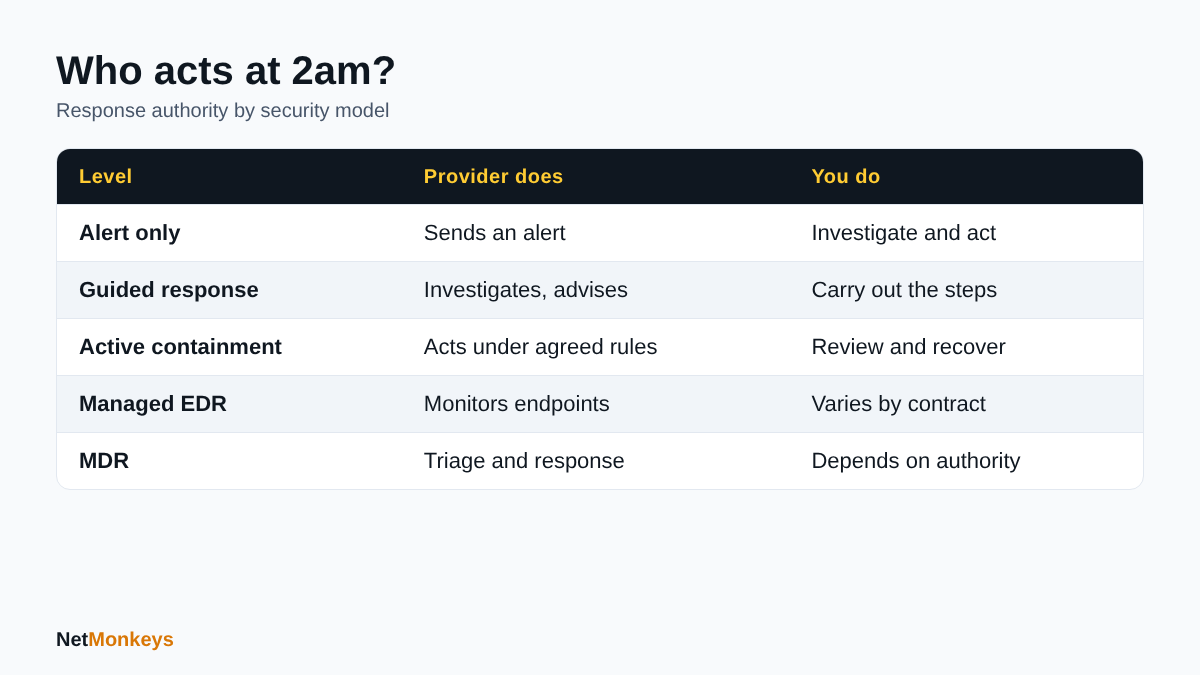 The contract, not the label, decides who acts first.
Who responds to a security alert at 2am? An illustrative timeline
This is an illustrative scenario, not a record of a real incident or a service-level commitment. It assumes a 120-person firm and a suspicious sign-in followed by unusual file activity.
| Time | Alert only | Guided response | Active containment |
|---|---|---|---|
| 02:00 | Alert emailed to a shared inbox | Analyst opens the alert and begins investigating | Analyst opens the alert and begins investigating |
| 02:15 | No one reads it | Analyst confirms a compromised account | Analyst confirms a compromised account |
| 02:20 | Attacker continues | Provider phones your on-call contact with instructions | Provider disables the account and isolates the device under pre-agreed rules |
| 02:40 | Attacker continues | Contact answers, or does not, and containment waits | Provider notifies your contact and records the actions |
| 08:30 | Your IT team reads the alert | Handover and review | Handover, evidence pack and review |
The difference is not the speed of detection; it is the gap between knowing and acting. In the alert-only column the attacker has hours. In the guided column the gap depends on whether someone answers the phone. In the containment column the provider closes it, which is why the contract wording about who is allowed to act, and whether that includes disabling accounts, matters so much.
If you rely on a service desk for out-of-hours cover, check whether it includes security triage or only fault logging. Our 24/7 IT support helpdesk page explains the difference between round-the-clock IT support and round-the-clock security monitoring.
↑ Back to ContentsWhich model suits a business of 20 to 250 staff?
Match the model to your in-house capability, not your headcount alone.
| Situation | Usually fits | Why |
|---|---|---|
| 20 to 50 staff, no security specialist | Managed EDR or MDR with containment rights | No one to act at night, so the provider must |
| 50 to 150 staff, IT generalists in-house or outsourced | MDR across endpoint, identity and email | Broader visibility, response not dependent on staff availability |
| 150 to 250 staff, small IT team | MDR, or SOC-as-a-service plus an internal responder | Internal team can own decisions; provider supplies 24/7 coverage |
| Strong internal security team | SOC-as-a-service or an MSSP for out-of-hours cover | Augments existing skills |
| Regulated sector with audit demands | MSSP or SOC-as-a-service with reporting, plus MDR | Evidence and log retention requirements |
Do I need MDR, an MSSP or SOC-as-a-service for a 100-person business?
Worked example, with stated assumptions: a 100-person professional services firm, Microsoft 365, no dedicated security staff, an outsourced IT provider covering office hours. Nobody is on call at night, so an alert-only service would leave alerts waiting until morning. The sensible choice is MDR, or managed EDR with documented isolation rights, covering endpoints and Microsoft 365 identity. The provider acts out of hours; your IT provider handles recovery during the day. An MSSP or SOC-as-a-service becomes relevant if a client contract or regulator requires log retention and reporting.
Who actually contains a breach in an MDR contract?
Whoever the contract says. Under active containment it is the provider, within an agreed list of actions. Under guided response it is your team or IT provider, following the provider's instructions. Under alert only it is you. Also confirm who owns eradication and recovery, because most MDR contracts exclude full incident response, as Microsoft's own documentation does for active-compromise work.
Before choosing, a cyber security audit shows which controls and visibility you already have. Smaller organisations can start with our guidance on cybersecurity for small business.
↑ Back to ContentsHow is each model priced, and which do cyber insurers prefer?
Pricing
Published prices vary widely and change often, so I will not quote figures. The common structures are:
- MDR and managed EDR: usually per user or per device, per month, with the endpoint licence either included or bought separately.
- SOC-as-a-service: often priced by log volume, number of sources or users, which can rise as you connect more systems.
- MSSP: usually a per-service or per-device fee for each managed tool, plus reporting.
Compare proposals on what is included: licences, onboarding, log storage, out-of-hours calls, containment actions and incident response hours. NetMonkeys quotes against your user, device and security needs, and you can request a scoped quotation.
Which security model do cyber insurers prefer?
I have not verified any insurer publishing a preference between MDR, MSSP and SOC-as-a-service, so I will not claim one. Insurers commonly ask about 24/7 monitoring and endpoint detection on proposal forms, and the wording differs between them. Read your own proposal form and ask your broker which answers it accepts. The NCSC cyber insurance guidance suggests asking what response services your insurer provides and whether Cyber Essentials or Cyber Essentials Plus can lower premiums. See our notes on cyber insurance and the Cyber Essentials certification service.
↑ Back to ContentsQuestions to ask a provider: a buyer checklist
Use these in every tender, whichever label appears on the proposal.
| Area | Ask | Look for |
|---|---|---|
| Response authority | What may you do without my approval? | A written list, not “as appropriate” |
| Containment actions | Can you isolate devices and disable accounts? | Named actions and pre-approved conditions |
| Mean-time targets | What are your detection, triage and containment targets? | Defined measures in the contract, with remedies |
| After-hours | Who is awake at 2am, and who do you phone? | Named escalation path and tested contact details |
| Evidence | What records do I receive after an incident? | Timeline, actions taken, logs retained |
| Escalation | When does an incident become full incident response? | Clear trigger and who pays |
| Tooling ownership | Who owns the licences, tenant and data? | Your tenant, your data, admin access retained |
| Exit | What happens if I leave? | Data return, no lock-in to proprietary agents |
Tooling ownership and exit deserve extra attention. Our guides on what to do when a provider withholds admin access and how to choose an IT support company cover the same principles for general IT. If you are weighing an internal hire against external cover, see outsourced IT support vs in-house IT.
↑ Back to ContentsConclusion: choosing between MDR vs MSSP vs SOC-as-a-service
On MDR vs MSSP, the practical answer for most 20 to 250 person organisations is to buy response, not just visibility. MDR, or managed EDR with explicit containment rights, closes the gap between detection and action. An MSSP or SOC-as-a-service earns its place where logging, reporting or an existing security team drives the need. Whichever you choose, judge the contract by its response authority, its out-of-hours arrangements and who owns the tooling.
If you want a second opinion on a proposal, or help scoping cover alongside outsourced IT support, contact NetMonkeys and we will review it with you.
↑ Back to ContentsFrequently Asked Questions (FAQs)
What's the difference between MDR and an MSSP?
MDR is built around investigating threats and responding to them, either by acting directly or by guiding your team. An MSSP traditionally monitors and manages security tools and passes alerts to you. The terms overlap, so compare the contract: what the provider may do without your approval matters more than the label on the proposal.
Is MDR the same as managed EDR?
Not always. Managed EDR usually means a provider deploys and monitors endpoint detection software. MDR typically adds wider telemetry such as identity, email and cloud, and places more emphasis on investigation and response. Providers use the names loosely, so compare the written scope, hours of cover and containment rights rather than the product name.
What is SOC-as-a-service?
SOC-as-a-service is a security operations centre delivered on subscription. Shared analysts and tooling monitor your logs and alerts, triage them and investigate. It describes how monitoring is delivered, not what happens next. Some contracts include containment, others stop at notification, so check the response terms before you sign.
Do I need MDR, an MSSP or SOC-as-a-service for a 100-person business?
For a 100-person firm with no dedicated security staff, MDR or managed EDR with documented containment rights usually fits best, because nobody is available to act at night. An MSSP or SOC-as-a-service becomes relevant if you need log retention, reporting or an audit trail for clients or regulators.
Who actually contains a breach in an MDR contract?
The contract decides. Under active containment the provider acts within an agreed list of actions, such as isolating a device. Under guided response your team follows the provider's instructions. Under alert only it is entirely you. Also confirm who handles eradication and recovery, as many MDR contracts exclude full incident response.
Which security model do cyber insurers prefer?
I have not seen a verified insurer preference for MDR, MSSP or SOC-as-a-service. Insurers commonly ask about 24/7 monitoring and endpoint detection, with wording that differs between them. Check your proposal form and ask your broker which answers are accepted. The NCSC also suggests asking whether Cyber Essentials can lower premiums.
Which model actually stops an attack?
None does on its own. Prevention depends on patching, multi-factor authentication, configuration and user awareness. These models reduce how long an intruder stays active after prevention fails. Active containment with fast response narrows that window most, which is why response authority matters more than the label.
Who responds to a security alert at 2am?
It depends on the contract. With alert only, the alert waits until someone reads it. With guided response, the provider phones your on-call contact. With active containment, the provider acts first under agreed rules, then informs you. Ask for the named escalation path and whether it has been tested.
Speak to a NetMonkeys specialist
Practical, plain-English IT advice for UK businesses, from our Manchester headquarters and our teams in London and Nottingham.
Book a conversation