How Much Does Outsourced IT Support Cost in the UK? 2026
UK managed IT support typically costs about £45 to £95 per user per month. This guide covers pricing models, hidden costs and how to compare proposals.

Key Takeaways
- UK providers publish managed support ranges of about £45 to £95 per user per month (2026 guides).
- Per user is the common model; per device suits shared equipment.
- In an illustrative 25-person example, outsourcing costs about £26,500 in year one against about £70,150 for an in-house IT manager.
- Onboarding, projects, out-of-hours work, licences and exit fees are the usual hidden costs.
- Compare proposals on total annual cost and written scope, not the headline fee.
Outsourced IT support in the UK typically costs between about £45 and £95 per user per month for a small or mid-sized business, with most published guides placing the middle of the market in the £50 to £85 range as at October 2026. For a 25-person company that works out at roughly £13,500 to £28,500 a year before Microsoft 365 licences, hardware and project work.
The headline figure is only part of the answer. What the monthly fee includes, how the provider counts users and devices, and what sits outside the contract decide whether outsourced IT support cost in the UK stays predictable or drifts upwards. This guide sets out the pricing models, the ranges published by UK providers in 2026, a worked 25-person example against an in-house IT manager, the hidden costs to look for, and a checklist for comparing proposals.
All ranges below come from provider guides published in 2026 and are cited with the year. Providers set their own prices, so treat them as benchmarks for testing a quote, not as a rate card. Where a figure is our own arithmetic, it is labelled as an illustrative budgeting example.
How much does outsourced IT support cost in the UK per user?
Per user, per month is the dominant way UK providers price managed support. Three 2026 guides give overlapping but not identical ranges, which is itself useful: it shows how much the market varies by scope.
| Source (year) | Range per user per month | What it describes |
|---|---|---|
| Inology (2026) | £45 to £95 | UK SMEs with 10 to 50 users; licences extra at the lower tiers |
| Cloudswitched (2026) | £30 to £50 basic; £50 to £85 standard; £85 to £150 premium | Tiered bands; headline average £65 to £75 |
| IT Pro Expert (2026) | £30 to £150 overall; £45 to £85 standard band | Ex VAT, excluding Microsoft 365 licences and hardware |
Sources: Inology (May 2026), Cloudswitched (April 2026) and IT Pro Expert (September 2026). These are provider-published figures, not independent surveys, and the IT Pro Expert page itself advises checking them against current quotes.
The pattern is consistent across all three. Basic, mainly reactive cover sits at the bottom. A standard tier with endpoint protection, Microsoft 365 administration and a helpdesk sits in the middle. Round-the-clock cover, managed detection and response and named senior engineers push the price towards the top.
Smaller teams usually pay more per head, because the provider's fixed costs are spread across fewer users. If you are in the small-business bracket, our small business IT support page explains how we scope cover for smaller teams. NetMonkeys quotes against your user, device and security needs, so there is no single rate to quote here.
↑ Back to ContentsIT support pricing models in the UK compared
Outsourced IT support pricing models fall into six groups. Most providers sell a variant of the first three and add the others as options.
| Model | How it is charged | Best suited to | Watch for |
|---|---|---|---|
| Per user | Fixed monthly fee for each named user | Most SMEs with roughly one main device per person | Extra devices and shared accounts may be charged or excluded |
| Per device | Monthly fee per managed device (IT Pro Expert (2026): £15 to £50) | Shared workstations, shop floors, warehouses, kiosks | Cost climbs with every laptop, tablet or phone added |
| Tiered | Bronze, silver, gold style bundles at set per-user rates | Firms that want to start small and add security later | Features you need may only appear in the top tier |
| All-inclusive | One fee covering support, security tooling and often licences | Firms wanting a single predictable line in the budget | Higher monthly price; check what 'all' really covers |
| Break-fix or time and materials | Hourly or daily rate when something goes wrong | Very small teams with simple needs | No budget certainty; no incentive to prevent faults |
| Hybrid | Monthly fee plus block hours or co-managed support alongside an internal IT person | Firms with an internal IT lead who needs backup | Clear division of responsibility is essential |
Hourly rates vary widely. IT Pro Expert (2026) reports remote ad-hoc support at £70 to £150 an hour and project work at £100 to £175 an hour, while Cloudswitched (2026) gives £75 to £150 for ad-hoc support. Break-fix looks cheap until the first serious incident.
For most firms above a handful of staff, a per-user or tiered managed contract is the practical choice. Our managed IT support service follows that structure, and our outsourced IT support page explains how the arrangement works day to day.
↑ Back to ContentsIs IT support priced per user or per device?
Both exist, but per user is more common for office-based firms. Per-device pricing makes sense where devices are shared or where staff and devices do not match one to one.
Which model suits a business with more devices than staff?
If every employee has a laptop, a phone and sometimes a tablet, a per-device model multiplies the bill. If your estate includes shared tablets, kiosks, warehouse scanners or workshop PCs used by many people, a per-user model can leave a lot of equipment unsupported.
Here is an illustrative budgeting example using the published ranges. A 25-person firm has 25 users and 40 managed devices. At the per-user range of £45 to £95, the monthly bill is £1,125 to £2,375 (25 x £45 and 25 x £95). At the per-device range of £15 to £50, it is £600 to £2,000 (40 x £15 and 40 x £50). The ranges overlap, so the answer depends on the exact quote, not the model name.
- Choose per user when staff map neatly to devices and the provider includes a stated number of devices per user.
- Choose per device when many devices are shared or unattended.
- Ask for a hybrid when you have both: a per-user fee for staff and a lower per-device fee for shared equipment.
- Always ask what happens when a new device or starter is added mid-term.
Source for per-device range: IT Pro Expert (September 2026).
↑ Back to ContentsWhat is included in a £50 per user IT support package?
A £50 per user package sits at the lower end of the standard band, so treat it as an example tier. Inology (2026) describes the £45 to £60 band as covering helpdesk, patching, basic endpoint protection, Microsoft 365 administration and monthly reporting, with licences extra. Cloudswitched (2026) places £30 to £50 in its basic tier and £50 to £85 in its standard tier.
| Price level (illustrative) | Typically included | Typically not included |
|---|---|---|
| Around £30 to £50 per user | Business-hours helpdesk, remote support, patching, basic antivirus | Out-of-hours cover, onsite visits, projects, licences, advanced security |
| Around £50 to £60 per user | Adds Microsoft 365 administration, endpoint protection, monthly reporting | 24/7 monitoring, extensive project hours, licences |
| Around £60 to £80 per user | Adds 24/7 cover, endpoint detection and response, MFA enforcement, some project hours, quarterly reviews | Licences, hardware, large migrations |
| Around £80 to £95 plus per user | Adds fuller security stack, strategic IT director time, named engineers, sometimes Microsoft 365 Business Premium | Hardware, major projects |
The bands come from Inology (May 2026), and the grouping is a summary of that guide, not a promise from any one provider. A low price is not a warning on its own, but Inology notes that anything below £45 can signal hidden exclusions, so ask for the scope in writing.
Security is where tiers differ most. If you need managed detection, look for tiers that include managed EDR and ask how alerts are handled out of hours.
↑ Back to ContentsWhat should a 25-person company pay for managed IT support?
This is an illustrative budgeting example, not a NetMonkeys quote. It uses published 2026 ranges and stated assumptions so you can substitute your own figures.
Assumptions
- 25 users, one managed device each, a single office.
- A mid-range managed tier at £70 per user per month, inside the £45 to £95 range from Inology (May 2026).
- One-off onboarding of £3,000, inside the £1,500 to £5,000 range reported by Cloudswitched (April 2026).
- 20 hours of project work a year at £125 an hour, inside the £100 to £150 range from the same source.
- Microsoft 365 licences and hardware excluded from both columns.
Outsourced cost
- Monthly fee: 25 x £70 = £1,750; annual fee: £1,750 x 12 = £21,000.
- Projects: 20 x £125 = £2,500.
- First year: £21,000 + £3,000 + £2,500 = £26,500. Later years: £23,500.
The full published range gives £13,500 (25 x £45 x 12) to £28,500 (25 x £95 x 12) a year before onboarding and projects.
Is outsourced IT support cheaper than hiring an IT manager?
At 25 users, usually yes on cost, and the comparison is not like for like. The median UK IT manager salary was £55,000 in the six months to 22 October 2026, according to IT Jobs Watch. Here are the employer costs on top, using GOV.UK employer rates and thresholds for 2026 to 2027 (employer National Insurance at 15% above a £5,000 threshold; statutory sick pay at £123.25 a week).
| In-house item (illustrative) | Arithmetic | Annual cost |
|---|---|---|
| Salary (median, IT Jobs Watch 2026) | As published | £55,000 |
| Employer National Insurance | (£55,000 - £5,000) x 15% | £7,500 |
| Employer pension, minimum 3% | 3% x £55,000 (upper estimate; the qualifying earnings band is narrower) | £1,650 |
| Monitoring and security tooling | 25 users x £20 x 12 (IT Pro Expert (2026) quotes £20 to £25 per person per month) | £6,000 |
| Total before recruitment, training and cover | £70,150 |
Against the £26,500 first-year outsourced figure, the gap is £43,650. The in-house figure still excludes recruitment fees, training, and the cost of cover during holiday (5.6 weeks of statutory leave) and sickness, when one person is your whole IT department.
Some firms keep an internal lead and add outside support, particularly beyond roughly 50 users. Our comparison of outsourced IT support vs in-house IT covers when each model fits.
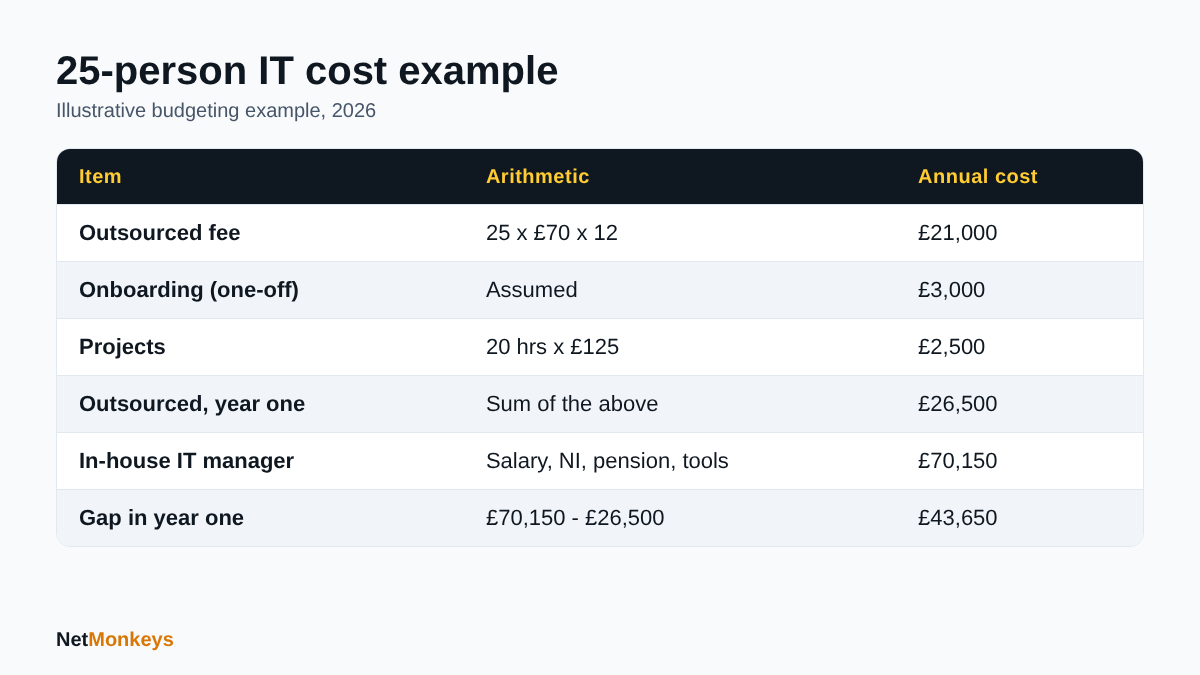 Illustrative budgeting example for 25 users, excluding Microsoft 365 licences and hardware.
What affects the price of IT support?
Two firms with 25 users can receive very different quotes. These are the factors that move the number most.
- User count. Smaller teams tend to pay more per head.
- Device count and type. Servers, shared devices, mobiles and tablets may be priced separately.
- Security requirements. Endpoint detection, MFA enforcement, tested backups and compliance support add cost. Cloudswitched (2026) reports a regulated-sector premium of £15 to £30 per user.
- Response times and hours. 24/7 cover costs more. IT Pro Expert (2026) puts the uplift at £10 to £30 per user per month.
- Environment condition. Inheriting an unmanaged estate means heavier first months.
- Contract length. Cloudswitched (2026) reports 24 to 36-month terms discounted by 8 to 15%, and rolling monthly terms priced 15 to 25% above fixed-term rates.
- Number of sites and onsite needs. Visits and travel are often charged separately.
- Microsoft 365 and licences. Whether they are bundled or passed through at cost. See our Microsoft 365 support service for how we handle this.
Does IT support cost more in London?
Published guides say yes, though the size of the premium varies. Cloudswitched (2026) reports London at 15% to 25% above the national average, with standard-tier prices of £65 to £100 per user per month, against £45 to £75 in the North West and £48 to £78 in the Midlands. IT Pro Expert (2026) reports London providers charging roughly 10% to more than 25% more than elsewhere, citing higher salaries and onsite costs such as the Congestion Charge, ULEZ and parking.
| Region | Standard tier per user per month (Cloudswitched 2026) |
|---|---|
| London | £65 to £100 |
| Midlands | £48 to £78 |
| North West | £45 to £75 |
| Scotland | £44 to £75 |
Both are provider-published figures and local quotes vary, so treat regional differences as a pricing driver, not a rule. The main drivers are staff salaries, office and travel costs, and local competition for engineers.
If you are comparing local providers, look at the regional pages for IT support in London, IT support in Manchester, IT support in Birmingham and IT support in Leeds. NetMonkeys is headquartered in Manchester with offices in Nottingham and London, and field engineers across around 12 UK cities, so location rarely limits who can support you on site.
↑ Back to ContentsWhat are the hidden costs in an IT support contract?
Most disputes about price come from items that were never in the monthly fee. Ask for each of the following in writing before you sign.
| Cost | Typical published range | What to ask |
|---|---|---|
| Onboarding and setup | £1,500 to £5,000 (Cloudswitched 2026); £500 to £5,000 (IT Pro Expert 2026) | Is it fixed, and what does it cover? |
| Projects excluded from the fee | £100 to £175 an hour (IT Pro Expert 2026) | What counts as a project, and how many hours are included? |
| Out-of-hours work | £100 to £200 an hour (IT Pro Expert 2026); £10 to £25 per user per month surcharge (Cloudswitched 2026) | Who answers, and what is the bank holiday rate? |
| Hardware | Mark-ups of 10% to 25% (IT Pro Expert 2026) | Is procurement a margin or a fee? |
| Licences | Microsoft 365 around £18.10 per user per month retail for Business Premium (Inology 2026) | Passed through at cost or marked up? |
| Contract exit | £1,000 to £3,000 transition fees (Cloudswitched 2026) | What are the notice period, handover duties and data return terms? |
| New starters and extras | £50 to £150 per new user (IT Pro Expert 2026) | Is joiner and leaver admin included? |
Sources: Inology (May 2026), Cloudswitched (April 2026) and IT Pro Expert (September 2026). The last row matters because exit terms decide how easily you can change provider. Make sure you hold your own admin credentials and documentation, as covered in our guides on what to do when a provider won't give admin access and switching IT support providers without downtime.
↑ Back to ContentsHow to compare two IT support proposals
Compare proposals on the same footing. A cheaper monthly fee can cost more once exclusions are added. Use this checklist.
| Question | Proposal A | Proposal B |
|---|---|---|
| Price per user per month, and what counts as a user? | ||
| Devices covered per user, and charge for extras? | ||
| Hours of helpdesk cover and out-of-hours rate? | ||
| Response and resolution targets in the contract? | ||
| Security tooling included (endpoint detection, MFA, backup testing)? | ||
| Microsoft 365 licences included or passed through? | ||
| Onboarding fee and project hours included? | ||
| Contract length, break clause and exit fees? | ||
| Admin access, documentation and handover terms? |
- Fill in both columns from the written proposals, not the sales call.
- Convert every price to a total annual figure including onboarding, licences and expected projects.
- Check security scope against your needs. Our Cyber Essentials service shows what a certified baseline involves.
- Ask for the handover process at exit, including documentation and credentials.
For wider selection criteria, see our practical guide on how to choose an IT support company.
↑ Back to ContentsConclusion: budgeting for outsourced IT support cost in the UK
Outsourced IT support cost in the UK is best judged as a total annual figure, not a headline per-user price. The published 2026 range of roughly £45 to £95 per user per month is a useful benchmark, but scope, security, licences, projects and exit terms decide what you actually pay.
For a 25-person firm, our illustrative example puts outsourced support well below the cost of an in-house IT manager, while the in-house route brings single-person risk. Whichever model you choose, ask for exclusions in writing and compare proposals line by line.
If you would like a quote built around your users, devices and security needs, contact NetMonkeys and we will scope it with you.
↑ Back to ContentsFrequently Asked Questions (FAQs)
How much does outsourced IT support cost in the UK per user?
Published UK guides in 2026 put managed IT support at roughly £45 to £95 per user per month for small and mid-sized businesses, with broader ranges of £30 to £150 across all tiers. Basic reactive cover sits at the bottom, while 24/7 cover and security-led services sit at the top. Licences, hardware and projects are usually extra.
What should a 25-person company pay for managed IT support in the UK?
Using the published range of £45 to £95 per user per month, a 25-person firm would expect about £13,500 to £28,500 a year. In our illustrative example at £70 per user, the annual fee is £21,000, plus onboarding and project work. Microsoft 365 licences and hardware are normally separate.
Is outsourced IT support cheaper than hiring an IT manager?
At 25 users it usually is. Our illustrative example gives about £26,500 in the first year for outsourced support, against about £70,150 for an in-house IT manager at the 2026 median salary once employer National Insurance, pension and tooling are added. The in-house figure still excludes recruitment, training and absence cover.
What's included in a £50 per user IT support package?
As an example tier, a package around £50 per user typically covers a business-hours helpdesk, patching, basic endpoint protection, Microsoft 365 administration and monthly reporting. It usually excludes licences, out-of-hours cover, onsite visits, large projects and advanced security. Ask for the scope in writing before comparing it with other quotes.
What are the hidden costs in an IT support contract?
Common extras include onboarding fees, project work outside the monthly fee, out-of-hours rates, hardware mark-ups, Microsoft 365 licences, charges for new starters and contract exit or transition fees. Published 2026 guides give ranges for each. Ask which items are included, which are charged, and at what rate, before signing.
Which IT support pricing model is best for a business with more devices than staff?
A per-device or hybrid model often suits this situation, because a per-user fee may not cover shared tablets, kiosks or workshop PCs. Compare the total for both models using your real device count. Published per-device ranges of £15 to £50 overlap with per-user ranges, so the quote matters more than the label.
Is IT support priced per user or per device?
Both are used. Per user is the most common model for office-based firms where each person has one main device. Per device suits shared or unattended equipment. Some providers offer a hybrid, charging per user for staff and a lower fee per device for shared hardware. Ask how extra devices and new starters are charged.
Does IT support cost more in London?
Published 2026 provider guides report a London premium of roughly 10% to 25% or more, driven by salaries, office costs and travel charges. These figures are provider-published, not independent, so quotes vary. Regional differences exist across the UK, so compare local quotes for London, Manchester, Birmingham and Leeds against the same scope.
Speak to a NetMonkeys specialist
Practical, plain-English IT advice for UK businesses, from our Manchester headquarters and our teams in London and Nottingham.
Book a conversation