Outsourced IT Support Vs In-House IT: The Real Cost


Key Takeaways
- You pay a fixed amount for monthly MSP plans, while internal hiring costs significantly more than the basic salary.
- Relying on one internal worker creates severe risks during sudden illnesses or unexpected resignations.
- External providers offer teams of cybersecurity specialists, whereas one internal staffer is limited to a few technical skills.
- Combining a single internal manager with an outside agency delivers fast office help alongside 24/7 network protection.
Did you know you could be paying significantly less when you outsource IT support?
Many business owners don’t realise the major difference between hiring internal and external IT support until they factor in the extra mandatory costs on each permanent hire. Per the United Kingdom labour code, employees are entitled to pension contributions and paid annual leave covered by the employer. Whereas you only pay a lower fixed monthly sum when you hire an elite IT team.
How much will you save with outsourced IT support? Can you hire an outside team without letting go of your in-house staff?
Evaluating these expenses helps you select the right support structure for your budget before server crashes stall daily operations.
Direct Salary vs Monthly Retainer Costs
 Unsplash
Hiring full-time technicians comes with many financial responsibilities for the company. In addition to forcing the business to pay a fixed yearly salary even during slow or quiet sales months, employers must also contribute other incentives such as bonuses and paid leave. Covering these fixed payroll costs is the way to avoid heavy fines and expensive lawsuits that threaten business growth.
Many organisations are beginning to hire experts for these roles at flexible rates through managed IT support services, you have the option of paying per project completed or per registered user. Outsourcing your IT support to modern IT experts at NetMonkeys keeps monthly tech expenses predictable whether your team grows or shrinks.
| Expense Category | Full-Time Internal IT | Outsourced IT Support |
|---|---|---|
| Base Fee Structure | Fixed annual salary | Flexible per-user monthly rate |
| Taxes & Benefits | Paid directly by employer | Included inside the monthly fee |
| Skill Upgrades | Paid by your company | Covered by service provider |
| Management Software | Purchased separately | Bundled into a monthly contract |
Comparing in-house vs. outsourced IT support shows how much a company can save on flat service contracts instead of unexpected payroll spikes. Small firms are perhaps the major beneficiaries of outsourced IT support. Despite limited funds, they can cut costs by avoiding paying high year-round wages for minor glitches or setting up new email accounts.
↑ Back to ContentsHidden Expenses of Internal IT Staff
The base salary numbers don’t tell the full story of the true cost of hiring a full-time technician. Focusing only on that figure conceals a high percentage of extra staff expenses companies pay out of pocket that most employees don’t realise.
You would have to add National Insurance tax, pension matches, and hardware setups to the true cost of hiring an IT manager UK.
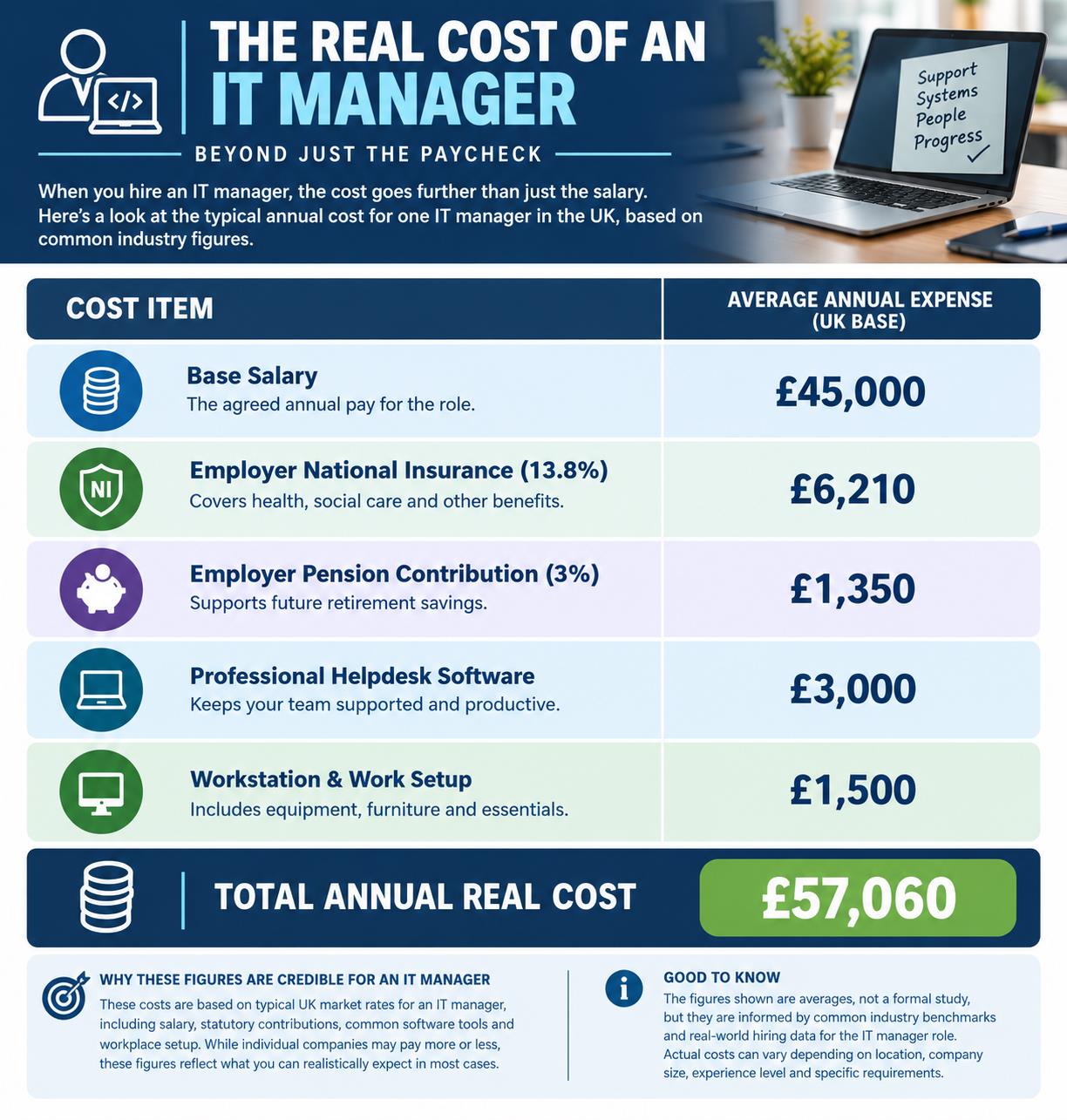
There’s more. Companies in the UK will typically pay recruiting agencies for the onboarding process while sponsoring ongoing technical certifications for staff. When you add pre-agreed bonuses and paid sick leave as regulated by the UK employment code, the total cost of hiring one IT person adds thousands more to the annual operating budget.
With these extra mandatory costs, a single full-time technician becomes far more expensive than basic salary listings indicate.
↑ Back to ContentsHeadcount Milestones: When to Shift Strategies
Many employers make the mistake of hiring full-time tech support too quickly. With too few paying customers, many employees automatically risk becoming surplus to requirements. To avoid paying technicians for doing nearly nothing, the total number of consistent users requiring daily assistance should determine when to hire an in-house IT person.
For instance, a 50-person company considering whether to hire an IT manager or outsource IT support must look at the ticket volume and budget limits. A small firm with low ticket volume may require a Managed Service Provider (MSP) on a monthly retainer or fully outsourced IT support to lower annual cost while offering high-value services.
Small and medium-sized businesses with under 50 employees may find small business IT support more cost-effective than funding a full-time internal team.
↑ Back to ContentsOperational Risks and Single-Point Failure
In-house hiring has its merits, such as providing immediate, physical desk visits and internal office familiarity. However, there’s only so much an internal IT person can do within official business hours. This leaves the organisational IT infrastructure vulnerable during overnight hacker attacks or server crashes.
Relying on a few internal professionals can leave massive coverage gaps during sudden illnesses or annual leave. In contrast, external agencies like NetMonkeys excel at managing multiple clients simultaneously, resolving issues through online ticketing systems rather than walking down the hallway.
Both day and night, an outsourced IT department handles major server crashes reliably, offering more than just addressing simple office complaints faster.
 Unsplash
Cybersecurity and Compliance Costs
Companies are responsible for protecting the confidential data of staff and customers on their systems to prevent facing serious charges. Yet, they need expensive monitoring systems and certified security analysts on call to make this happen.
A single internal IT manager likely wears many hats, applying a generalist approach to stopping modern ransomware threats. With outsourced IT support, you get a team of trained specialists in various areas, especially in detecting and thwarting complex data breaches. These dedicated security teams monitor network traffic and update firewalls around the clock.
Even the most skilled in-house IT personnel require sophisticated security tools such as managed EDR services to spot danger before it reaches the internal system. However, buying enterprise security software for one internal staff member costs far more per user than the industry-standard tools outside vendors provide.
Partnering with an external team ensures compliance with industry data regulations without having to purchase separate software suites.
↑ Back to ContentsAfter-Hours and Emergency Support Realities
You can close the previous day with no issues only to resume work the following day due to computer crashes, power outages, and cyber threats. Many unexpected events happen after hours with no one present to address them.
Expecting a full-time employee to monitor servers overnight is a tall order and a possible violation of employment law. These working conditions make many employees quit while others suffer from burnout.
Respected UK-based agencies like NetMonkeys employ over 60 dedicated experts strictly on day or night shifts, and others for weekend support. That way, there is always someone available to catch and troubleshoot server failures before your in-house staff arrives the next morning.
These rapid emergency responses keep businesses online 24/7, minimising costly downtime that halts operations and loses client trust.
↑ Back to ContentsHybrid IT Support Strategy
 Unsplash
Outsourcing IT support doesn’t have to replace your internal workforce. Implementing a hybrid IT support model combines the strength of an onsite staff member with an external agency for total coverage.
Evaluating a potential hybrid setup reveals the ideal setup for expanding your mid-sized business.
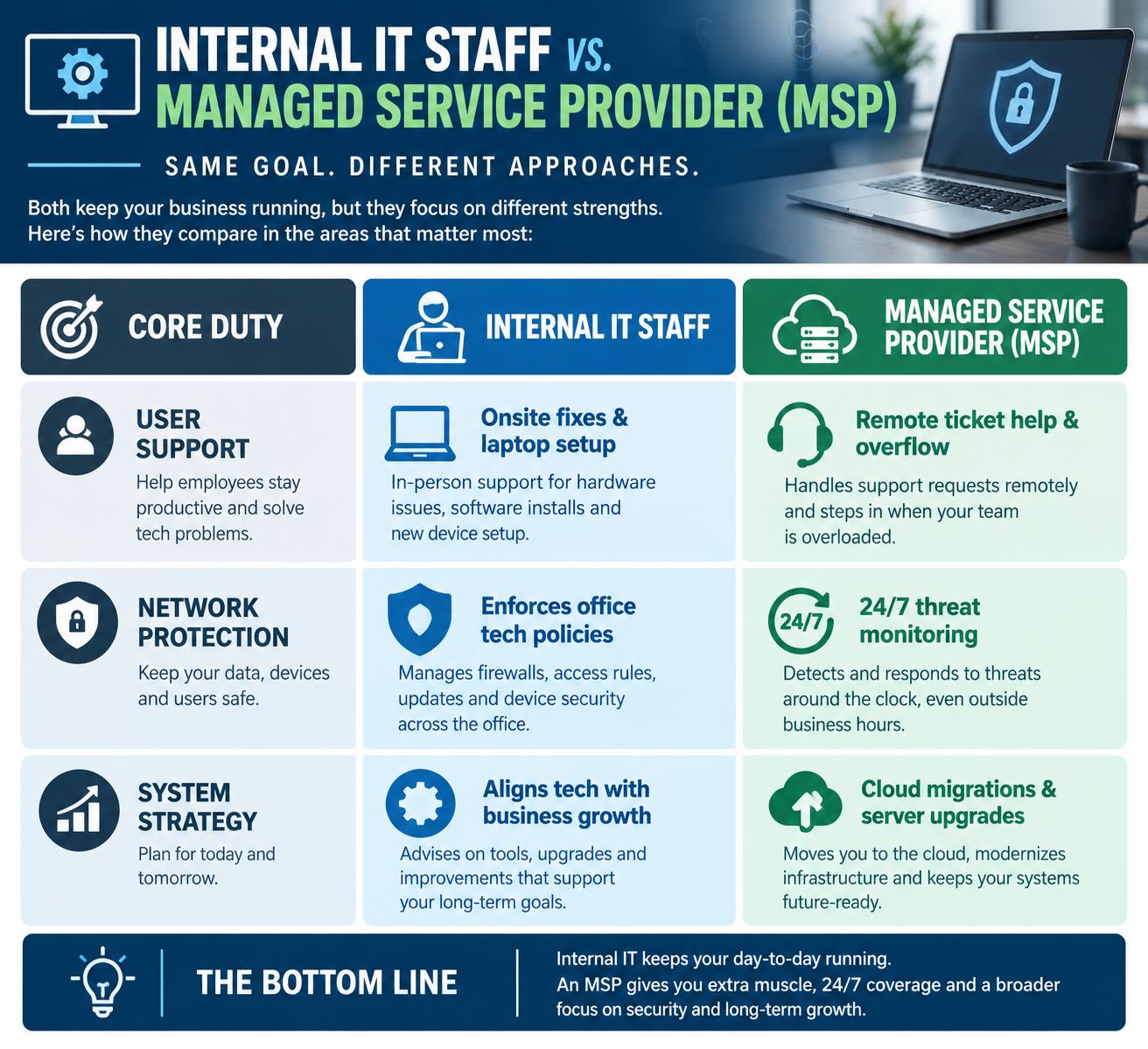
Comparing MSP vs internal IT team approaches proves growing companies can benefit from having both options. While your internal worker handles daily requests, the outside provider manages complex security and network projects.
↑ Back to ContentsExtensive Expertise for Less
Considering the wages, taxes, software tools, and paid holiday costs to cover, outside support objectively saves small businesses substantial money. With a reliable outside team, you stop overpaying for technical help before your headcount requires dedicated staff and ease the burden on your internal staff.
If you run a startup, you can reinvest money saved in your current infrastructure while complying with the labour code. Keeping employees productive and maintaining manageable operational expenses can be that simple: you only need to select the right support model.
Wouldn’t you like to cut tech expenses and secure your business network for less than the average recruiting cost?
Contact NetMonkey’s expert IT support team today for a free cost audit and custom quote!
↑ Back to ContentsFrequently Asked Questions
Is outsourced IT support cheaper than in-house IT?
Yes. You can save significant money meant for hiring internal IT personnel by outsourcing IT support. Paying outside teams a fixed per-user monthly fee saves small businesses money compared to funding full salaries that also include tax remittance and software tool purchases.
At what size should we hire in-house IT?
Most businesses hire their first internal tech employee after reaching 70 to 100 active computer users. You may hire internal IT once you cross the 50-user mark.
What does an in-house IT hire actually cost?
In the UK, an IT worker with a £45,000 base salary costs an employer over £57,000 after adding National Insurance, pensions, and equipment fees.
What do you lose by outsourcing IT?
You lose immediate desk visits and having a technician who focuses exclusively on your office all day. To maintain the physical presence of technicians in your organisation while you enjoy 24/7 IT framework monitoring, consider hiring both sets of IT experts in your office.
Can we keep our IT person and use a provider?
Yes. Combining internal and outside expertise brings the benefits of both sides to your doorstep. While your internal staff member handles daily office tickets, an outside firm manages overnight security and large projects.
Which is better for cybersecurity?
Skilled internal IT managers can help solve cybersecurity issues but mainly during official hours. Meanwhile, outsourced providers are better because they employ specialised security teams from various time zones and use 24/7 monitoring software that single workers cannot match.
Related IT Support Services
IT Support Company in London
Managed IT support for businesses across London.
View Service → ManchesterIT Support Company in Manchester
Managed IT support from our Manchester headquarters.
View Service → BirminghamIT Support Company in Birmingham
Managed IT support for businesses across the West Midlands.
View Service → NottinghamIT Support Company in Nottingham
Managed IT support for businesses across the East Midlands.
View Service →